(Updated at 6:45 p.m. to reflect clarifications from Chief of Staff Jerry Hendrix)
It’s part and parcel of every cable franchise agreement. The franchisee, in this case Time Warner Cable, agrees to pay an annual franchise fee to the municipality that grants the franchise. Back in the day, when each municipality worked out its own cable television franchise agreement, that fee was based on penetration rates; i.e., the franchisee paid between 10 and 25 cents/month for everyone cable television subscriber within the boundaries covered by the franchise agreement. The city was then supposed to use those funds to operate a public-access cable channel.
It’s a little bit different today.
"The State of Texas issues and regulates the franchise agreements for cable franchises in municipalities," Kyle Chief of Staff Jerry Hendrix told me today. "All the terms are dictated by the state-issued agreement and cities have to work within the terms of that agreement. In terms of the franchise fee, the city gets 5 percent of the gross revenues and a portion of that is committed for the PEG channel. These dedicated funds must be used toward the capital investment for the channel and not permitted to be allocated for other uses."
Be that as it may, there’s an item on Tuesday’s City Council agenda to spend $120,000 of those franchise fees "for the design and installation of a cable TV channel for the City of Kyle." That means sometime soon, perhaps before the end of the summer, Kyle residents who subscribe to Time Warner Cable can sit back in the comfort of their own homes and watch City Council and perhaps even Planning & Zoning and other commission meetings on their wide-screen televisions. I know that sends your hearts all a-twitter.
The presentation to the council notes it will be possible with this system "to deliver an Adobe Flash stream of the channel output to the City IT department for use on the City website."
The $120,000 will also cover the costs of training for the people at the city who will have to learn how to run a TV station, most importantly what to do to fill in the dead time during the Council’s one-to-two hour executive sessions that are a bi-weekly ritual.
The money is going to be used to add technical upgrades. Unfortunately, the microphones on the dais will not be upgraded, but perhaps the staff training will include instructing council members how to speak into their microphones, an ability that seems beyond too many of our current council members. However, the presentation does say "The chamber audio system will be upgraded with a new DSP (digital signal processor, which converts digital signals to analog and vice-versa) system to improve council audio and reduce feedback." Additional technical upgrades will include "four HD Pan-Tilt-Zoom cameras" that will be installed in council chambers, presumably one of which can be trained to capture the front of the person speaking to the council from the chamber podium.
"We haven’t finalized the camera positions, but are planning on one for the speakers," Hendrix said today.
"A six-button control panel will be installed at the dais to allow easy management of the presentation system," according to the materials provided to the Council. "New 19-inch wide-screen HDMI displays will be installed on the dais to replace the existing VGA displays. The existing projector will be replaced with a 65-inch LCD screen in a similar location. Two 65-inch displays will be added to make it possible for viewers in the Falcon room to see presentation materials. Volume controls will be installed in the break room and Falcon room to allow use of those rooms independently of the main chamber. Four new wireless microphones will be added to the system to complement the existing microphones."
I don’t know yet when the city’s channel will go on the air, although the presentation claims "The Installation of this system is estimated to take approximately one and a half weeks, with training to be done concurrently as systems are completed."
"We do not have a target date for the launch of the channel, but we would like to make that happen as soon as we can complete the installation of the equipment and coordinate with Time Warner," Hendrix said. "The trick will be finding the programming necessary to keep the station on the air when meetings are not scheduled.
"A requirement of having a channel is broadcasting a minimum amount of original content and meeting that requirement will include the city producing or acquiring programming," Hendrix added. "We are already working toward the development of videos about water conservation, waste reduction, composting, and other city services. We are using existing staff and university interns to develop this content."
I was also wondering what recording and playback capabilities are included in this deal. In other words, will the council meetings be recorded for playback at other times? Will it be possible to videotape at remote locations for eventual playback on the channel? Hendrix also addressed that issue for me.
"We are also planning on recording events and activities from areas other than city hall, but they will not be "live" with this package," he said, which means the city will be able to videotape events such as Chamber of Commerce addresses by city officials for later playback.
The Kyle Report

Saturday, April 30, 2016

Friday, April 29, 2016
Hervol raises, spends seven times more than Mitchell
District 1 City Council incumbent Diane Hervol raised and spent just about seven times more than her election challenger, local business owner Travis Mitchell, during the last three weeks, according to the final campaign reports to be filed before the May 7 election.
Hervol took in $325 in contributions of $50 or less (which do not have to be itemized on the reports) and $1,100 in other monetary contributions — $1,000 from William T. Johnson, a trustee of the Burdine Johnson Foundation, and $100 from Hays County Justice of the Peace Beth Smith and her husband, Everett. She recorded $1,418.81 in expenditures, $400 of which was a charitable donation to Hope & Love 4 Kids. She also spent $470 on postage, $293.36 for postcards, $227.33 to make copies of flyers and $28.12 for labels.
Mitchell, by contrast, reported only $220 in contributions and $205 in expenditures, all of which went to what he listed as "advertising expense." At the same time, although he reported having $1,115 remaining in his campaign war chest, he filed a "Designation of Final Report," which means he will not be spending any more funds during the last week of the campaign. His contributions were $100 from Hays County Commissioner Bill Conley of Wimberly and $120 from a Canyon Lake area-based towing company, Comal Towing LLC of Spring Branch. The second reading of an ordinance amending how the city regulates wrecker services is on Tuesday’s City Council agenda, but, if it passes, it should not be an election issue, unless Mitchell makes Hervol’s vote on the proposed ordinance into one during the final week of campaigning.
The other race — the District 3 contest pitting incumbent Shane Arabie against challenger Randall Lloyd — was notable for the fact that neither candidate reported raising or spending a dime.
Hervol took in $325 in contributions of $50 or less (which do not have to be itemized on the reports) and $1,100 in other monetary contributions — $1,000 from William T. Johnson, a trustee of the Burdine Johnson Foundation, and $100 from Hays County Justice of the Peace Beth Smith and her husband, Everett. She recorded $1,418.81 in expenditures, $400 of which was a charitable donation to Hope & Love 4 Kids. She also spent $470 on postage, $293.36 for postcards, $227.33 to make copies of flyers and $28.12 for labels.
Mitchell, by contrast, reported only $220 in contributions and $205 in expenditures, all of which went to what he listed as "advertising expense." At the same time, although he reported having $1,115 remaining in his campaign war chest, he filed a "Designation of Final Report," which means he will not be spending any more funds during the last week of the campaign. His contributions were $100 from Hays County Commissioner Bill Conley of Wimberly and $120 from a Canyon Lake area-based towing company, Comal Towing LLC of Spring Branch. The second reading of an ordinance amending how the city regulates wrecker services is on Tuesday’s City Council agenda, but, if it passes, it should not be an election issue, unless Mitchell makes Hervol’s vote on the proposed ordinance into one during the final week of campaigning.
The other race — the District 3 contest pitting incumbent Shane Arabie against challenger Randall Lloyd — was notable for the fact that neither candidate reported raising or spending a dime.
Wednesday, April 27, 2016
P&Z commissioners ponder complete streets, design guidelines, sidewalk banks, other topics
City Planning Director Howard Koontz has apparently spent a significant amount of time pouring over the city’s ordinances, many of which he said were drafted quickly out of necessity, and discovered a host of changes he thinks should be made "to update them, to modernize them." He shared a number of those ideas, plans, concepts, proposals — whatever you would like to label them — to four of the seven members of the Planning & Zoning Commission during a workshop last night.
Chairman Mike Rubsam and fellow commissioners Dex Ellison, Allison Wilson and newly appointed Bradley Growt attended. Lori Huey, Timothy Kay and Irene Melendez were absent.
Among the subjects discussed were complete streets (a concept I was somewhat shocked to realize was a completely new one for the commissioners), design guidelines to compensate for the inability to use conditional zoning, a sidewalk study and a companion sideway bank, new guidelines for commercial parking lots to make them more pedestrian friendly, impervious surface ratios and a dark skies ordinance (something I would love to see if it meant that finally it would force the school district to turn off the lights at the football stadium that are left on every single night of the year, regardless of whether anything is happening at the stadium – talk about light pollution!!!).
"Tonight’s meeting is about you educating me," Koontz told the commissioners to open the workshop. "I’ve been here about a year and in the past year I have looked at our codes, policies, procedures and am looking to update them, modernize them, look at strengths, weaknesses. One of the things I keep going back to is when Dan Ryan was on the (P&Z) Commission, he told me the genesis of our zoning codes which was when Kyle went from being general rule to home rule they needed to put a code together ASAP. They put that code together very quickly. They said they started basically with the City of Austin’s code and made some minor tweaks and amendments to make it fit Kyle with the expectation that they would throw that code in under the door and get it in place knowing full well that it was a workable document that needed to be upgraded later to respect the fact that Kyle is not Austin. That was, to the best of my math, 11 years ago.
"So 11 years now we’ve been working with a document that was known to be in need of upgrading, updating and modernization. So I’ve gone through the code and I’ve looked at some things that I’ve wanted to change or at least wanted to discuss. I’m hopeful that you all drive around the city and see things you think could change in the build environment that we could do from a regulatory standpoint. Not just what we do regulate, but maybe things that we over-regulate and maybe would want to release a little bit.
"To that end, I wanted to find out first of all if you had any of these thoughts yourselves and wanted to let me know about them. But otherwise I have made a list and I could start going through the list."
Which he did, because none of the commissioners present really came with any ideas for possible changes they wanted to discuss.
It was not the first item on his list, but the one I found most intriguing and in need of immediate discussion not only at P&Z but even at the City Council level was the concept of a Sidewalk Bank. The first step would be the creation of a "sidewalk map" that not only inventoried where all the sidewalks were in Kyle but, more importantly, those areas in the city where sidewalks are desperately needed. Rebel Road was cited last night as just one location that is in obvious need of sidewalks. Under current ordinances, a new development is required to provide sidewalks for that development even if those sidewalks prove to be superfluous. One example cited last night was the Polo Tropical and Taco Cabana developments currently under construction on the northeast corner of I-35 and Kyle Parkway. Sidewalks are not needed at that development, but the ordinance requires one so apparently there will be some sort of loopy unneeded sidewalk winding around the back of both establishments that no one will ever use. In fact, Koontz argued, sidewalks are not needed for any development along the I-35 access roads. Under provisions of Koontz’s "Sidewalk Bank," instead of constructing unnecessary sidewalks, developers would be required to deposit money equal to the cost of constructing that unnecessary sidewalk into the bank and those funds would be used for the construction of sidewalks in established neighborhoods where those walkways are necessary, such as along Rebel Road.
Although I found the idea of the Sidewalk Bank one that is not only necessary but one that could be implemented comparatively rapidly (in fact, the sooner the better), it was not the first item on Koontz’s list. That was a Complete Streets resolution.
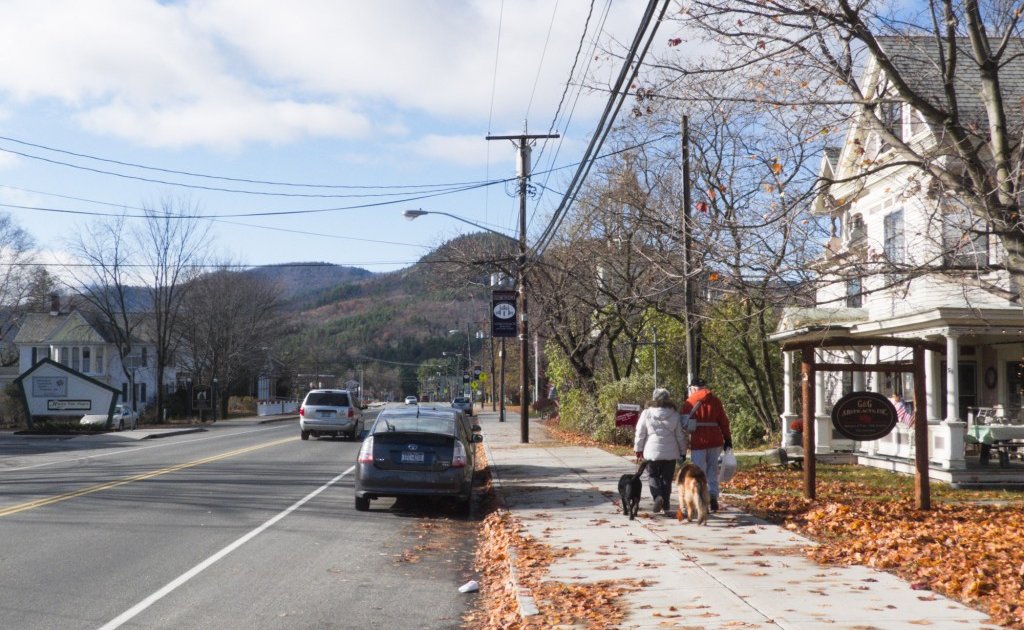
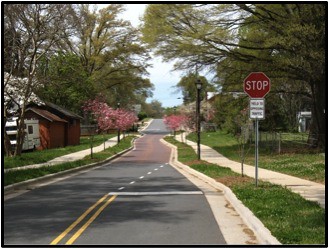
"I’m not sure you’re familiar with what Complete Streets is," Koontz told the four commissioners, "but it’s a national initiatives to make our rights-of-way not solely for the benefit of automobiles. Complete Streets makes assurances for pedestrian connectivity, making sure you have sidewalks, making sure the sidewalks are detached from the traffic rights-of-way so that there’s some form of intermediate buffer be it on-street parking, a landscape buffer or it can be a multi-role path that is completely removed from traffic."
The commissioners seemed receptive to the idea, while admitting that today Kyle is far from being a walkable community. But Rubsam wanted to know if Koontz was also talking about "redesigning the existing street or just adding sidewalks to them?"
"Typically, there would be two expectations," Koontz replied. "By and large, infrastructure like streets is not constructed by the City. They’re built by whomever it is that is developing. So one category would be anytime a new street is constructed it would be built to a standard such that there would be additional width of right-of-way — not necessarily of pavement — that would make an allowance of minimum for automobiles, bike lanes and then acceptable sidewalk widths. On the other hand, there would be a line item in the Capital Improvement Plan that reads anytime the City does a renovation project to a corridor that you don’t simply go in there and refresh and revitalize the existing, but build it to the current design standards. So we would retrofit some roads as appropriate for bike lanes and sidewalks. That means you might consume on-street parking or you substitute bike lanes for on-street parking. It all depends on the street section that you’re working."
The purpose of Complete Streets, Koontz said, "is to link higher-use areas in ways that are not necessarily tied to the automobile."
On another item on his list, Koontz suggest the implementation of design guidelines could be helpful because Texas law prohibits conditional zoning. In other words, zoning decisions can’t be made based on precisely what a developer wants to put on a piece of property. That was the sticking point, for example, in the recent truck stop debate when certain commissioners said they had no problem with rezoning that area for warehouse but we’re going to vote against that zoning request because the developer wanted to put a truck stop there. Texas law prohibits those kinds of zoning decisions; i.e., zoning decisions can not be conditional on what exactly the developer wants to use the land for.
"Here in Kyle, if someone wants to come in and build an office park, the only allowable zoning for that is warehouse," Koontz said. "Well, we all know what’s allowable in warehouse and for those reasons we know why warehouse is considered nefarious. You can go through just about every zoning district and think of a use that’s allowable in that district that would think would be objectionable in any place here. Using that thought process you could find a legitimate reason to deny every request for zoning.
"So my thought was, what if it wasn’t necessarily what was going on there that was so objectionable, what if it was what it looks like was so objectionable?"
That led him to the subject of design guidelines; i.e., "should we institute design guidelines that get really specific in architecture standards." The requirement should be specifically not what was located at a specific spot, but the aesthetic of what was being developed. "Is it really such a challenge what’s going on inside that structure as long as you pass it on the road and it doesn’t strike you as being objectionable?"
Rubsam wasn’t buying this at first. "I think people would have objected to that truck stop down there even if it had looked like the Taj Mahal and smelled like an evening in Paris," he said.
Allison, however, said she favored such an idea for all zoning.
Koontz warned the commissioners that establishing these design guidelines "takes a lot of work." But, he added, "Fortunately there are a lot of design guidelines nationally" that commissioners could adapt to fit Kyle, Rubsam asked if there were any locally, and Koontz said he hadn’t examined that.
"I don’t want to turn anyone away" because of strict design guidelines, Koontz said. "But, at the same time, I don’t want to just allow anybody to be here. I’m not necessarily crazy about letting somebody build a 4-side steel or panel building because it’s the cheapest way for them to build their business. There’s plenty of places for that in the county. I think we just change the nature of what people build here, just prescribe what it should look like. It might be more expensive but there are plenty of suppliers and architects out there that make their business on creating a means for these businesses to build in communities that have a higher standard. There’s a reason why businesses want to locate there because people want to live there. You want to live a nicer place. And if enough people want to live in that nicer place then the businesses will want to follow them because they need patrons.
"I’m not a huge proponent of letting the business community tale wag the city dog," Koontz said. "I’ve always decided that make the best city you can and then let people come to you rather than having to go out and chase something that might not ever show up.
"I don’t think we’re being obstinate" by instituting design guidelines, he continued. "I don’t think we’re saying ‘No, we don’t want that.’ We’re still receptive to anybody that wants to locate here. But, at the same time, we’re not going to abandon any standard we have for quality by just letting anybody show up and do whatever they want in whatever manner they want."
Rubsam said he would like to see a Texas-based workable model where such design guidelines have been employed "and custom tailor that model to fit Kyle’s requirements rather than just start writing from the ground up. If we could come up with somebody that is doing this, take a look at that model and see how we might modify it, that might work better than anything else."
"If we elevate Kyle to a place where we don’t have to have fights with Economic Development about lowering our standards low enough to let people come here," Koontz said, "someday we’ll be a place where it doesn’t matter what we make them do they will want to be here so badly they gonna build whatever it is they’re required to build. I have worked in places where the developers come in and say what they are going to do for the municipality and not asking what kind of tax breaks are you going to give me. If you’re not trying to make the community better, why are you coming here? I’m not looking for the people who want to build the lowest common denominator projects. There are a lot of people who have invested in Kyle and our responsibility is to make that investment worth it by increasing that quality of life however we can. I think design guidelines are a good way to do that."
Chairman Mike Rubsam and fellow commissioners Dex Ellison, Allison Wilson and newly appointed Bradley Growt attended. Lori Huey, Timothy Kay and Irene Melendez were absent.
Among the subjects discussed were complete streets (a concept I was somewhat shocked to realize was a completely new one for the commissioners), design guidelines to compensate for the inability to use conditional zoning, a sidewalk study and a companion sideway bank, new guidelines for commercial parking lots to make them more pedestrian friendly, impervious surface ratios and a dark skies ordinance (something I would love to see if it meant that finally it would force the school district to turn off the lights at the football stadium that are left on every single night of the year, regardless of whether anything is happening at the stadium – talk about light pollution!!!).
"Tonight’s meeting is about you educating me," Koontz told the commissioners to open the workshop. "I’ve been here about a year and in the past year I have looked at our codes, policies, procedures and am looking to update them, modernize them, look at strengths, weaknesses. One of the things I keep going back to is when Dan Ryan was on the (P&Z) Commission, he told me the genesis of our zoning codes which was when Kyle went from being general rule to home rule they needed to put a code together ASAP. They put that code together very quickly. They said they started basically with the City of Austin’s code and made some minor tweaks and amendments to make it fit Kyle with the expectation that they would throw that code in under the door and get it in place knowing full well that it was a workable document that needed to be upgraded later to respect the fact that Kyle is not Austin. That was, to the best of my math, 11 years ago.
"So 11 years now we’ve been working with a document that was known to be in need of upgrading, updating and modernization. So I’ve gone through the code and I’ve looked at some things that I’ve wanted to change or at least wanted to discuss. I’m hopeful that you all drive around the city and see things you think could change in the build environment that we could do from a regulatory standpoint. Not just what we do regulate, but maybe things that we over-regulate and maybe would want to release a little bit.
"To that end, I wanted to find out first of all if you had any of these thoughts yourselves and wanted to let me know about them. But otherwise I have made a list and I could start going through the list."
Which he did, because none of the commissioners present really came with any ideas for possible changes they wanted to discuss.
It was not the first item on his list, but the one I found most intriguing and in need of immediate discussion not only at P&Z but even at the City Council level was the concept of a Sidewalk Bank. The first step would be the creation of a "sidewalk map" that not only inventoried where all the sidewalks were in Kyle but, more importantly, those areas in the city where sidewalks are desperately needed. Rebel Road was cited last night as just one location that is in obvious need of sidewalks. Under current ordinances, a new development is required to provide sidewalks for that development even if those sidewalks prove to be superfluous. One example cited last night was the Polo Tropical and Taco Cabana developments currently under construction on the northeast corner of I-35 and Kyle Parkway. Sidewalks are not needed at that development, but the ordinance requires one so apparently there will be some sort of loopy unneeded sidewalk winding around the back of both establishments that no one will ever use. In fact, Koontz argued, sidewalks are not needed for any development along the I-35 access roads. Under provisions of Koontz’s "Sidewalk Bank," instead of constructing unnecessary sidewalks, developers would be required to deposit money equal to the cost of constructing that unnecessary sidewalk into the bank and those funds would be used for the construction of sidewalks in established neighborhoods where those walkways are necessary, such as along Rebel Road.
Although I found the idea of the Sidewalk Bank one that is not only necessary but one that could be implemented comparatively rapidly (in fact, the sooner the better), it was not the first item on Koontz’s list. That was a Complete Streets resolution.
"I’m not sure you’re familiar with what Complete Streets is," Koontz told the four commissioners, "but it’s a national initiatives to make our rights-of-way not solely for the benefit of automobiles. Complete Streets makes assurances for pedestrian connectivity, making sure you have sidewalks, making sure the sidewalks are detached from the traffic rights-of-way so that there’s some form of intermediate buffer be it on-street parking, a landscape buffer or it can be a multi-role path that is completely removed from traffic."



The commissioners seemed receptive to the idea, while admitting that today Kyle is far from being a walkable community. But Rubsam wanted to know if Koontz was also talking about "redesigning the existing street or just adding sidewalks to them?"
"Typically, there would be two expectations," Koontz replied. "By and large, infrastructure like streets is not constructed by the City. They’re built by whomever it is that is developing. So one category would be anytime a new street is constructed it would be built to a standard such that there would be additional width of right-of-way — not necessarily of pavement — that would make an allowance of minimum for automobiles, bike lanes and then acceptable sidewalk widths. On the other hand, there would be a line item in the Capital Improvement Plan that reads anytime the City does a renovation project to a corridor that you don’t simply go in there and refresh and revitalize the existing, but build it to the current design standards. So we would retrofit some roads as appropriate for bike lanes and sidewalks. That means you might consume on-street parking or you substitute bike lanes for on-street parking. It all depends on the street section that you’re working."
The purpose of Complete Streets, Koontz said, "is to link higher-use areas in ways that are not necessarily tied to the automobile."
On another item on his list, Koontz suggest the implementation of design guidelines could be helpful because Texas law prohibits conditional zoning. In other words, zoning decisions can’t be made based on precisely what a developer wants to put on a piece of property. That was the sticking point, for example, in the recent truck stop debate when certain commissioners said they had no problem with rezoning that area for warehouse but we’re going to vote against that zoning request because the developer wanted to put a truck stop there. Texas law prohibits those kinds of zoning decisions; i.e., zoning decisions can not be conditional on what exactly the developer wants to use the land for.
"Here in Kyle, if someone wants to come in and build an office park, the only allowable zoning for that is warehouse," Koontz said. "Well, we all know what’s allowable in warehouse and for those reasons we know why warehouse is considered nefarious. You can go through just about every zoning district and think of a use that’s allowable in that district that would think would be objectionable in any place here. Using that thought process you could find a legitimate reason to deny every request for zoning.
"So my thought was, what if it wasn’t necessarily what was going on there that was so objectionable, what if it was what it looks like was so objectionable?"
That led him to the subject of design guidelines; i.e., "should we institute design guidelines that get really specific in architecture standards." The requirement should be specifically not what was located at a specific spot, but the aesthetic of what was being developed. "Is it really such a challenge what’s going on inside that structure as long as you pass it on the road and it doesn’t strike you as being objectionable?"
Rubsam wasn’t buying this at first. "I think people would have objected to that truck stop down there even if it had looked like the Taj Mahal and smelled like an evening in Paris," he said.
Allison, however, said she favored such an idea for all zoning.
Koontz warned the commissioners that establishing these design guidelines "takes a lot of work." But, he added, "Fortunately there are a lot of design guidelines nationally" that commissioners could adapt to fit Kyle, Rubsam asked if there were any locally, and Koontz said he hadn’t examined that.
"I don’t want to turn anyone away" because of strict design guidelines, Koontz said. "But, at the same time, I don’t want to just allow anybody to be here. I’m not necessarily crazy about letting somebody build a 4-side steel or panel building because it’s the cheapest way for them to build their business. There’s plenty of places for that in the county. I think we just change the nature of what people build here, just prescribe what it should look like. It might be more expensive but there are plenty of suppliers and architects out there that make their business on creating a means for these businesses to build in communities that have a higher standard. There’s a reason why businesses want to locate there because people want to live there. You want to live a nicer place. And if enough people want to live in that nicer place then the businesses will want to follow them because they need patrons.
"I’m not a huge proponent of letting the business community tale wag the city dog," Koontz said. "I’ve always decided that make the best city you can and then let people come to you rather than having to go out and chase something that might not ever show up.
"I don’t think we’re being obstinate" by instituting design guidelines, he continued. "I don’t think we’re saying ‘No, we don’t want that.’ We’re still receptive to anybody that wants to locate here. But, at the same time, we’re not going to abandon any standard we have for quality by just letting anybody show up and do whatever they want in whatever manner they want."
Rubsam said he would like to see a Texas-based workable model where such design guidelines have been employed "and custom tailor that model to fit Kyle’s requirements rather than just start writing from the ground up. If we could come up with somebody that is doing this, take a look at that model and see how we might modify it, that might work better than anything else."
"If we elevate Kyle to a place where we don’t have to have fights with Economic Development about lowering our standards low enough to let people come here," Koontz said, "someday we’ll be a place where it doesn’t matter what we make them do they will want to be here so badly they gonna build whatever it is they’re required to build. I have worked in places where the developers come in and say what they are going to do for the municipality and not asking what kind of tax breaks are you going to give me. If you’re not trying to make the community better, why are you coming here? I’m not looking for the people who want to build the lowest common denominator projects. There are a lot of people who have invested in Kyle and our responsibility is to make that investment worth it by increasing that quality of life however we can. I think design guidelines are a good way to do that."
Friday, April 22, 2016
The little engine that shouldn’t
In an op-ed piece that appeared in yesterday’s Austin American-Statesman, Dr. Victor Frankenstein … er, Sid Covington, chairman of the board of the Lone Star Rail District, tried to resuscitate some life in that dying monster by pronouncing to the world that his board endorsed the completion of an environmental impact study for a possible rail line connecting San Antonio to Georgetown.
You don’t need to get out your maps to realize the fastest route between these two destinations is right smack dab through our fair city.
Granted, I’m seeing this vote by the board not as a statement that they actually plan on creating this dang thing. I think it’s nothing more than a desperate grab for some much needed moolah. Recently, Hays County opted out of the district and with it took its hefty annual dues that, as I recall, amounted to almost a half million smackeroos. That had to hurt. Now, the only way the district can qualify for federal transportation funds is to complete the environmental impact study and I think that’s the only reason the board voted for this charade. What they plan to do with these federal funds, if indeed they ever receive them, remains a mystery. But then it would take Sherlock Holmes teaming up with Harry Bosch to find out what happened to all the dough this outfit has already extorted.
For those who have been following this debacle, the original plan was to run this commuter line on the Union Pacific tracks which currently cuts through the eastern edge of downtown Kyle just west of I-35. But, lo and behold, UP finally came to its senses, decided it wanted nothing more to do with these masters of the transportation shell game and took its offer to use those tracks off the table.
Those living on the planet who still maintain their sanity thought, surely, this act by UP killed the beast, But just like director James Whale and Universal Studios resurrected Mary Wollstonecraft Shelley’s beast in the early 1930s with Bride of Frankenstein, Covington claims Lone Star Rail "is alive! It’s alive!" and actually has five other alternatives on the back burner to replace using the UP tracks.
The first of these alternatives listed by Covington is "an alignment adjacent to the railroad’s current freight line." Reading that made me want to grab my torches and pitchforks and put a stop to this madness immediately, if not sooner. In my opinion, one rail line running through the heart of downtown Kyle is one too many, but I doubt if there’s anything anyone can do about that. It was here first. But a second one? Hell, no!!!
Look, I’m as big a fan of mass transportation as anyone. When I lived in Dallas I used the DART light rail network just about every day. I grew up in New York City and, contrary to popular belief, the NYC subway system actually predates me. If you ever go to Paris, don’t bother renting a car. The superb Metro system will take you anywhere in the city you want to go quickly and easily.
But the key word in the above paragraph is "network" and one north-south rail line does not a mass transportation "network" make. You know what else? We already have that north-south passenger rail service. It’s called Amtrak. I see that passenger train whizzing along outside my window just about every evening. Of course, you may argue, Amtrak doesn’t serve Kyle. And that’s true. But the reason it doesn’t serve Kyle is that there is no demand for the service here. Mineola, east of Dallas, has a population of 4,500, give or take, and the Amtrak train stops there on daily basis. Amtrak has scheduled service to both Austin and San Marcos. If there was a demand for Amtrak service here, I guarantee you Amtrak would stop here just like it does in much tinier Mineola. But there isn’t that demand and although I hear a few local residents wax wistfully about the possibility of north-south transportation services, I don’t see a sufficient number of people out their pushing it enough to make such a service viable. Besides, when push comes to shove, and we’re told how much the property tax would have to be raised to pay for Lone Star Rail or any similar rail alternative, I’m convinced even those few local residents will quickly clean the wax out of their ears.
Anyway, I voiced my concerns about all this to Mayor Todd Webster, posing about a half-dozen questions about the possibility of another rail line through Kyle. What follows is a transcript of that interchange:
Is there sufficient land through downtown Kyle for another line adjacent to the current UP line?
Mayor Webster: Attempting to run an additional line outside of existing UP right-of-way would be problematic and would necessarily require the exercise of eminent domain powers to accomplish. While much of that property may go through green field areas within the city, I think there would be homeowners and some businesses that may be negatively impacted by such an approach. So, the land is there but the financial and political cost would very high. Again, this assumes that they aren't talking about an adjacent line with existing right of way. If the latter is the case, it would certainly be easier but unlikely given what has been published regarding UP's recent stance on Lone Star Rail.
What role would the Kyle City Council play in approving such an alignment through downtown Kyle?
Mayor Webster: Lone Star's approach has been to entice municipal/taxpayer investment into the project by offering the opportunity to influence the planning of the line and the location of stops on the route. Unless the city agreed to their terms, I do not believe that we would have the ability to participate in those alignment discussions with Lone Star Rail in an impactful manner. Outside of participating, we would need to engage the legislature and other entities that may have oversight, similar to what we would do with a state highway project, to address any issues that would arise from the creation of the line.
If it did have a role, what do you think are the chances the city council would approve such a line (which, granted, is a tough one because no one knows what the makeup of the council will be if and when this ever comes up for a vote, but I'm wondering given the current mood of this council)?
Mayor Webster: I can only really speak for myself. I don't think that the financial arrangement that was original proposed by Lone Star Rail was feasible for Kyle. They were asking for too much and too far in advance of any concrete proposal. Their approach was inconsistent from community to community and generated a lot of ill-will toward commuter rail within our community. I think future city councils will have a tough time approving such a long-term and costly financial commitment if Lone Star Rail continues with the same approach and sales pitch. Long-term, rail transportation could be viable in central Texas but I am not convinced this group is the one that can pull it off.
Could the city insist on the district constructing an elevated track system through the downtown area and do you think that would be a viable alternative?
Mayor Webster: Anything is possible. The benefit of an elevated track system would be the opportunity to use existing right of way. I personally believe that an elevated track system should be considered, particularly if it is possible to utilize existing right of way. For example, if it was possible to run an elevated system above and in the center of IH-35, it could be more cost-effective and less time-consuming to accomplish because the state already owns most of the property that would be necessary to construct. With this type of project, eminent domain should be used as sparingly as possible and I think elevated track may help, regardless of where it is located.
Is Kyle a member of the Lone Star Rail District and, if so, how much does the city pay the district per year? If it is not. do you see any desire to become a member? If it isn't a member and doesn't wish to become one, doesn't that preclude the city from having a Lone Star Rail station in Kyle?
Mayor Webster: Before I was elected, the city council voted to keep talking to Lone Star Rail but chose not to commit resources. Lone Star expected an annual fee to be part of the organization, which they attempted to collect early on in my term. We do not pay that fee ($60,000 per year or about a ½ cent of our ad valorem tax rate) and therefore, I do not consider us to be a member. I have not participated in any discussions with them since I have been elected, though I have often spoken with those who are involved as members about my lack of confidence in their overall approach while clearly expressing my views generally supporting the long-term need for a rail transportation system within the IH-35 corridor. I do not plan to advocate that the city join Lone Star Rail and there simply isn't anything close to enough community support to commit the annual resources and to the very substantial redirection of future tax revenue that this organization was demanding of the city. As for a future station, market-based economics and functionality of the rail line are what should drive the location of stations. Stations should go where the most people will be able to access and easily use the line. In a properly conceived system, up front political maneuvering and "buy in early to get a station" tactics should not be the approach. Maybe that sentiment is naïve on my part but this type of behavior is what initially led to my skepticism regarding this project.
If such a rail system is ever realized and Kyle is a stop on that route, where do you think the station should be located? I've heard arguments for a depot near the 1626 overpass and, if that is the location, should Lone Star rail be required to pay for and install the necessary infrastructure necessary to access and park at that depot? What do you think of the argument that a depot at that location would only serve commuters, but a depot downtown could possibly bring out of town visitors to Kyle?
Mayor Webster: The location of stops is a difficult question. I do believe that wherever a stop may be located would see some level of economic benefit. The city had previously identified an area near FM 1626 and Kohler's Crossing as a suitable location and made plans for it to be there. I do think that a stop in Old Town would boost the economic outlook for that area of town. The problem is that there cannot be too many stops on the line. Otherwise, the train would take too long to be an effective option for commuters. Another consideration is the need for parking and what it would take in a particular area to provide for adequate parking. In Old Town, I think we would need to consider a parking garage. Other areas of town may not require having to build a vertical structure to accommodate parking.
You don’t need to get out your maps to realize the fastest route between these two destinations is right smack dab through our fair city.
Granted, I’m seeing this vote by the board not as a statement that they actually plan on creating this dang thing. I think it’s nothing more than a desperate grab for some much needed moolah. Recently, Hays County opted out of the district and with it took its hefty annual dues that, as I recall, amounted to almost a half million smackeroos. That had to hurt. Now, the only way the district can qualify for federal transportation funds is to complete the environmental impact study and I think that’s the only reason the board voted for this charade. What they plan to do with these federal funds, if indeed they ever receive them, remains a mystery. But then it would take Sherlock Holmes teaming up with Harry Bosch to find out what happened to all the dough this outfit has already extorted.
For those who have been following this debacle, the original plan was to run this commuter line on the Union Pacific tracks which currently cuts through the eastern edge of downtown Kyle just west of I-35. But, lo and behold, UP finally came to its senses, decided it wanted nothing more to do with these masters of the transportation shell game and took its offer to use those tracks off the table.
Those living on the planet who still maintain their sanity thought, surely, this act by UP killed the beast, But just like director James Whale and Universal Studios resurrected Mary Wollstonecraft Shelley’s beast in the early 1930s with Bride of Frankenstein, Covington claims Lone Star Rail "is alive! It’s alive!" and actually has five other alternatives on the back burner to replace using the UP tracks.
The first of these alternatives listed by Covington is "an alignment adjacent to the railroad’s current freight line." Reading that made me want to grab my torches and pitchforks and put a stop to this madness immediately, if not sooner. In my opinion, one rail line running through the heart of downtown Kyle is one too many, but I doubt if there’s anything anyone can do about that. It was here first. But a second one? Hell, no!!!
Look, I’m as big a fan of mass transportation as anyone. When I lived in Dallas I used the DART light rail network just about every day. I grew up in New York City and, contrary to popular belief, the NYC subway system actually predates me. If you ever go to Paris, don’t bother renting a car. The superb Metro system will take you anywhere in the city you want to go quickly and easily.
But the key word in the above paragraph is "network" and one north-south rail line does not a mass transportation "network" make. You know what else? We already have that north-south passenger rail service. It’s called Amtrak. I see that passenger train whizzing along outside my window just about every evening. Of course, you may argue, Amtrak doesn’t serve Kyle. And that’s true. But the reason it doesn’t serve Kyle is that there is no demand for the service here. Mineola, east of Dallas, has a population of 4,500, give or take, and the Amtrak train stops there on daily basis. Amtrak has scheduled service to both Austin and San Marcos. If there was a demand for Amtrak service here, I guarantee you Amtrak would stop here just like it does in much tinier Mineola. But there isn’t that demand and although I hear a few local residents wax wistfully about the possibility of north-south transportation services, I don’t see a sufficient number of people out their pushing it enough to make such a service viable. Besides, when push comes to shove, and we’re told how much the property tax would have to be raised to pay for Lone Star Rail or any similar rail alternative, I’m convinced even those few local residents will quickly clean the wax out of their ears.
Anyway, I voiced my concerns about all this to Mayor Todd Webster, posing about a half-dozen questions about the possibility of another rail line through Kyle. What follows is a transcript of that interchange:
Is there sufficient land through downtown Kyle for another line adjacent to the current UP line?
Mayor Webster: Attempting to run an additional line outside of existing UP right-of-way would be problematic and would necessarily require the exercise of eminent domain powers to accomplish. While much of that property may go through green field areas within the city, I think there would be homeowners and some businesses that may be negatively impacted by such an approach. So, the land is there but the financial and political cost would very high. Again, this assumes that they aren't talking about an adjacent line with existing right of way. If the latter is the case, it would certainly be easier but unlikely given what has been published regarding UP's recent stance on Lone Star Rail.
What role would the Kyle City Council play in approving such an alignment through downtown Kyle?
Mayor Webster: Lone Star's approach has been to entice municipal/taxpayer investment into the project by offering the opportunity to influence the planning of the line and the location of stops on the route. Unless the city agreed to their terms, I do not believe that we would have the ability to participate in those alignment discussions with Lone Star Rail in an impactful manner. Outside of participating, we would need to engage the legislature and other entities that may have oversight, similar to what we would do with a state highway project, to address any issues that would arise from the creation of the line.
If it did have a role, what do you think are the chances the city council would approve such a line (which, granted, is a tough one because no one knows what the makeup of the council will be if and when this ever comes up for a vote, but I'm wondering given the current mood of this council)?
Mayor Webster: I can only really speak for myself. I don't think that the financial arrangement that was original proposed by Lone Star Rail was feasible for Kyle. They were asking for too much and too far in advance of any concrete proposal. Their approach was inconsistent from community to community and generated a lot of ill-will toward commuter rail within our community. I think future city councils will have a tough time approving such a long-term and costly financial commitment if Lone Star Rail continues with the same approach and sales pitch. Long-term, rail transportation could be viable in central Texas but I am not convinced this group is the one that can pull it off.
Could the city insist on the district constructing an elevated track system through the downtown area and do you think that would be a viable alternative?
Mayor Webster: Anything is possible. The benefit of an elevated track system would be the opportunity to use existing right of way. I personally believe that an elevated track system should be considered, particularly if it is possible to utilize existing right of way. For example, if it was possible to run an elevated system above and in the center of IH-35, it could be more cost-effective and less time-consuming to accomplish because the state already owns most of the property that would be necessary to construct. With this type of project, eminent domain should be used as sparingly as possible and I think elevated track may help, regardless of where it is located.
Is Kyle a member of the Lone Star Rail District and, if so, how much does the city pay the district per year? If it is not. do you see any desire to become a member? If it isn't a member and doesn't wish to become one, doesn't that preclude the city from having a Lone Star Rail station in Kyle?
Mayor Webster: Before I was elected, the city council voted to keep talking to Lone Star Rail but chose not to commit resources. Lone Star expected an annual fee to be part of the organization, which they attempted to collect early on in my term. We do not pay that fee ($60,000 per year or about a ½ cent of our ad valorem tax rate) and therefore, I do not consider us to be a member. I have not participated in any discussions with them since I have been elected, though I have often spoken with those who are involved as members about my lack of confidence in their overall approach while clearly expressing my views generally supporting the long-term need for a rail transportation system within the IH-35 corridor. I do not plan to advocate that the city join Lone Star Rail and there simply isn't anything close to enough community support to commit the annual resources and to the very substantial redirection of future tax revenue that this organization was demanding of the city. As for a future station, market-based economics and functionality of the rail line are what should drive the location of stations. Stations should go where the most people will be able to access and easily use the line. In a properly conceived system, up front political maneuvering and "buy in early to get a station" tactics should not be the approach. Maybe that sentiment is naïve on my part but this type of behavior is what initially led to my skepticism regarding this project.
If such a rail system is ever realized and Kyle is a stop on that route, where do you think the station should be located? I've heard arguments for a depot near the 1626 overpass and, if that is the location, should Lone Star rail be required to pay for and install the necessary infrastructure necessary to access and park at that depot? What do you think of the argument that a depot at that location would only serve commuters, but a depot downtown could possibly bring out of town visitors to Kyle?
Mayor Webster: The location of stops is a difficult question. I do believe that wherever a stop may be located would see some level of economic benefit. The city had previously identified an area near FM 1626 and Kohler's Crossing as a suitable location and made plans for it to be there. I do think that a stop in Old Town would boost the economic outlook for that area of town. The problem is that there cannot be too many stops on the line. Otherwise, the train would take too long to be an effective option for commuters. Another consideration is the need for parking and what it would take in a particular area to provide for adequate parking. In Old Town, I think we would need to consider a parking garage. Other areas of town may not require having to build a vertical structure to accommodate parking.
I guess that clears that up
The Planning and Zoning Commission is conducting a workshop Tuesday in lieu of a regularly scheduled action meeting. And I found the one actual item on the agenda for this workshop to be, shall we say, somewhat nebulous. That agenda item was "Discussion regarding text revisions and amendments to the Code of Ordinance." But, instead of heading directly to the liquor cabinet I decided a better first course of action would be to ask city spokesperson Kim Hilsenbeck to translate that for me.
And she did.
"The agenda item is a workshop meant to generate discussion on several items," Hilsenbeck replied. "It's a way to take the pulse of the commission to see if they want Planning Director Howard Koontz to pursue changes to the city code.
"Over the past year or so of Mr. Koontz's employment, he found several items in the code that he wants to get feedback about, such as a dark sky lighting ordinance," she continued. "Other examples include complete streets, stream buffers, parking circulation and impervious surface ratios. This will be a workshop only; no action will be taken."
Then she added "This discussion during the workshop will not focus on the landscape ordinance and is not related to annexation."
And, apparently, it will not focus on that other past due Planning & Zoning Commission responsibility besides revisions to the landscape ordinance: its report to the city council on the Comprehensive Plan.
So now I’m heading to the liquor cabinet.
And she did.
"The agenda item is a workshop meant to generate discussion on several items," Hilsenbeck replied. "It's a way to take the pulse of the commission to see if they want Planning Director Howard Koontz to pursue changes to the city code.
"Over the past year or so of Mr. Koontz's employment, he found several items in the code that he wants to get feedback about, such as a dark sky lighting ordinance," she continued. "Other examples include complete streets, stream buffers, parking circulation and impervious surface ratios. This will be a workshop only; no action will be taken."
Then she added "This discussion during the workshop will not focus on the landscape ordinance and is not related to annexation."
And, apparently, it will not focus on that other past due Planning & Zoning Commission responsibility besides revisions to the landscape ordinance: its report to the city council on the Comprehensive Plan.
So now I’m heading to the liquor cabinet.
Wednesday, April 20, 2016
1 wrecked car = 1 wrecking company, 2=2, and so on and so on
Updated at 12:15 a.m. Thursday to include additional statements from council member Damon Fogley
The city council passed by a 5-2 vote last night proposed amendments to the city’s Commercial Towing and Wrecker Services ordinance, proposed and shepherded by council member Damon Fogley that Police Chief Jeff Barnett said "will help improve our partnerships with our wrecker companies and improve our service to our citizens."
Some last-minute additional changes were made to the proposed amendments. One, suggested by Mayor Todd Webster, clarifies that individuals employed by the wrecker company could be held accountable for criminal activity. Additional minor changes are expected when the proposal comes up for its second reading on May 3.
Fogley said his actions were driven by three major concerns he had with the ordinance. One of those involved the towing of 18-wheelers. He said local wreckers are preferred by the city’s dispatch system when it comes to hauling away pickup trucks and cars, "but we don’t have a local preference for heavy wreckers. So what we have is large vehicles being towed outside the city limits to Austin or to San Marcos and those citizens are incurring increased costs because they are going outside the city limits."
It appears, however, Kyle does not have a lot where 18-wheelers can be towed inside the city limits and Mayor Webster noted that finding such a spot could be problematic because of neighborhood objections.
Fogley’s second concern arose, he said, over the increased number of multi-vehicle accidents in Kyle, especially on I-35. "The way (the ordinance) is written now," he said, "the same wrecker company can tow all three vehicles." That, he said, can cause major delays in clearing accident scenes because the one company summoned doesn’t have enough wreckers at its immediate disposal to haul away that many vehicles. It also keeps police officers at the scene of the accident longer than they need to be there.
"We’re clarifying the rotational pull system," Barnett added. "As council member Fogley mentioned today, if we have a three-car accident, the next-up wrecker on rotation that we maintain at our dispatch center — as long as they are physically able of picking up all three passenger cars with the one wrecker — we’re going to let them pick all three of those vehicles up. They may put one on a flatbed, they may lift one, they may pull one — whatever they can get, they get. When it gets beyond them, we’ll call the next company.
"What we have seen," Barnett said, echoing Fogley’s earlier remarks, "is that this extends the time our officers are on the scene and it extends the amount of time that we are blocking the roadway. And when that’s the interstate, that has an impact on our community. So we’ll just go back to what we used to have — the rotation was that each wrecker company gets one vehicle. So, if it’s a two-car accident, we’re going to call the next rotational wrecker and then the next rotational wrecker. Each of them will be assigned one vehicle. That way the roadways are cleaned up a lot faster."
Fogley’s third change involved the aforementioned criminal background checks. "What I am proposing is that those companies that have employees, managers or owners who have convictions on their record related to their (wrecker) jobs can no longer do business with the city. We should protect our citizens and make sure we have the best qualified towing companies with the city."
The proposed amendments, however, said companies convicted of a crime would be excluded, and Mayor Webster’s accepted change spelled out the ordinance referred to the individuals working for those companies with wrecker-related criminal convictions.
"Section H (of the ordinance) just refers to a conviction of the wrecker company," Mayor Webster said to Fogley. "I think your intention was any convictions of the workers at the company. My thought is that section needs to be changed so that it reads something like this: ‘the owner or a current employee of the wrecker company.’"
The mayor said the term "current employee" was necessary to give the wrecker company the opportunity to dismiss any employee found to have such a conviction before punitive action is taken against the company.
Council members Diane Hervol and Daphne Tenorio voted against the proposed amendments,
"I would like to see more feedback and input from the actual towing companies," Tenorio said, which is strange because that’s sort of like asking the NRA to draft gun control legislation. But it is not unprecedented: Developers were largely responsible for writing Kyle’s horrendous PID ordinance and I still maintain the day will come, sooner I expect rather than later, when the city will rue the day it ever passed that ordinance.
Chief Barnett, however, did say he would schedule a meeting before the second reading of the ordinance to get public input and would present those findings in a report to council members. Personally, I would like to see input from the unfortunates who have had their vehicles towed by Kyle wrecking companies. I think they, not the wrecking companies, are the customers the city should be concerned about. But that’s just me.
(Updated information begins here)Late this evening, council member Fogley told me via e-mail "When I was on the public safety committee we decided to only regulate PD contracted tows which includes rotational tows (traffic accidents, DUIs, major offenses etc) and not private party tows which includes cases where a vehicle may be parked on private property and a property owner requests that the vehicle be towed from the property. One of the things that we spent a lot of time discussing as a committee was the concept of ‘local preference.’ This was brought to the table for discussion with many of the wrecker companies and many who were on the committee at the time felt the need to have this local preference in order to (A) give preference to companies that hire locally, (B) keep some of the sales tax revenues within the city limits and (C) not inconvenience those being towed by having a local VSF (towing yard). We came to find out that some of these companies would have to jump through hoops to try to get a towing yard within the city limits. At the time there was very limited land for this type of use.
"We also discovered that the amount of sales tax that the city would receive would be nominal since sales tax is only charged for certain storage fees and not the actual main charge for the wrecker service," Fogley wrote. "Therefore we decided to allow for a 15-mile radius from Kyle City Hall for the wrecker companies to operate a VSF. This draft was forwarded to the city council at the time. Then council member (Samantha) Lamense requested that it be changed back to within the city limits. However, this change was not discussed with the committee which was frustrating for some of us. Nevertheless it is not my desire to change this requirement back to a 15-mile radius."
Fogley also wrote "At the time of the draft ordinance there were no heavy wrecker companies operating within the city limits. None of the companies came forward to express interest in the heavy wrecker service, therefore we allowed for the heavy wreckers to be dispatched from other cities. This includes Saucedos Towing out of San Marcos and Southside out of Austin. Now that we have many companies that have come forward and have expressed the desire to operate a heavy wrecker service and have a VSF (to planning standard) within the city limits, we should have a local preference priority for these companies also just as we have for regular vehicle tows."
Fogley said a meeting involving wrecker companies and the Police Department is scheduled for 9:30 a.m. tomorrow in city council chambers and that he plans on attending that meeting.
(Resuming original post)Last night’s meeting moved along rather well (although two speakers during the Citizen Comments section blatantly abused the three-minute time limitation, especially an attorney for a wrecking company who consumed twice the allotted time). However, a 2-hour, 14-minute executive session, after which no action was taken, left a scar. Other items of note on last night’s city council agenda included:
The city council passed by a 5-2 vote last night proposed amendments to the city’s Commercial Towing and Wrecker Services ordinance, proposed and shepherded by council member Damon Fogley that Police Chief Jeff Barnett said "will help improve our partnerships with our wrecker companies and improve our service to our citizens."
Some last-minute additional changes were made to the proposed amendments. One, suggested by Mayor Todd Webster, clarifies that individuals employed by the wrecker company could be held accountable for criminal activity. Additional minor changes are expected when the proposal comes up for its second reading on May 3.
Fogley said his actions were driven by three major concerns he had with the ordinance. One of those involved the towing of 18-wheelers. He said local wreckers are preferred by the city’s dispatch system when it comes to hauling away pickup trucks and cars, "but we don’t have a local preference for heavy wreckers. So what we have is large vehicles being towed outside the city limits to Austin or to San Marcos and those citizens are incurring increased costs because they are going outside the city limits."
It appears, however, Kyle does not have a lot where 18-wheelers can be towed inside the city limits and Mayor Webster noted that finding such a spot could be problematic because of neighborhood objections.
Fogley’s second concern arose, he said, over the increased number of multi-vehicle accidents in Kyle, especially on I-35. "The way (the ordinance) is written now," he said, "the same wrecker company can tow all three vehicles." That, he said, can cause major delays in clearing accident scenes because the one company summoned doesn’t have enough wreckers at its immediate disposal to haul away that many vehicles. It also keeps police officers at the scene of the accident longer than they need to be there.
"We’re clarifying the rotational pull system," Barnett added. "As council member Fogley mentioned today, if we have a three-car accident, the next-up wrecker on rotation that we maintain at our dispatch center — as long as they are physically able of picking up all three passenger cars with the one wrecker — we’re going to let them pick all three of those vehicles up. They may put one on a flatbed, they may lift one, they may pull one — whatever they can get, they get. When it gets beyond them, we’ll call the next company.
"What we have seen," Barnett said, echoing Fogley’s earlier remarks, "is that this extends the time our officers are on the scene and it extends the amount of time that we are blocking the roadway. And when that’s the interstate, that has an impact on our community. So we’ll just go back to what we used to have — the rotation was that each wrecker company gets one vehicle. So, if it’s a two-car accident, we’re going to call the next rotational wrecker and then the next rotational wrecker. Each of them will be assigned one vehicle. That way the roadways are cleaned up a lot faster."
Fogley’s third change involved the aforementioned criminal background checks. "What I am proposing is that those companies that have employees, managers or owners who have convictions on their record related to their (wrecker) jobs can no longer do business with the city. We should protect our citizens and make sure we have the best qualified towing companies with the city."
The proposed amendments, however, said companies convicted of a crime would be excluded, and Mayor Webster’s accepted change spelled out the ordinance referred to the individuals working for those companies with wrecker-related criminal convictions.
"Section H (of the ordinance) just refers to a conviction of the wrecker company," Mayor Webster said to Fogley. "I think your intention was any convictions of the workers at the company. My thought is that section needs to be changed so that it reads something like this: ‘the owner or a current employee of the wrecker company.’"
The mayor said the term "current employee" was necessary to give the wrecker company the opportunity to dismiss any employee found to have such a conviction before punitive action is taken against the company.
Council members Diane Hervol and Daphne Tenorio voted against the proposed amendments,
"I would like to see more feedback and input from the actual towing companies," Tenorio said, which is strange because that’s sort of like asking the NRA to draft gun control legislation. But it is not unprecedented: Developers were largely responsible for writing Kyle’s horrendous PID ordinance and I still maintain the day will come, sooner I expect rather than later, when the city will rue the day it ever passed that ordinance.
Chief Barnett, however, did say he would schedule a meeting before the second reading of the ordinance to get public input and would present those findings in a report to council members. Personally, I would like to see input from the unfortunates who have had their vehicles towed by Kyle wrecking companies. I think they, not the wrecking companies, are the customers the city should be concerned about. But that’s just me.
(Updated information begins here)Late this evening, council member Fogley told me via e-mail "When I was on the public safety committee we decided to only regulate PD contracted tows which includes rotational tows (traffic accidents, DUIs, major offenses etc) and not private party tows which includes cases where a vehicle may be parked on private property and a property owner requests that the vehicle be towed from the property. One of the things that we spent a lot of time discussing as a committee was the concept of ‘local preference.’ This was brought to the table for discussion with many of the wrecker companies and many who were on the committee at the time felt the need to have this local preference in order to (A) give preference to companies that hire locally, (B) keep some of the sales tax revenues within the city limits and (C) not inconvenience those being towed by having a local VSF (towing yard). We came to find out that some of these companies would have to jump through hoops to try to get a towing yard within the city limits. At the time there was very limited land for this type of use.
"We also discovered that the amount of sales tax that the city would receive would be nominal since sales tax is only charged for certain storage fees and not the actual main charge for the wrecker service," Fogley wrote. "Therefore we decided to allow for a 15-mile radius from Kyle City Hall for the wrecker companies to operate a VSF. This draft was forwarded to the city council at the time. Then council member (Samantha) Lamense requested that it be changed back to within the city limits. However, this change was not discussed with the committee which was frustrating for some of us. Nevertheless it is not my desire to change this requirement back to a 15-mile radius."
Fogley also wrote "At the time of the draft ordinance there were no heavy wrecker companies operating within the city limits. None of the companies came forward to express interest in the heavy wrecker service, therefore we allowed for the heavy wreckers to be dispatched from other cities. This includes Saucedos Towing out of San Marcos and Southside out of Austin. Now that we have many companies that have come forward and have expressed the desire to operate a heavy wrecker service and have a VSF (to planning standard) within the city limits, we should have a local preference priority for these companies also just as we have for regular vehicle tows."
Fogley said a meeting involving wrecker companies and the Police Department is scheduled for 9:30 a.m. tomorrow in city council chambers and that he plans on attending that meeting.
(Resuming original post)Last night’s meeting moved along rather well (although two speakers during the Citizen Comments section blatantly abused the three-minute time limitation, especially an attorney for a wrecking company who consumed twice the allotted time). However, a 2-hour, 14-minute executive session, after which no action was taken, left a scar. Other items of note on last night’s city council agenda included:
- Council member Hervol’s presentation to Rosalio Tobias Jr., who survived an Oklahoma plane crash 50 years ago and went on to make valuable contributions to the Kyle area, particularly as the first Hispanic elected to the Hays Consolidated School District’s board of trustees. What set this presentation apart from similar ones was Tobias’s moving remarks after accepting the proclamation in his honor. "One of the things I really appreciate about this commemoration is that were are remembering the 82 lives that were lost that day," an obviously emotional Tobias said. "They were all 18, 19-years-old, just starting out on their lives and they never got to live their lives." Tobias said he is attending a special ceremony this weekend at the airfield in Ardmore, Okla,, where the crash occurred and he plans to show the proclamation to the other crash survivors attending "to show them what a wonderful community we have, what a wonderful city we have in Kyle — that they are able to come together and do this commemoration in their honor and in the honor of those 82 servicemen that died."
- A unanimous vote to appoint Bradley Growt to fill a vacancy on the Planning and Zoning Commission. As I noted last week, the commissioners were supposed to make a recommendation to the council from among two applicants to the commission, but abdicated that responsibility. As a result, according to city spokesperson Kim Hilsenbeck "In the absence of a recommendation from the P&Z Commission, the mayor is making a recommendation to council to appoint Bradley Growt to the commission."
- Considering all the protests this proposed action attracted earlier, the council without any hubbub or major displays of citizen opposition, voted 5-2 (Hervol and Tenorio dissenting) to expand the city by annexing 529.6 acres, most of it located south of the current city limits, Strangely, a companion piece calling for the voluntarily annexation of a much larger tract of land was not on last night’s agenda.
- Another unanimous vote to approve a wastewater effluent reclamation project agreement as well as a longstanding lawsuit agreement with Aqua Texas, the company that had been the owner/operator of the city’s wastewater treatment plant until the city purchased it last October. "This is an item that has long been awaited," City Manager Scott Sellers told the council. The legal dispute, according to Sellers, involved "a billing issue," and, he said, he and the person who "manages the affairs of Aqua Texas" had several meetings to "discuss a potential settlement options. We finally landed on one that we were able to work through and when I informed our legal counsel I was met with a hug, I’m not expecting a hug tonight but it really is a big deal that we are able to settle this without going through a full litigation." Under the terms of the agreement, Aqua Texas will purchase from the city treated wastewater, or effluent, released from the city’s wastewater plant and then inject that effluent into an aquifer for subsequent resale to, for example, hydraulic fracking companies that use that type of water for injection purposes in their oilfield operations. It also frees up some $1.3 million the city was holding in an escrow account in case it lost the billing dispute.
- That $1.3 million could come in handy, especially after City Engineer Leon Barba informed the council about the two options available for repairs to Windy Hill Road. Barba said the Halloween floods severely damaged Windy Hill Road at the point where the Richmond Branch flows under the road, near the Dollar General store just east of the intersection with Indian Paintbrush. The first option, Barba said, "is to repair the structure to its pre-existing condition. The general scope would include some guardrail repair, some limited channel regrading, pavement repairs and some striping, of course." He said outside contractors would be needed and FEMA would not approve any of the contractors the city is currently using so delays would occur because of the time needed to request additional proposals for these services. He said the total construction cost of this option would be $360,000. He said 75 percent of these costs could be reimbursed by FEMA, but if a subsequent flood event caused additional damages, FEMA would not pay for any additional repairs. "The second option: We build a structure to a 10-year design frequency, which is recommended by TxDOT guidelines." He said, under this option, the city would need to replace the two existing box culverts and replace them with five larger box culverts. This option would cost $960,000, 75 percent of which might also be reimbursed by FEMA. However, "there is no guarantee we would get the 75 percent or any percent from FEMA," Finance Director Perwez Moheet told the council. "So we have to make sure we can fund the entire 100 percent. FEMA takes 12 to 18 months to even cut us a check. The last experience we had with them, our claim took close to 18 months to get reimbursed. So regardless of what option you choose, we would have to secure 100 percent of the funding up front. For option one, we do have a funding source identified for it. That would be from the fund balance in our Road Improvement Fund, which is approximately a half million dollars." He said option two would require funding jointly from the Road Improvement Fund and the General Fund or "unused balances in other funds." Moheet emphasized the half million dollars in the Road Improvement Fund should not be confused with the half million dollars the council set aside in the current budget for on-going street maintenance. The council voted unanimously to instruct the staff to pursue the second option.
- Sellers additionally informed the council that between 10 a.m. and 2 p.m. Saturday, April 30 Kyle residents in possession of prescription drugs they no longer need may dispose of them at Kyle Police Department headquarters during a Drug Take Back event.
Wednesday, April 13, 2016
The City Council-P&Z disconnect
I’m not sure the Planning & Zoning Commission gets it. There’s something about handling an assignment from the City Council that simply evades the individual commissioners. Take the Comprehensive Plan, for example. The time had come for a five-year (mid-term) tweak of the plan. The City didn’t want to spend taxpayer funds on the consultant that usually deals with all things involving the Comprehensive Plan so it asked the Planning & Zoning Commission to handle it. The commission took one look at the plan and said, in effect, "Whoa, there! This plan contains a number of items that are just beyond our limited means to handle." So what they did was they drafted a letter (the wording of which will be finalized at P&Z’s May 10 meeting) informing the council of those areas of the Comprehensive Plan a consultant should be hired to address.
I may be way off base here, but I don’t think that letter fulfills the assignment handed the commissioners by the City Council. Neither do I think the Council sought to have the commissioners deal with any part of the plan that was outside their expertise and capabilities. But there was plenty of information in that plan that did fall within those confines, much of that information needs to be changed and the commissioners haven’t done that.
The same thing happened last night, at least to my way of thinking: The Planning & Zoning Commission shirked its responsibility. The City Council has asked the City’s various boards and commissions to vet candidates seeking to serve on the respective boards/commissions. I know that recent council meetings have featured the chair of both the Library and the Parks board appearing before the council with the names of the candidates they had vetted and were recommending as replacements for departing board members. Last night was commissioner Mike Wilson’s last meeting and the names of two possible replacements – Brad Growt and John Atkins — were placed before the commissioners to be considered as Wilson’s successor. However, instead of discussing the merits (or possibly the liabilities) of the two candidates and then voting on which one to recommend, the commissioners, for all practical purposes, just threw up their lands and said "Both are fine with us. Let the City Council decide" and by a 4-2 vote decided not to approve either candidate. Which was exactly what the council was trying to avoid, i.e., the perception that politics interferes with the selection of boards and commission members.
Like I said, I’m just not sure they get it.

Another oddity from last night’s meeting had to do with the Consent Agenda, which, theoretically, is supposed to contain items that are so routine, so non-controversial, they don’t even need to be discussed. They can simply be passed en-masse with a single motion, a single second and a single vote. Last night’s Planning & Zoning Agenda contained five items and Wilson pulled two of them, which had to do with a proposed residential development on that peninsula nestled in the Plum Creek Golf Course that extends into the pond. (It’s that beige area in the map above). Wilson lives in Plum Creek and after noting that both Fairway, the street that’s closest to the proposed development on the south and Sanders, which borders it on the west, flooded during the Halloween storms and said he was concerned that homes located in this development would be underwater in the case of another 800-year flood event.
However, Tony Spano of Plum Creek Development, tried to assure the commissioners there was no problem here.
"Rest assured Plum Creek is extremely interested in whether or not homes flood," Spano said. "In the past two years we’ve had two major events. One was a 500-year flood and one was an 800-year flood. In both of those situations we didn’t have a single homeowner flood.
"In this particular area, the lowest point of the street itself 762.4, which is three and a half feet above the flood level," Spano said. "And the home itself is two feet above that. So in the worst case condition, the homes in this area will be six feet above flood plain."
Not everyone on the commission was persuaded, however. When it came time to approve the two items involving these homes, they only passed 4-2 (Commissioner Irene Melendez did not attend last night’s meeting). Wilson voted against, but it was impossible to determine where the second nay vote came from. I suspected it was from Commissioner Lori Huey.
It’s not unheard of that items are pulled from a consent agenda. In fact, it happens regularly. But it is somewhat unusual that when those items come to a vote, a third of the voting members are against it.
All three action items on last night’s agenda passed unanimously.


The commissioners approved a conditional use permit for the construction of a veterinarian clinic to be located in the vacant lot pictured above which is one of the last two undeveloped lots in the Goforth Road business park across from Fuentes Elementary School. The clinic will look like all the other buildings in the park, one of which is pictured to the right. For what it’s worth, the clinic will be right across Elmhurst from the local Fox Pizza outlet.
 Approved a conditional use permit for the rehabilitation of the building pictured above which is located at 114 S. Front St., next to Pizza Classic. The owners of the 800-square foot structure are hoping to convert it from home, which has been in their family since 1945, into a store where religious artifacts are sold. The commissioners also gave the owners permission to paint the structure purple, although Chairman Mike Rubsam clearly wasn’t overly enthusiastic about that particular color scheme. I have not been inside the building, but a quick look at the place reveals its exterior requires major repair. The owners also said they will make the facility ADA compliant.
 Recommended the City Council consider changing the zoning on property on Windy Hill Road where the above-pictured self-storage units are located. The property is currently zoned for agriculture and the owner wants warehouse zoning attached to it. This is another one of those instances in which land was annexed into the city long after the storage units were built. The act of annexation itself does not require the owner of the annexed land make zoning compliant with its use unless changes are planned for it post annexation. Now, however, the owner, Jacob Jisha, said he wants to add 121 more units totaling 14,000 square feet to the property which, he said, is currently "about 30 percent build out."
I may be way off base here, but I don’t think that letter fulfills the assignment handed the commissioners by the City Council. Neither do I think the Council sought to have the commissioners deal with any part of the plan that was outside their expertise and capabilities. But there was plenty of information in that plan that did fall within those confines, much of that information needs to be changed and the commissioners haven’t done that.
The same thing happened last night, at least to my way of thinking: The Planning & Zoning Commission shirked its responsibility. The City Council has asked the City’s various boards and commissions to vet candidates seeking to serve on the respective boards/commissions. I know that recent council meetings have featured the chair of both the Library and the Parks board appearing before the council with the names of the candidates they had vetted and were recommending as replacements for departing board members. Last night was commissioner Mike Wilson’s last meeting and the names of two possible replacements – Brad Growt and John Atkins — were placed before the commissioners to be considered as Wilson’s successor. However, instead of discussing the merits (or possibly the liabilities) of the two candidates and then voting on which one to recommend, the commissioners, for all practical purposes, just threw up their lands and said "Both are fine with us. Let the City Council decide" and by a 4-2 vote decided not to approve either candidate. Which was exactly what the council was trying to avoid, i.e., the perception that politics interferes with the selection of boards and commission members.
Like I said, I’m just not sure they get it.


Another oddity from last night’s meeting had to do with the Consent Agenda, which, theoretically, is supposed to contain items that are so routine, so non-controversial, they don’t even need to be discussed. They can simply be passed en-masse with a single motion, a single second and a single vote. Last night’s Planning & Zoning Agenda contained five items and Wilson pulled two of them, which had to do with a proposed residential development on that peninsula nestled in the Plum Creek Golf Course that extends into the pond. (It’s that beige area in the map above). Wilson lives in Plum Creek and after noting that both Fairway, the street that’s closest to the proposed development on the south and Sanders, which borders it on the west, flooded during the Halloween storms and said he was concerned that homes located in this development would be underwater in the case of another 800-year flood event.

However, Tony Spano of Plum Creek Development, tried to assure the commissioners there was no problem here.
"Rest assured Plum Creek is extremely interested in whether or not homes flood," Spano said. "In the past two years we’ve had two major events. One was a 500-year flood and one was an 800-year flood. In both of those situations we didn’t have a single homeowner flood.
"In this particular area, the lowest point of the street itself 762.4, which is three and a half feet above the flood level," Spano said. "And the home itself is two feet above that. So in the worst case condition, the homes in this area will be six feet above flood plain."
Not everyone on the commission was persuaded, however. When it came time to approve the two items involving these homes, they only passed 4-2 (Commissioner Irene Melendez did not attend last night’s meeting). Wilson voted against, but it was impossible to determine where the second nay vote came from. I suspected it was from Commissioner Lori Huey.
It’s not unheard of that items are pulled from a consent agenda. In fact, it happens regularly. But it is somewhat unusual that when those items come to a vote, a third of the voting members are against it.
All three action items on last night’s agenda passed unanimously.


The commissioners approved a conditional use permit for the construction of a veterinarian clinic to be located in the vacant lot pictured above which is one of the last two undeveloped lots in the Goforth Road business park across from Fuentes Elementary School. The clinic will look like all the other buildings in the park, one of which is pictured to the right. For what it’s worth, the clinic will be right across Elmhurst from the local Fox Pizza outlet.


Subscribe to:
Posts (Atom)