- Kyle’s sax tax receipts for April were $1,159 more than anticipated for the month, but the city still has yet to overcome its dismal haul from two months ago. For the year, Kyle’s receipts are $82,682.32 less than what the fiscal year budget forecast. Again, that does not mean the city is that much in debt, only that it has that much less available to spend than it planned. Plus, the city’s strong reserves more than compensate for this budget gap. The main contributor to this gap appears to be the fact that consumers spent far fewer sales tax dollars during the Christmas holiday period than anticipated, resulting in February’s receipts being $56,000 less than forecast. April’s numbers were a scant 0.24 percent above what was projected; however they are $46,055, or 10.37 percent, higher than April 2016's collections, a sign that the local economy continues to grow.
- Interestingly, Mountain City has established a Sunday deadline for those wishing to be considered for its city administrator position. Sunday seems like a strange deadline to me, but who am I to tell Mountain City how to conduct its business. I have to wonder, however, who gets to man City Hall that Sunday to wait around in case Federal Express brings one final delivery or someone personally delivers a resume in a plain brown wrapper sometime before 5 p.m. As outlined in the official job description, "The city administrator (CA) serves as the administrative manager under the direction of the mayor and city council and is responsible for the efficient administration of the affairs for the city. The CA will work closely with the mayor, council, city personnel and support staff towards accomplishing short and long term objectives. The CA supervises and coordinates city activities to ensure that all laws and ordinances are faithfully performed and enforced. The CA should be a positive leader, a self-starter, and a person of high moral character and integrity. The CA is expected to be responsive to the needs of all stakeholders and strive to work toward positive, effective, and fiscally responsible solutions." The notice also says the city administrator must be a resident of Mountain City, so I guess that means anyone wishing the job who lives outside the city only has less than a 100 hours in which to relocate.
- In preparation for writing the story on possible fixes for the Lehman High neighborhood parking kurfuffle, I asked city spokesperson Kim Hilsenbeck whether the city manager had given any consideration to forming a separate department to handle any and all situations involving mobility and the city’s street infrastructure. Her reply: "We have an internal committee that functions the same as the department you proposed. The committee is made up of the chief of police, our public works director, the city engineer, and several members of our city administration team. Those folks make decisions about mobility infrastructure together." So therein lies the problem, folks. By definition, such a committee could not accomplish what a separate department composed mainly of engineers trained in municipal mobility issues could achieve. It could, however, produce proposed ordinances like the one the City Council wisely and unanimously shot down earlier this week. As we’ve recently seen, such a committee can come up with answers to a problem, but not solutions.
- Received a notice from the Hays CISD yesterday announcing it will be staging a parade eginning at 10 a.m., Saturday, May 6, the day, according to the notice, that "marks the anniversary of the vote taken in 1967 to consolidate the Buda, Kyle, and Wimberley school districts into one." I’m trying to convince myself that it’s just a coincidence that this parade will take place the same time the Kyle City Council will be conducting its first workshop to consider ideas for the 2017-18 fiscal year budget. And I am the last person in the world to be considered a conspiracy theorist. But, still …
The Kyle Report

Showing posts with label Mountain City. Show all posts
Showing posts with label Mountain City. Show all posts
Thursday, April 20, 2017
On sales taxes, parades, Sunday deadlines, administering by committee

Tuesday, February 9, 2016
The new Anthem
Updated Wednesday 2-10 to include comments from Mountain City Mayor Tiffany Carnutt and Hays CISD spokesperson Tim Savoy
I ventured over to sit in on Mountain City’s City Council meeting last night because (1) I wanted to view the "official" reaction to the decision by the Kyle City Council to dissolve the Interlocal Agreement between the two cities and (2) the agenda promised an update from Clark Wilson on his Anthem development — a primarily residential development that appears, at least on Anthem’s website, to be at least twice the size of Mountain City — that prompted the proposed ILA.
First things first. The feeling among the City Council members about the ILA’s status was one of "relief" as in "We’re glad we put that behind us" and "This is how this thing should have played out all along." These words or anything similar we never said by anyone out loud. But there was no mistaking the vibes coming from the council members.
A quick history lesson. When Wilson first announced his Anthem development, located in Mountain City’s extra-territorial jurisdiction, the question that quickly arose was where were the folks who would live there someday get their water. Wilson had signed a deal with a Houston outfit, Electro Purification, but its water source quickly evaporated. Kyle leapt to the rescue telling Mountain City, in effect, "We’ll be more than happy to supply the water as well as the wastewater services the development needs. All we ask in return is that your relinquish jurisdiction so we can annex the development." Enough folks in Mountain City found that idea abhorrent enough to delay signing the deal until finally Kyle said "Keep Anthem. We’ll just sell water and wastewater services to the folks there like we would any other customer." This is a gross over-simplification but it addresses the essence of the deal.
An obviously relieved Wilson told the Mountain City council last night that he is scaling back on the number of homes he plans to build from the original 2,100 figure that was being tossed around. He told the council he’s looking at 1,600 residences starting at $300,000 on lots as big "as the market will bear." In other words, he looking more at what I would refer to as "estates" than just "new homes."
He also said he is moving the proposed elementary school from its original planned location immediately northwest of the proposed "Kyle Loop" that will traverse the development to an area in close proximity to the traffic circle near the southwestern Ranch Road 150 entrance to the development.
I have noticed that many communities have begun partnering with school districts to develop joint library and park facilities. All elementary schools require playgrounds and the latest thinking among city planners is there is a cost saving if these playgrounds can also double as a city park. Wilson was working along these lines with the park planned for the school. The same thought process is going into libraries that are also required for public schools. I asked Wilson if he had thought about such a cooperative deal, one that might even involve Mountain City itself as well as the Hays Consolidated Independent School District.
"Great idea and I will propose that concept to the school district," Wilson replied. "The drive from Mountain City to Anthem is a couple of miles on the ground even though it's almost touching as the crow flies. We will have a trail system throughout the Anthem community and could try to connect that trail system to Mountain City if that is desirable to the current residents. My experience is since a connection is ‘two-way’ there could be some folks that would not want that connection. … We want to build a community that works well and is an integral part of the area."
The geography is fascinating. As it stands right now, it appears that Carolina Panthers quarterback Cam Newton could stand on the western border of Mountain City and easily toss a football into Anthem. But to drive there, Mountain City residents will have to go south on 2770 to the intersection of Rebel Drive and then northwest on Ranch Road 150 to the Anthem entrance, a distance of almost four miles.
"First, I love the idea and wasn't aware of this growing concept, but it really makes so much sense," Mountain City Mayor Tiffany Carnutt said.
"We have had some resident opposition to a direct connection with Anthem, both road and trail opposition at various different times," the mayor continued. "As Mr. Wilson continues to develop the layout of the Anthem plan we would like to survey the residents to get their feedback for ideas such as this one and the trail concept.
"I understand that there is also an elementary school site planned for the east side of 2770 directly across from Mountain City (between Kohlers Crossing, 1626 and 2770)," she said. "It may be a new can of worms but, logistically, a library would make more sense in that particular location as far as we are concerned. And who knows, that may be where our Mountain City kids end up attending when rezoning takes place again in this fast growing district.
"With that said, now that we are back to the original development agreement and ready to move forward with a plan I think it will be easier for our residents and council to get our arms around the Anthem plan and how we can work together to be good neighbors and welcome them into our ETJ," Carnutt concluded. "Mr. Wilson has been great to work with and we are sure there will be plenty more meetings and ideas as we continue through this process."
The school district, on the other hand, would not even commit to the idea of an elementary school in Anthem. But the district’s spokesman said the district would be open to some form of a joint library.
"The school district wouldn't be opposed to having some type of extended hours with the library, should the district decide to finalize an elementary campus in Anthem," district spokesperson Tim Savoy said. "Nothing has been concluded at present on the project.
"Also, the construction of an elementary school would ultimately be up to voters to decide in a future bond election," he continued. "We have had libraries open in other schools to serve community needs at various times, particularly concerning access to computer labs, etc.
"There are really two issues to consider," Savoy said. "First, building and outfitting the facility. That would actually be a matter of voters determining whether to approve a bond. The other consideration is the operational budget — where funds would come from for paid staff members and utility usage, etc., if the library would regularly operate extended hours. That would be the more challenging detail to work out.
"I think we would be limited in using general operating money earmarked for school operations to expand to city library services for non-students," he concluded. "However, there are always grant possibilities or inter-local agreements with the city or other entities. It's a good idea that would have some details to work out, but the short answer is that we would not be opposed to the possibilities."
So there you have it.
I ventured over to sit in on Mountain City’s City Council meeting last night because (1) I wanted to view the "official" reaction to the decision by the Kyle City Council to dissolve the Interlocal Agreement between the two cities and (2) the agenda promised an update from Clark Wilson on his Anthem development — a primarily residential development that appears, at least on Anthem’s website, to be at least twice the size of Mountain City — that prompted the proposed ILA.
First things first. The feeling among the City Council members about the ILA’s status was one of "relief" as in "We’re glad we put that behind us" and "This is how this thing should have played out all along." These words or anything similar we never said by anyone out loud. But there was no mistaking the vibes coming from the council members.
A quick history lesson. When Wilson first announced his Anthem development, located in Mountain City’s extra-territorial jurisdiction, the question that quickly arose was where were the folks who would live there someday get their water. Wilson had signed a deal with a Houston outfit, Electro Purification, but its water source quickly evaporated. Kyle leapt to the rescue telling Mountain City, in effect, "We’ll be more than happy to supply the water as well as the wastewater services the development needs. All we ask in return is that your relinquish jurisdiction so we can annex the development." Enough folks in Mountain City found that idea abhorrent enough to delay signing the deal until finally Kyle said "Keep Anthem. We’ll just sell water and wastewater services to the folks there like we would any other customer." This is a gross over-simplification but it addresses the essence of the deal.
An obviously relieved Wilson told the Mountain City council last night that he is scaling back on the number of homes he plans to build from the original 2,100 figure that was being tossed around. He told the council he’s looking at 1,600 residences starting at $300,000 on lots as big "as the market will bear." In other words, he looking more at what I would refer to as "estates" than just "new homes."
He also said he is moving the proposed elementary school from its original planned location immediately northwest of the proposed "Kyle Loop" that will traverse the development to an area in close proximity to the traffic circle near the southwestern Ranch Road 150 entrance to the development.
I have noticed that many communities have begun partnering with school districts to develop joint library and park facilities. All elementary schools require playgrounds and the latest thinking among city planners is there is a cost saving if these playgrounds can also double as a city park. Wilson was working along these lines with the park planned for the school. The same thought process is going into libraries that are also required for public schools. I asked Wilson if he had thought about such a cooperative deal, one that might even involve Mountain City itself as well as the Hays Consolidated Independent School District.
"Great idea and I will propose that concept to the school district," Wilson replied. "The drive from Mountain City to Anthem is a couple of miles on the ground even though it's almost touching as the crow flies. We will have a trail system throughout the Anthem community and could try to connect that trail system to Mountain City if that is desirable to the current residents. My experience is since a connection is ‘two-way’ there could be some folks that would not want that connection. … We want to build a community that works well and is an integral part of the area."
The geography is fascinating. As it stands right now, it appears that Carolina Panthers quarterback Cam Newton could stand on the western border of Mountain City and easily toss a football into Anthem. But to drive there, Mountain City residents will have to go south on 2770 to the intersection of Rebel Drive and then northwest on Ranch Road 150 to the Anthem entrance, a distance of almost four miles.
"First, I love the idea and wasn't aware of this growing concept, but it really makes so much sense," Mountain City Mayor Tiffany Carnutt said.
"We have had some resident opposition to a direct connection with Anthem, both road and trail opposition at various different times," the mayor continued. "As Mr. Wilson continues to develop the layout of the Anthem plan we would like to survey the residents to get their feedback for ideas such as this one and the trail concept.
"I understand that there is also an elementary school site planned for the east side of 2770 directly across from Mountain City (between Kohlers Crossing, 1626 and 2770)," she said. "It may be a new can of worms but, logistically, a library would make more sense in that particular location as far as we are concerned. And who knows, that may be where our Mountain City kids end up attending when rezoning takes place again in this fast growing district.
"With that said, now that we are back to the original development agreement and ready to move forward with a plan I think it will be easier for our residents and council to get our arms around the Anthem plan and how we can work together to be good neighbors and welcome them into our ETJ," Carnutt concluded. "Mr. Wilson has been great to work with and we are sure there will be plenty more meetings and ideas as we continue through this process."
The school district, on the other hand, would not even commit to the idea of an elementary school in Anthem. But the district’s spokesman said the district would be open to some form of a joint library.
"The school district wouldn't be opposed to having some type of extended hours with the library, should the district decide to finalize an elementary campus in Anthem," district spokesperson Tim Savoy said. "Nothing has been concluded at present on the project.
"Also, the construction of an elementary school would ultimately be up to voters to decide in a future bond election," he continued. "We have had libraries open in other schools to serve community needs at various times, particularly concerning access to computer labs, etc.
"There are really two issues to consider," Savoy said. "First, building and outfitting the facility. That would actually be a matter of voters determining whether to approve a bond. The other consideration is the operational budget — where funds would come from for paid staff members and utility usage, etc., if the library would regularly operate extended hours. That would be the more challenging detail to work out.
"I think we would be limited in using general operating money earmarked for school operations to expand to city library services for non-students," he concluded. "However, there are always grant possibilities or inter-local agreements with the city or other entities. It's a good idea that would have some details to work out, but the short answer is that we would not be opposed to the possibilities."
So there you have it.
Wednesday, February 3, 2016
Council goes in wrong direction to solve transportation complaints
(Updated to include Mountain City Mayor Tiffany Carnutt’s reaction to last night’s action by the city council to rescind the Anthem related ILA)
The Kyle City Council, in response to about a half-dozen mostly elderly residents who have serious transportation needs, turned to the city staff last night and instructed it to come up with a financially feasible solution.
It was the wrong action to take, the wrong direction in which to turn.
For one thing, the city’s transportation issues are not the responsibility of municipal government and I’ll explain why in a minute. Before that, however, the issue remains how to deal with the specific problem facing council members last night. Yes, there are people in this community, however small a percentage of the total population that group might comprise, who have real transportation needs. If the government of the city in which they have chosen to reside can’t and shouldn’t provide the solution, who can?
I can only speak for myself, but if I sat on the Kyle City Council and I felt passionately about dealing with this issue, I would be out in the community right this minute banging on the door of every church in town, seeking to meet with every religious leader and any other faith-based organizations that existed around here. It is a mission, perhaps a primary mission, of church groups and other faith-based organizations to reach out to those in need and I’m convinced with the assistance of Kyle’s religious leaders a network of volunteers could be created to provide for the transportation needs of this small group of citizens. Not only that, these churches might be able to find additional members among this group or at least a few who would like to not only attend church services but become aware of other programs the churches might offer as part of their outreach to the elderly. At the very least, these volunteers have another charitable deduction to include on their income tax filings. If the city wants to take an additional role in this, it could, once a year, stage a small ceremony before a City Council meeting in which these volunteers along with the religious institution they represent, are recognized and publicly thanked for their contributions to making Kyle a more liveable community for all its residents.
Now to return to the overarching question of meeting the transportation needs of the many instead of just a select few. Mayor Todd Webster was correct last night when he said a regional solutioon, not a local municipal approach was needed. But here’s an important question that must be answered: Is Kyle really at a place where there is even a viable regional approach that could be inclusive of Kyle? I am not sure the city is at that point. Not yet, anyway.
Here’s why: Effective transportation, like effective communications, has to be two-way. Talking is not the same thing as effectively communicating, which requires there be one or more persons on the other end to both hear and understand what you’re saying and then even acting upon it. Before Kyle can be a viable participant in any regional transportation plan it must become a city not just where residents want a transportation alternative to get somewhere else, but where there is also that same need and desire to come to Kyle. Or, in the words of City Manager Scott Sellers, Kyle needs to become a destination city.
The best way to achieve this, of course, is to make the city more of an employment destination, to convert Kyle into a city where the daytime population is significantly higher than its nighttime census. That could create a demand from outside of Kyle to include our city in a regional transportation network. And then these businesses must be encouraged to find ways to convince their employees to seek alternative forms of transportation. Part of the employment package at the City of Dallas, where I worked for a number of years, is an annual DART (Dallas Area Rapid Transit) pass. One quickly learns, when you add in the wear-and-tear on your private vehicle, parking expenses, fuel expenses, etc., that these passes are worth far more than simply the train/bus fare the pass pays for. At the same time, the city should investigate any and all ways to place unique retail/dining options in the city. If the word gets out in Central Texas "The only place you’re going to find that is in Kyle," the greater the demand becomes to get to Kyle, if only for a couple of hours. I’m also convinced, by studying the trends popping up all over the place, more and more people would like to turn away from their SOVs to other transportation options if those options were reliable. And a single municipal government — not Kyle’s, not even Austin’s — can provide that.
What is required is a far-reaching, all-inclusive self-governing regional transportation authority to design, fund and implement an integrated transportation network. And what I mean by integrated is simply this: Any such network which services Kyle should provide for transportation options to take Kyle residents to Austin Bergstrom International Airport, to the Greyhound or the Amtrak terminals in Austin and San Marcos. And when I say far-reaching, all-inclusive I’m talking about a network that will give me a transportation alternative to attend a home game of the San Antonio Spurs, an event at the Alamodome and even treat my granddaughter to a day at Schlitterbahn or an evening at Wurstfest, a dinner at a restaurant located on South or North Lamar in Austin, a day at the Bullock Museum, a game at Dell Diamond without having to face the obstacles of dealing with traffic or trying to find a convenient place to park.
Kyle city government’s role in all of this is not to provide those transportation networks, but to find ways to reduce the need for those networks on a local basis. Kyle planning is basically founded on the principles of municipal planning developed immediately after World War II and, now here we are, 70 years later, still following those same outdated models. To put it bluntly, Kyle is little more than a collection of slightly upgraded Levittowns.
Let me quote a section from The Smart Growth Manual by Andres Duany and Jeff Beck, both respected municipal planning experts: "With the exception of regional-scale corridors and special-use districts, growth should be organized as neighborhoods. The term neighborhood has the specific technical meaning of being compact, walkable, diverse, and connected. It is compact — as dense as the market will allow — in order not to waste land, and it is typically no larger than a half-mile across. It is walkable in that this size corresponds to a five-minute walk from edge to the center and that all its streets are pedestrian-friendly. It is diverse in that it can provide the full range of daily needs, including shopping, workplace, and housing for all ages, incomes, and living arrangements. Finally, it is connected in that it is seamlessly integrated into transit, roadway and bicycle networks."
City planning that incorporates this thinking makes sense on so many levels. Ask most of Kyle citizens what they feel is the most pressing problem facing the city, and they’ll reply the condition of the city’s streets. That’s because that Levittown planning concept puts too much burden on those streets and the cost of maintaining and repairing them consumes too high a percentage of the city’s budget. And the city’s current growth model simply compounds the problem. Kyle is accumulating a debt for future generations that could become insurmountable and that borders on the criminal.
Again, as recommended by The Smart Growth Manual, Kyle’s No. 1 growth priority should be urban revitalization, which, of course, here should be concentrated in an around the downtown area. Priority No. 2 is urban infill, 3 is urban extension and the fourth priority should be suburban retrofit. Its least important priority, which is exactly opposite of Kyle’s current mode of operation, is new neighborhoods that require new infrastructure. These priorities reduce the tax burden on future residents and frees up municipal funds to be used for other needs such as participating in a regional transportation network.
Many municipalities, including San Antonio and El Paso to name just two in the state of Texas, are seeing the wisdom in this and are already implementing form-based growth codes. For anyone interested, a guide called The SmartCode may be downloaded at www.smartcodecentral.org.
In other action last night, the council:
The Kyle City Council, in response to about a half-dozen mostly elderly residents who have serious transportation needs, turned to the city staff last night and instructed it to come up with a financially feasible solution.
It was the wrong action to take, the wrong direction in which to turn.
For one thing, the city’s transportation issues are not the responsibility of municipal government and I’ll explain why in a minute. Before that, however, the issue remains how to deal with the specific problem facing council members last night. Yes, there are people in this community, however small a percentage of the total population that group might comprise, who have real transportation needs. If the government of the city in which they have chosen to reside can’t and shouldn’t provide the solution, who can?
I can only speak for myself, but if I sat on the Kyle City Council and I felt passionately about dealing with this issue, I would be out in the community right this minute banging on the door of every church in town, seeking to meet with every religious leader and any other faith-based organizations that existed around here. It is a mission, perhaps a primary mission, of church groups and other faith-based organizations to reach out to those in need and I’m convinced with the assistance of Kyle’s religious leaders a network of volunteers could be created to provide for the transportation needs of this small group of citizens. Not only that, these churches might be able to find additional members among this group or at least a few who would like to not only attend church services but become aware of other programs the churches might offer as part of their outreach to the elderly. At the very least, these volunteers have another charitable deduction to include on their income tax filings. If the city wants to take an additional role in this, it could, once a year, stage a small ceremony before a City Council meeting in which these volunteers along with the religious institution they represent, are recognized and publicly thanked for their contributions to making Kyle a more liveable community for all its residents.
Now to return to the overarching question of meeting the transportation needs of the many instead of just a select few. Mayor Todd Webster was correct last night when he said a regional solutioon, not a local municipal approach was needed. But here’s an important question that must be answered: Is Kyle really at a place where there is even a viable regional approach that could be inclusive of Kyle? I am not sure the city is at that point. Not yet, anyway.
Here’s why: Effective transportation, like effective communications, has to be two-way. Talking is not the same thing as effectively communicating, which requires there be one or more persons on the other end to both hear and understand what you’re saying and then even acting upon it. Before Kyle can be a viable participant in any regional transportation plan it must become a city not just where residents want a transportation alternative to get somewhere else, but where there is also that same need and desire to come to Kyle. Or, in the words of City Manager Scott Sellers, Kyle needs to become a destination city.
The best way to achieve this, of course, is to make the city more of an employment destination, to convert Kyle into a city where the daytime population is significantly higher than its nighttime census. That could create a demand from outside of Kyle to include our city in a regional transportation network. And then these businesses must be encouraged to find ways to convince their employees to seek alternative forms of transportation. Part of the employment package at the City of Dallas, where I worked for a number of years, is an annual DART (Dallas Area Rapid Transit) pass. One quickly learns, when you add in the wear-and-tear on your private vehicle, parking expenses, fuel expenses, etc., that these passes are worth far more than simply the train/bus fare the pass pays for. At the same time, the city should investigate any and all ways to place unique retail/dining options in the city. If the word gets out in Central Texas "The only place you’re going to find that is in Kyle," the greater the demand becomes to get to Kyle, if only for a couple of hours. I’m also convinced, by studying the trends popping up all over the place, more and more people would like to turn away from their SOVs to other transportation options if those options were reliable. And a single municipal government — not Kyle’s, not even Austin’s — can provide that.
What is required is a far-reaching, all-inclusive self-governing regional transportation authority to design, fund and implement an integrated transportation network. And what I mean by integrated is simply this: Any such network which services Kyle should provide for transportation options to take Kyle residents to Austin Bergstrom International Airport, to the Greyhound or the Amtrak terminals in Austin and San Marcos. And when I say far-reaching, all-inclusive I’m talking about a network that will give me a transportation alternative to attend a home game of the San Antonio Spurs, an event at the Alamodome and even treat my granddaughter to a day at Schlitterbahn or an evening at Wurstfest, a dinner at a restaurant located on South or North Lamar in Austin, a day at the Bullock Museum, a game at Dell Diamond without having to face the obstacles of dealing with traffic or trying to find a convenient place to park.
Kyle city government’s role in all of this is not to provide those transportation networks, but to find ways to reduce the need for those networks on a local basis. Kyle planning is basically founded on the principles of municipal planning developed immediately after World War II and, now here we are, 70 years later, still following those same outdated models. To put it bluntly, Kyle is little more than a collection of slightly upgraded Levittowns.
Let me quote a section from The Smart Growth Manual by Andres Duany and Jeff Beck, both respected municipal planning experts: "With the exception of regional-scale corridors and special-use districts, growth should be organized as neighborhoods. The term neighborhood has the specific technical meaning of being compact, walkable, diverse, and connected. It is compact — as dense as the market will allow — in order not to waste land, and it is typically no larger than a half-mile across. It is walkable in that this size corresponds to a five-minute walk from edge to the center and that all its streets are pedestrian-friendly. It is diverse in that it can provide the full range of daily needs, including shopping, workplace, and housing for all ages, incomes, and living arrangements. Finally, it is connected in that it is seamlessly integrated into transit, roadway and bicycle networks."
City planning that incorporates this thinking makes sense on so many levels. Ask most of Kyle citizens what they feel is the most pressing problem facing the city, and they’ll reply the condition of the city’s streets. That’s because that Levittown planning concept puts too much burden on those streets and the cost of maintaining and repairing them consumes too high a percentage of the city’s budget. And the city’s current growth model simply compounds the problem. Kyle is accumulating a debt for future generations that could become insurmountable and that borders on the criminal.
Again, as recommended by The Smart Growth Manual, Kyle’s No. 1 growth priority should be urban revitalization, which, of course, here should be concentrated in an around the downtown area. Priority No. 2 is urban infill, 3 is urban extension and the fourth priority should be suburban retrofit. Its least important priority, which is exactly opposite of Kyle’s current mode of operation, is new neighborhoods that require new infrastructure. These priorities reduce the tax burden on future residents and frees up municipal funds to be used for other needs such as participating in a regional transportation network.
Many municipalities, including San Antonio and El Paso to name just two in the state of Texas, are seeing the wisdom in this and are already implementing form-based growth codes. For anyone interested, a guide called The SmartCode may be downloaded at www.smartcodecentral.org.
In other action last night, the council:
- Approved the appointment of former police officer Aaron Townsend to the Civil Service Commission.
- After watching a self-policing stormwater video, approved on first reading an ordinance adding much needed teeth to the city’s storm water regulations including providing criminal penalties for violators of the ordinance.
- Asked the city’s staff to prepare a report summarizing what other cities (I presume cities comparable to Kyle in one way or another) are doing regarding ordinances to limit or permit the use of tobacco and tobacco-related products in public areas.
- Rescinded its approval of an ILA with Mountain City and Hays County that would have resulted in Kyle annexing the planned Anthem subdivision, currently situated in Mountain City’s ETJ, and the city providing utility services to Anthem and, to a lesser extent, Mountain City itself. The council replaced the proposed ILA with a letter of intent to sell water and wastewater services directly to Anthem, with Anthem providing the necessary infrastructure and also contributing to the costs of expanding Kyle’s wastewater treatment facility. "I think it's a great way to move forward," Mountain City Mayor Tiffany Carnutt said. "We discussed this as an option initially with Clark Wilson and the city of Kyle and it wasn't an option for the city of Kyle at that time. So it's great that it's worked out. We appreciate the time put into the research and discovery behind this project from all parties including the city of Kyle, the city of Dripping Springs, Clark Wilson and our staff and council members as well. It's been a really long road getting to this point and it's kind of funny how we came full circle back to one of the initial ideas. At least we can also be comfortable in the fact that we reviewed and discussed every avenue possible to move forward with the idea."
- Was informed by City Manager Scott Sellers that the lawsuit filed by Louisiana anesthesiologist Glen Hurlston against the cities of Kyle and Princeton, Texas, alleging a series of "unlawful police actions" in connection with Hurlston’s arrest on charges he physically abused his then wife after he learned of her affair with Kyle Police Chief Jeff Barnett, had been dismissed with prejudice, which means Hurlston cannot appeal the decision.
Saturday, January 30, 2016
Anthem developer proposes new water deal
The Kyle City Council is scheduled to consider Tuesday evening a proposal from Clark Wilson, the developer of the proposed 673-acre Anthem subdivision located about a mile northwest of the intersection of FM 150 and RR 2770 in Mountain’s City’s extra-territorial jurisdiction, that would call for Kyle to sell water and wastewater services to Anthem through infrastructure provided and paid for by Anthem.
The proposal would presumably replace a far more complicated proposed Interlocal Agreement that would have ultimately led to Anthem being annexed by the City of Kyle. Under Wilson’s latest proposal, Anthem would remain in Mountain City’s ETJ under the terms of a Development Agreement signed in December 2014 by Wilson and Mountain City Mayor Tiffany Carnutt. The proposed Interlocal Agreement created a political turmoil in Mountain City, arising from the fact that many of that community’s residents did not want Kyle to annex the subdivision.
Prior to considering Wilson’s latest proposal, the Kyle City Council is supposed to rescinding approval of the ILA with Mountain City and Hays County, which could be moot anyway because, the way I understand it, Hays County withdrew from the deal several months ago and was replaced by the City of Dripping Springs.
Under the terms of the agreement, Mountain City 150, a limited partnership Wilson formed when he signed the original Development Agreement with Mountain City, "at its own cost and expense, will construct a potable water distribution system" so that Kyle can provide water services to the estimated 1,900 residences in the project as well as "wastewater improvements and all necessary facilities to allow (Kyle) to provide retail wastewater services to the customers." Presumably, although it’s not actually stated in Wilson’s proposal, Kyle would bill the customers directly for the water and wastewater services.
In addition, Wilson would, through MC 150, pay Kyle "funds to assist in financing offsite improvements, including expansion of the city’s wastewater treatment plant," which, depending on the amount he plans to chip in, could be just the sweetener needed for the council to look favorably on the deal. Wilson’s proposal says "The amount, timing of payment and all details shall be included in a binding retail water and wastewater services agreement."
If agreed to, the agreement could end a lot of the current friction that exists among the neighboring communities of Kyle, Mountain City and, lately, Buda, which has expressed its dissatisfaction with a deal Kyle is trying to negotiate involving the Dahlstrom Ranch, property the city needed to acquire in order to legally annex Anthem, but may not be needed under this latest proposal. It would also appease local critics who argued Kyle did not need to add such a large chunk of residential property owners to the city’s tax rolls because the property tax burden already falls too heavily on homeowners.
There is no public hearing attached to either agenda item — the one to rescind the ILA and the companion piece to approve Wilson’s latest offer — so any citizen wishing to speak for or against either issue will have to do so during the public comment section that begins the 7 p.m. council session.
As reported earlier, the City Council will not consider Tuesday a zoning change that could have resulted in a truck stop in South Kyle, but it is expected to consider:
The proposal would presumably replace a far more complicated proposed Interlocal Agreement that would have ultimately led to Anthem being annexed by the City of Kyle. Under Wilson’s latest proposal, Anthem would remain in Mountain City’s ETJ under the terms of a Development Agreement signed in December 2014 by Wilson and Mountain City Mayor Tiffany Carnutt. The proposed Interlocal Agreement created a political turmoil in Mountain City, arising from the fact that many of that community’s residents did not want Kyle to annex the subdivision.
Prior to considering Wilson’s latest proposal, the Kyle City Council is supposed to rescinding approval of the ILA with Mountain City and Hays County, which could be moot anyway because, the way I understand it, Hays County withdrew from the deal several months ago and was replaced by the City of Dripping Springs.
Under the terms of the agreement, Mountain City 150, a limited partnership Wilson formed when he signed the original Development Agreement with Mountain City, "at its own cost and expense, will construct a potable water distribution system" so that Kyle can provide water services to the estimated 1,900 residences in the project as well as "wastewater improvements and all necessary facilities to allow (Kyle) to provide retail wastewater services to the customers." Presumably, although it’s not actually stated in Wilson’s proposal, Kyle would bill the customers directly for the water and wastewater services.
In addition, Wilson would, through MC 150, pay Kyle "funds to assist in financing offsite improvements, including expansion of the city’s wastewater treatment plant," which, depending on the amount he plans to chip in, could be just the sweetener needed for the council to look favorably on the deal. Wilson’s proposal says "The amount, timing of payment and all details shall be included in a binding retail water and wastewater services agreement."
If agreed to, the agreement could end a lot of the current friction that exists among the neighboring communities of Kyle, Mountain City and, lately, Buda, which has expressed its dissatisfaction with a deal Kyle is trying to negotiate involving the Dahlstrom Ranch, property the city needed to acquire in order to legally annex Anthem, but may not be needed under this latest proposal. It would also appease local critics who argued Kyle did not need to add such a large chunk of residential property owners to the city’s tax rolls because the property tax burden already falls too heavily on homeowners.
There is no public hearing attached to either agenda item — the one to rescind the ILA and the companion piece to approve Wilson’s latest offer — so any citizen wishing to speak for or against either issue will have to do so during the public comment section that begins the 7 p.m. council session.
As reported earlier, the City Council will not consider Tuesday a zoning change that could have resulted in a truck stop in South Kyle, but it is expected to consider:
- Much needed additional emphasis on storm water management including elevating it to an actual utility, under a proposed ordinance amendment, and levying punishments against those who pollute the storm water system. As part of this, the council could consider the concept of Limited Impact Districts in Kyle, which would go a long way to make the city greener in terms of water and energy conservation.
- Council member Becky Selberra’s request for a "discussion on smoking ordinance," which presumably has to do with Section 23-182 of Ordinance 334 which states "It shall be unlawful for any person within the city limits, in any way, to intentionally or carelessly burn or cause to be burned any combustibles which causes noxious smoke or smoke of a significant quantity or quality to be released so as to inhibit the use and enjoyment of neighboring properties is hereby declared a nuisance and is hereby prohibited." I have, however, unsuccessfully tried to find any ordinance regarding smoking by citizens in public facilities so perhaps she wants to talk about that. Your guess is as good as mine on this one. I have reached out to council member Selberra requesting she provide me some specifics.
- Council member Diane Hervol’s request to learn about and make public the city’s plans to provide public transportation for those citizens, many of whom are elderly, who relied on Austin’s Cap Metro before the city terminated that contract late last year.
- The disposition, delivered as part of the city manager’s report, of a lawsuit between the city and Dr. Glen Hurlston of Princeton, Texas, who sued both the cities of Princeton and Kyle in federal court alleging Kyle Police Chief Jeff Barnett abused his powers by ordering Hurlston’s arrest for the domestic abuse of his then-wife, Suzanne, who gave birth to a child fathered by Barnett.
Tuesday, November 17, 2015
A conversation with the city about the house of cards known as the Dahlstrom deal
 |
| The Dahlstrom land reflects many aquifer recharge features, including this cave. |
Item 33 of tonight’s City Council agenda states: "Consider and possible action in regards to an Agreement between the City of Kyle, Texas and the Dahlstrom Family regarding the Consensual Release of Extraterritorial Jurisdiction from Dripping Springs to the City of Kyle." This aroused my curiosity because I was wondering why the city was so anxious to have in its jurisdiction a huge swath of land that could not be developed because it was under a conservation easement. So I approached Assistant City Manager James Earp, who was gracious enough to take time out of his schedule this morning to talk about the deal and he says it all has to do with "connectivity." There is a subdivision, called Anthem, planned for property in Mountain City’s ETJ. The problem is getting water to the homes planned there. Originally the water was supposed to come from wells drilled by a company called Electro-Purification (EP) out of Houston, but that deal collapsed for reasons too complicated to go into here. Kyle said it would provide the water if Mountain City gave the ETJ to Kyle (this provision is contained in something called an Interlocal Agreement [ILA], which also contains a lot more provisions than merely the land for water swap). I call the Dahlstrom agreement a "house of cards," because everything is precipitated on Kyle absorbing land that is currently in Mountain City’s jurisdiction — land, if I read the tea leaves correctly, Mountain City has no plans on surrendering to Kyle.
Regardless, what follows is the transcript of my conversation with the assistant city manager.
Kyle Report: Why does the city want this property?
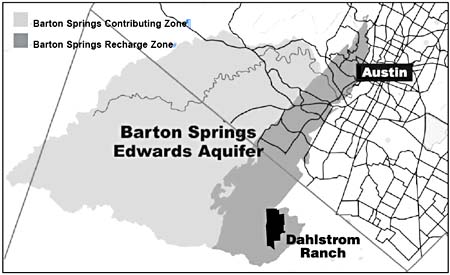
KR: You’re assuming, however, Mountain City will approve the ILA. My interpretation of the recent Mountain City election results is that Mountain City is firmly against agreeing to the ILA. So isn’t all of this unnecessary?
Earp: No, it’s not, because we can’t get to that to that ILA without all these other steps.
KR: What happens if Mountain City doesn’t agree to the ILA? Where does that leave you?
 |
| The scenic Dahlstrom Ranch property |
KR: So the City of Kyle has no plans to build a wastewater treatment plant on the west side of I-35?
Earp: We don’t have plans. I suppose that is something that will happen some time in the future, but for the Blanco basin. We plan to connect Anthem to our current wastewater treatment plant.
KR: Do you plan to run any utilities through the Dahlstrom property?
Earp: No. We can’t annex the (Anthem) property and we can’t serve it in our jurisdiction if we don’t connect to it. So we have to connect our ETJ, but not our utilities. Our utilities are either going to run by the (Hays) high school or down by the (Barton) middle school — these two areas are how we’re going to get back to the property. Or we can come up 150 if we have to.
KR: Do you have any additional plans for the Dahlstrom property?
Earp: Yes. So the Dahlstrom property is under a conservation easement so our intent is to market it and show it off and get the word out. It will be opening up, hopefully with their partnership with Hays County as soon as next year. The family wants to be careful about saying it is opening to the public because it’s controlled about how many people can be on the property at any given point in time. But it will be open as a park with some trails and some facilities.
KR: Are you referring to that 384-acre portion the county has already designated as a park in the northwest corner of the property or the entire ranch?
Earp: No, they are not going to open the entire ranch because the Onion Creek splits it in half. So they’re not going to have a way to get across the Onion Creek. Plus, part of the southern part of the property is under lease to Centex Materials. But to my knowledge — and I don’t want to mislead the public, because I don’t know all the details — I know there’s a plan for the northern part of the ranch off of 967. They already have plans with the county that they are working on. My understanding is they hope to be open by the first of the year or the middle of next year.
KR: Were you aware that even as we speak the Hays County Commissioners Court has on its agenda this morning an item to "execute an agreement with Plateau Land and Wildlife Management in the amount of $8,085 for a wildlife management plan for the Dahlstrom property"?
Earp: No, but that makes sense. The county doesn’t have a whole lot of park type resources as far as personnel and consultants and professionals go, so it makes sense to me that they would be hiring out for someone to do a wildlife plan.
KR: If Kyle assumes the property, will the city be assuming what is now a county park and, with it, O&M responsibility for the park?
Earp: Essentially, that would apply if we annexed the property, which we don’t intend to do, at least immediately. I do foresee there being some sort of a partnership arrangement in the future. We’re willing to partner with the county if that means we staff the visitors center. So it would be in our ETJ, just like any other county facility in our ETJ. The county’s the one responsible for operating it, manning it and running it, but, because I think this is going to be such a neat thing for our area to have — we don’t really have, to my knowledge, a conservation easement property that’s protected that you’re allowed to go into and go see. I think it’s going to be something that’s really going to be unique and neat for our community. I think we’re going to want to be a part of that. I just don’t know how that’s going to look yet. We haven’t had any conversations with the county or with the county and the Dahlstroms about that. But that’s something I see happening over the next year or two as we start to build a relationship with the Dahlstroms, in particular.
KR: Any thought been given to constructing, for lack of a better name or description, a conservation/wildlife educational center on the property?
Earp: The only way I can answer that is through the comments I’ve heard the Dahlstroms make, because I haven’t been a party to what they’ve negotiated with Hays County. But they did mention something to that effect, whether it be something like an information kiosk that would teach about the natural flora and fauna and interesting geological features. To what extend, I do not know, but I do know that’s something they’ve been very conscious of and thinking about. I’ve heard the Dahlstroms and/or their attorneys say they were considering having like cabins on site where people could stay and then have that as part of the experience. But there aren’t any immediate plans for that. The immediate plan is to have the information kiosk for visitors to check in and to open up trails and that’s about the extent of what the immediate plans are that I’m aware of.
KR: Is the city going to take over operations of the quarry?
Earp: No. The city will be responsible for the oversight and any type of licensing issues through the state. We would be responsible for those pieces. Right now, Dripping Springs has been doing that because it’s in Dripping Springs’ ETJ. But we’re not going to operate the quarry by any means.
KR: So right now you are telling me there are absolutely no plans to develop the Dahlstrom property if it becomes part of Kyle’s ETJ?
Earp: You can’t develop the property.
KR: You could if you bought the conservation easement.
Earp: Possibly, but that would cost money.
KR: About $350,000, as I understand it.
Earp: Yeah, today. But that’s not the family’s wishes. It’s definitely not our desire. In fact, our motivation was purely just to connect to the south. But, in meeting with the family, they’re the ones that made it clear that while they wanted to participate they didn’t know if they were comfortable breaking the ranch up into multiple jurisdictions anymore than it already is. They already have one little piece that I believe is in Buda or in Austin, one of the two. So they are the ones that told us that this is a bigger deal than you think it is because we really want to see our entire ranch go one way or the other. And we’ve been having those conversations for months, trying to figure out how that would work and how the family wants to see it. For the longest time the Dahlstroms have had more of a relationship with the Buda community than the Kyle community. So there’s concerns and considerations in that regard as well. I do know the property has in its conservation easement they excluded 20 acres on the vary far north on 967 that they could develop perhaps a visitors center or a conference center to go along with the property. Or they could do retail or something. But it’s my understanding from speaking with their attorney, because the impervious cover limits are so stringent that even though it’s 20 acres the development itself could only be four acres, maybe even three.
KR: Are you aware that the Greater San Marcos Partnership’s web site lists that the land on which the Anthem development is supposed to be built is for sale?
Earp: That was brought up at the Dripping Springs meeting. Clark Wilson owns the property. Where the San Marcos Partnership pulls those listings from is from a third party who then gets it from the original listing information. So what you’re seeing is the original listing from whenever Clark Wilson bought the property. I have e-mails from Clark Wilson where he was trying to track down how that information was still making it out to the web site because he doesn’t have it on the market.
KR: So it’s not really for sale.
Earp: It’s not really for sale.
KR: Aren’t you putting the cart before the horse? Shouldn’t you secure the ILA with Mountain City before pursuing this deal?
Earp: Let me tell you about the chicken and the egg conversation. Mountain City has represented they will not consider or take action until Dripping Springs takes action. Dripping Springs says it will not consider or take action until the Dahlstroms request in writing that they be released. The Dahlstroms said we won’t request in writing to be released until we have an agreement with Kyle. So the agreement with Kyle is on the agenda for tonight. That should lead to the letter which should lead to Dripping Springs releasing it which should lead to Mountain City considering it.
KR: Considering it, but not passing it.
Earp: I can’t guarantee, but they won’t even take it up until Dripping has done their part. Dripping won’t take it up until the Dahlstroms have requested that it be released. The Dahlstroms won’t request it until they have protections from Kyle.
So round and round it goes and where it stops …
Wednesday, November 4, 2015
The likely demise of the Mountain City ILA
Last night’s elections for the Mountain City City Council may have secured the final nail in the coffin of a proposed agreement between Mountain City and Kyle involving, to put it simply, selling water for land.
I’m going to try make this explanation as bare bones as possible and, in doing so, I will, admittedly, being omitting a lot of details, but the situation is basically this. A developer proposed the construction of a trendy residential district it called Anthem on property located in Mountain City’s Extraterritorial Jurisdiction (ETJ). In order to provide water for the subdivision, the developer reached an agreement with an outfit known as Electro Purification which proposed to drill wells near Wimberly in an area that was not regulated by any water district. Residents around the proposed drilling feared those wells would drain water from their water supplies and they took their complaints to county and state government officials. The result was legislation enacted that placed the disputed area under supervision, having the effect of limiting the amount of water Electro Purification could extract from their wells. As a result, Anthem still had no water source.
So the City of Kyle decided to saddle its white horse and ride to the rescue. It told Mountain City it would provide the water needed for Anthem if Mountain City would cede jurisdiction of the Anthem property to Kyle which, probably sooner than later, would annex the territory into its city limits. There was more to the agreement than that and, originally Hays County was part of the deal, throwing in some free road reconstruction for Mountain City, but recently I have heard that the county is out of the deal and the city of Dripping Springs has become the third party.
The populace of Mountain City was sharply divided over the proposal. (The populace of Kyle, as usual, didn’t seem to care one way or another.) I don’t want to say the Mountain City population was "split," because that would infer there were as many Mountain City residents for the ILA as there were against it. My feeling, from attending a couple of town hall meetings and one city council meeting, was that there were far more people against the deal than there were those for it. I didn’t realize just how overwhelming those numbers were until I saw the results of last night’s elections, which basically was a referendum on the ILA. Those that are against the ILA are divided into two camps. The first, under no conditions whatsoever, wants to cede any land to Kyle — they insist a "buffer" must be maintained to protect them from Kyle. The other camp just thinks Mountain City is not getting enough in return for ceding the property. (Back when Kyle Mayor Todd Webster was not afraid to talk with me, he said right after the ILA was proposed that, had he been in Mountain City’s shoes, he would oppose it.)
Last night’s Mountain City City Council election featured five candidates all running for three positions on the council — the top three vote getters would win. Three of the candidates — incumbent Lee Taylor, Suzanne Halam and Ralph McClendon Jr. — had either expressed dissatisfaction with the ILA or said they hadn’t reached a final position on it. The other two — Eva Brown and Thomas W. Brown Jr. (wife and husband) — were solidly in favor of it. The Browns, together, tallied only 8.8 percent of the votes cast. That’s not 8.8 percent each, but 8.8 total: 5 percent for Thomas Brown and 3.8 percent for Eva Brown. That’s astonishing. From where I sit, the folks in Mountain City spoke loudly, clearly and resoundingly about how they feel about the ILA and they don’t want it. And since any proposed agreement would have to be approved by the Mountain City City Council, I can’t see how this deal has any future.
I’m going to try make this explanation as bare bones as possible and, in doing so, I will, admittedly, being omitting a lot of details, but the situation is basically this. A developer proposed the construction of a trendy residential district it called Anthem on property located in Mountain City’s Extraterritorial Jurisdiction (ETJ). In order to provide water for the subdivision, the developer reached an agreement with an outfit known as Electro Purification which proposed to drill wells near Wimberly in an area that was not regulated by any water district. Residents around the proposed drilling feared those wells would drain water from their water supplies and they took their complaints to county and state government officials. The result was legislation enacted that placed the disputed area under supervision, having the effect of limiting the amount of water Electro Purification could extract from their wells. As a result, Anthem still had no water source.
So the City of Kyle decided to saddle its white horse and ride to the rescue. It told Mountain City it would provide the water needed for Anthem if Mountain City would cede jurisdiction of the Anthem property to Kyle which, probably sooner than later, would annex the territory into its city limits. There was more to the agreement than that and, originally Hays County was part of the deal, throwing in some free road reconstruction for Mountain City, but recently I have heard that the county is out of the deal and the city of Dripping Springs has become the third party.
The populace of Mountain City was sharply divided over the proposal. (The populace of Kyle, as usual, didn’t seem to care one way or another.) I don’t want to say the Mountain City population was "split," because that would infer there were as many Mountain City residents for the ILA as there were against it. My feeling, from attending a couple of town hall meetings and one city council meeting, was that there were far more people against the deal than there were those for it. I didn’t realize just how overwhelming those numbers were until I saw the results of last night’s elections, which basically was a referendum on the ILA. Those that are against the ILA are divided into two camps. The first, under no conditions whatsoever, wants to cede any land to Kyle — they insist a "buffer" must be maintained to protect them from Kyle. The other camp just thinks Mountain City is not getting enough in return for ceding the property. (Back when Kyle Mayor Todd Webster was not afraid to talk with me, he said right after the ILA was proposed that, had he been in Mountain City’s shoes, he would oppose it.)
Last night’s Mountain City City Council election featured five candidates all running for three positions on the council — the top three vote getters would win. Three of the candidates — incumbent Lee Taylor, Suzanne Halam and Ralph McClendon Jr. — had either expressed dissatisfaction with the ILA or said they hadn’t reached a final position on it. The other two — Eva Brown and Thomas W. Brown Jr. (wife and husband) — were solidly in favor of it. The Browns, together, tallied only 8.8 percent of the votes cast. That’s not 8.8 percent each, but 8.8 total: 5 percent for Thomas Brown and 3.8 percent for Eva Brown. That’s astonishing. From where I sit, the folks in Mountain City spoke loudly, clearly and resoundingly about how they feel about the ILA and they don’t want it. And since any proposed agreement would have to be approved by the Mountain City City Council, I can’t see how this deal has any future.
Tuesday, June 23, 2015
Mountain City votes to continue haggling over “sale” price
Update and correction: I have updated and corrected this item to reflect the fact that Mountain City Mayor Curnutt did not say the $500-per-lot payment from Anthem to Mountain City should be part of the ILA. She did say, as she pointed out in an e-mail to me, that this would be a part of a separate agreement between Mountain City and Anthem Development. I stand corrected on that point.
-----------
A developer wants to place a comparatively high-end subdivision on land that’s part of Mountain City’s Extraterritorial Jurisdiction (ETJ). Problem is the subdivision has no guaranteed source for water. So the City of Kyle stepped in and said it will extend its water and wastewater lines north to the subdivision, sell the residents its water and carry its wastewater south to Kyle’s wastewater treatment plant. It also threw in a few other goodies. In return, Kyle would take control of Mountain City’s ETJ and eventually annex it into Kyle so the property taxes of those in the subdivision can help pay for the infrastructure extensions. To sweeten the deal for Mountain City, Hays County jumped in and said it would pay to build new roads for Mountain City if Mountain City paid for the materials needed to build them. A document was prepared reflecting all this and that document is called an Interlocal Agreement (ILA).
That’s a simplified synopsis of the deal, but it hits the important parts.
The residents of Mountain City, however, don’t like the deal. Not one bit. And, as evidenced by a town hall meeting held a week ago last night, these residents are divided into two camps: One that doesn’t want to give up the ETJ under any conditions and a second that is willing to give it up, but not under the provisions as outlined in the current ILA. It was that second group that showed up last night at Mountain City’s City Council meeting that ended with the council unanimously approving a motion to continue negotiating with Kyle and Hays County for what it feels is a better deal, although neither Mountain City Mayor Tiffany Curnutt nor Mayor Pro Tem Phillip Taylor wanted to express confidence that an agreement will ever be reached.
The residents who attended last night’s council meeting do not view the action Mountain City might take as trading its ETJ. They call it "selling" the land in question and they are after a better sale price. In fact, Mayor Curnutt said she and Taylor met with Kyle City Manager Scott Sellers, Hays County Commissioner Will Conley, Anthem developer Clark Wilson and others for "about an hour" yesterday to discuss with them "If we were going to sell – I think that’s a good term – the ETJ what would make it worth our while."
To that end, she said, an attorney representing Mountain City will, in Mayor Curnutt’s words, "take first stab" at drafting an entirely new ILA which will be presented to Kyle and Hays County officials. She did not refer to this pending new document as a take-it-or-leave-it proposal, however, just the next step in the negotiating process.
Now I’m not an impartial observer in this discussion. Because I am a resident of Kyle, I want what’s best for the city in which I live and my observations on last night’s discussion are going to be filtered through that lens.
For example, I’m going to mention one of the last ideas broached last night first and that is the ILA should state if, for any reason, the subdivision, presently known as Anthem, doesn’t come to fruition, the ETJ would be returned to Mountain City. On the surface, that might sound reasonable, but there’s a chicken-egg question going on here. I will argue that once Kyle begins constructing the water and wastewater lines extensions, the ETJ remains in Kyle’s possession regardless of the fate of Anthem. Besides, the owner of the property says development is going to take place on that land, whether it’s called Anthem or Antler or Antares or Antebellum or Antediluvian or Antepenultimate or even Anticlimax. Something’s going to be constructed on that land and soon and, whatever it is, it will need water. Now, if Anthem becomes a no-go before construction begins, I see no reason Mountain City can’t reclaim its ETJ, although I would hope Kyle leaders become reluctant to enter into any further ILAs over it. Let Mountain City deal with it.
Another provision Mountain City wants as part of a revised ILA is that only that part of the ETJ that will be occupied by Anthem would be part of the deal. That would mean, as someone explained it to me last night, that instead of a 10-foot wide swath of land separating the city limits of Mountain City and Kyle, there would be a 50-foot separation, a separation Mountain City said it would like to use for a hike and bike trail. That one sounds rather reasonable to me.
"We may have to incorporate some language to the effect if signs or other structures are built they would have to fall within Kyle’s requirements as well," Curnutt said. "For example they don’t allow the pillar signs. So they don’t want any 70-foot pillar signs. So we would have to mutually agree on whatever signs are placed there."
Then she mentioned something that I had a problem with and that’s the development agreement that currently exists between Anthem and Mountain City.
"If Kyle were to adopt the development agreement as it stands or perhaps make it more stringent – whatever that means – but if they’re going to do that, it has to be outlined," the mayor said. "It may be better for them but we don’t consider it better." For example, she cited, Kyle Mayor Todd Webster "had mentioned all the homes in Plum Creek … are not our standards of masonry. Hardy plank, in our own minds, is not considered masonry. So that was one thing we talked about. Hardy plank is not going to work for us."
She also said the "timing was really weird" on when the property would be annexed. She said, according to the terms of the ILA as it is presently written "Basically, the minute we sign the ILA then the development agreement goes away and Kyle can write whatever it wants. So we want some language that says they are going to adhere to these rules when they write their development agreement. We would like to see a draft of that."
Here’s my problem with all that. No city should be allowed to dictate to another city how it should construct homes or the contents of any development districts or anything else about the way that city operates. You can dictate the rules for your own municipality but I have grave concerns when one municipality thinks it
has the right to dictate the rules for another municipality.
She also said she wanted to see maps of where the water and wastewater lines would be located before she would agree to any ILA..
In addition, she said, she wants "clarification" on Mountain City’s ability to "tie in" to Kyle’s water lines. She said she wondered if that allowed Mountain City residents, on an individual basis, to decide whether they would prefer to pay to have access to Kyle water. "That’s pretty much not the case," she told the council and the audience. "It would be pretty much all or none. We would have a main tie-in and the city of Mountain City would be responsible for paying the City of Kyle whether it’s in-city or out-of-city rates. That’s negotiable. Their out-of-city rates are 130 percent of what they currently charge their city residents, which is high to begin with. But just for clarification, it would be one main tie in. It could be used as an alternate source or for something if we ever decided to stop providing water. That’s not at all in the plans, but the City of Kyle would have the ability if we gave them the authorization to start providing water."
Curnutt said Mountain City would have to address what she referred to as extremely expensive infrastructure improvements before it could connect to Kyle’s water supply and will probably have to make those improvements sometime in the future anyway because of aging. "Our water costs are going to go up regardless," she said. "It’s a very old system."
To help defray the costs of these improvements, Curnutt wants an agreement with Anthem that stipulates Wilson will pay Mountain City $500 for every lot sold in Anthem, which, of course, is strictly between Anthem and Mountain City.
Mountain City, for some reason known only to it (perhaps it has to do with the possible increase in traffic on its streets), wants all entrances and exits to Anthem be located on RR 150, with another one possibly located on the northeast edge of the project, away from Mountain City, and that there be absolutely no street connection whatsoever between Anthem and Mountain City. According to current plans, there is only one way in or out of the subdivision but, from what I’m hearing, the project is big enough that state law requires at least two, because, if one was blocked for any reason, there would need to be a way for emergency vehicles to access the area. The problem is, however, the area of the project that fronts 150 is relatively small, meaning the two access points would have to be so close to each other to result in major traffic problems along that stretch of 150, particularly when you consider that stretch of highway is scheduled for major renovation, i.e. widening, as part of the area’s transportation plan.
To give you another idea, of how clueless elected officials around here are when it comes to PIDs, Mayor Curnutt said Wilson is, of course, working on a PID to present to the Kyle officials. When someone asked her what a PID was, she replied it was a "Public Infrastructure District." Yipes!
There also seems to be some disagreement about what Plum Creek plans to do with the land it owns north of Kohler’s Crossing and east of 2770, basically across the street from Mountain City. According to a Plum Creek web site, this area, known as Uptown, will eventually contain "mixed-use multifamily development, restaurants, retail and office uses, the central administration offices of the local school district, a new City of Kyle library, and urban civic space in the form of plazas and an amphitheatre." Taylor, however, swore to the audience last night Uptown is not zoned for multi-family.
That’s the highlights of the discussion on the one item that was on Mountain City’s council agenda last night. Fortunately, I got to hear it when I did because, knowing that Kyle officials don’t believe in open, transparent government as much as Mountain City seems to, I’m willing to bet all mention of Monday’s meeting from Kyle’s point of view will be discussed in executive session.
After the meeting I asked both Curnutt and Taylor whether they were confident that an ILA would ever been signed. "As long as it was agreeable to all parties concerned," Taylor said. I basically repeated my question by asking, on a scale from one to 10, how confident they were a document could be written that "was agreeable to all parties concerned." They both replied, in unison, "I don’t want to go there." That, to me, did not exude a whole lot of confidence on their part a deal would ever get done.
So there’s that.
-----------
A developer wants to place a comparatively high-end subdivision on land that’s part of Mountain City’s Extraterritorial Jurisdiction (ETJ). Problem is the subdivision has no guaranteed source for water. So the City of Kyle stepped in and said it will extend its water and wastewater lines north to the subdivision, sell the residents its water and carry its wastewater south to Kyle’s wastewater treatment plant. It also threw in a few other goodies. In return, Kyle would take control of Mountain City’s ETJ and eventually annex it into Kyle so the property taxes of those in the subdivision can help pay for the infrastructure extensions. To sweeten the deal for Mountain City, Hays County jumped in and said it would pay to build new roads for Mountain City if Mountain City paid for the materials needed to build them. A document was prepared reflecting all this and that document is called an Interlocal Agreement (ILA).
That’s a simplified synopsis of the deal, but it hits the important parts.
The residents of Mountain City, however, don’t like the deal. Not one bit. And, as evidenced by a town hall meeting held a week ago last night, these residents are divided into two camps: One that doesn’t want to give up the ETJ under any conditions and a second that is willing to give it up, but not under the provisions as outlined in the current ILA. It was that second group that showed up last night at Mountain City’s City Council meeting that ended with the council unanimously approving a motion to continue negotiating with Kyle and Hays County for what it feels is a better deal, although neither Mountain City Mayor Tiffany Curnutt nor Mayor Pro Tem Phillip Taylor wanted to express confidence that an agreement will ever be reached.
The residents who attended last night’s council meeting do not view the action Mountain City might take as trading its ETJ. They call it "selling" the land in question and they are after a better sale price. In fact, Mayor Curnutt said she and Taylor met with Kyle City Manager Scott Sellers, Hays County Commissioner Will Conley, Anthem developer Clark Wilson and others for "about an hour" yesterday to discuss with them "If we were going to sell – I think that’s a good term – the ETJ what would make it worth our while."
To that end, she said, an attorney representing Mountain City will, in Mayor Curnutt’s words, "take first stab" at drafting an entirely new ILA which will be presented to Kyle and Hays County officials. She did not refer to this pending new document as a take-it-or-leave-it proposal, however, just the next step in the negotiating process.
Now I’m not an impartial observer in this discussion. Because I am a resident of Kyle, I want what’s best for the city in which I live and my observations on last night’s discussion are going to be filtered through that lens.
For example, I’m going to mention one of the last ideas broached last night first and that is the ILA should state if, for any reason, the subdivision, presently known as Anthem, doesn’t come to fruition, the ETJ would be returned to Mountain City. On the surface, that might sound reasonable, but there’s a chicken-egg question going on here. I will argue that once Kyle begins constructing the water and wastewater lines extensions, the ETJ remains in Kyle’s possession regardless of the fate of Anthem. Besides, the owner of the property says development is going to take place on that land, whether it’s called Anthem or Antler or Antares or Antebellum or Antediluvian or Antepenultimate or even Anticlimax. Something’s going to be constructed on that land and soon and, whatever it is, it will need water. Now, if Anthem becomes a no-go before construction begins, I see no reason Mountain City can’t reclaim its ETJ, although I would hope Kyle leaders become reluctant to enter into any further ILAs over it. Let Mountain City deal with it.
Another provision Mountain City wants as part of a revised ILA is that only that part of the ETJ that will be occupied by Anthem would be part of the deal. That would mean, as someone explained it to me last night, that instead of a 10-foot wide swath of land separating the city limits of Mountain City and Kyle, there would be a 50-foot separation, a separation Mountain City said it would like to use for a hike and bike trail. That one sounds rather reasonable to me.
"We may have to incorporate some language to the effect if signs or other structures are built they would have to fall within Kyle’s requirements as well," Curnutt said. "For example they don’t allow the pillar signs. So they don’t want any 70-foot pillar signs. So we would have to mutually agree on whatever signs are placed there."

Then she mentioned something that I had a problem with and that’s the development agreement that currently exists between Anthem and Mountain City.
"If Kyle were to adopt the development agreement as it stands or perhaps make it more stringent – whatever that means – but if they’re going to do that, it has to be outlined," the mayor said. "It may be better for them but we don’t consider it better." For example, she cited, Kyle Mayor Todd Webster "had mentioned all the homes in Plum Creek … are not our standards of masonry. Hardy plank, in our own minds, is not considered masonry. So that was one thing we talked about. Hardy plank is not going to work for us."

She also said the "timing was really weird" on when the property would be annexed. She said, according to the terms of the ILA as it is presently written "Basically, the minute we sign the ILA then the development agreement goes away and Kyle can write whatever it wants. So we want some language that says they are going to adhere to these rules when they write their development agreement. We would like to see a draft of that."
Here’s my problem with all that. No city should be allowed to dictate to another city how it should construct homes or the contents of any development districts or anything else about the way that city operates. You can dictate the rules for your own municipality but I have grave concerns when one municipality thinks it
has the right to dictate the rules for another municipality.
She also said she wanted to see maps of where the water and wastewater lines would be located before she would agree to any ILA..
In addition, she said, she wants "clarification" on Mountain City’s ability to "tie in" to Kyle’s water lines. She said she wondered if that allowed Mountain City residents, on an individual basis, to decide whether they would prefer to pay to have access to Kyle water. "That’s pretty much not the case," she told the council and the audience. "It would be pretty much all or none. We would have a main tie-in and the city of Mountain City would be responsible for paying the City of Kyle whether it’s in-city or out-of-city rates. That’s negotiable. Their out-of-city rates are 130 percent of what they currently charge their city residents, which is high to begin with. But just for clarification, it would be one main tie in. It could be used as an alternate source or for something if we ever decided to stop providing water. That’s not at all in the plans, but the City of Kyle would have the ability if we gave them the authorization to start providing water."
Curnutt said Mountain City would have to address what she referred to as extremely expensive infrastructure improvements before it could connect to Kyle’s water supply and will probably have to make those improvements sometime in the future anyway because of aging. "Our water costs are going to go up regardless," she said. "It’s a very old system."
To help defray the costs of these improvements, Curnutt wants an agreement with Anthem that stipulates Wilson will pay Mountain City $500 for every lot sold in Anthem, which, of course, is strictly between Anthem and Mountain City.
Mountain City, for some reason known only to it (perhaps it has to do with the possible increase in traffic on its streets), wants all entrances and exits to Anthem be located on RR 150, with another one possibly located on the northeast edge of the project, away from Mountain City, and that there be absolutely no street connection whatsoever between Anthem and Mountain City. According to current plans, there is only one way in or out of the subdivision but, from what I’m hearing, the project is big enough that state law requires at least two, because, if one was blocked for any reason, there would need to be a way for emergency vehicles to access the area. The problem is, however, the area of the project that fronts 150 is relatively small, meaning the two access points would have to be so close to each other to result in major traffic problems along that stretch of 150, particularly when you consider that stretch of highway is scheduled for major renovation, i.e. widening, as part of the area’s transportation plan.
To give you another idea, of how clueless elected officials around here are when it comes to PIDs, Mayor Curnutt said Wilson is, of course, working on a PID to present to the Kyle officials. When someone asked her what a PID was, she replied it was a "Public Infrastructure District." Yipes!
There also seems to be some disagreement about what Plum Creek plans to do with the land it owns north of Kohler’s Crossing and east of 2770, basically across the street from Mountain City. According to a Plum Creek web site, this area, known as Uptown, will eventually contain "mixed-use multifamily development, restaurants, retail and office uses, the central administration offices of the local school district, a new City of Kyle library, and urban civic space in the form of plazas and an amphitheatre." Taylor, however, swore to the audience last night Uptown is not zoned for multi-family.
That’s the highlights of the discussion on the one item that was on Mountain City’s council agenda last night. Fortunately, I got to hear it when I did because, knowing that Kyle officials don’t believe in open, transparent government as much as Mountain City seems to, I’m willing to bet all mention of Monday’s meeting from Kyle’s point of view will be discussed in executive session.
After the meeting I asked both Curnutt and Taylor whether they were confident that an ILA would ever been signed. "As long as it was agreeable to all parties concerned," Taylor said. I basically repeated my question by asking, on a scale from one to 10, how confident they were a document could be written that "was agreeable to all parties concerned." They both replied, in unison, "I don’t want to go there." That, to me, did not exude a whole lot of confidence on their part a deal would ever get done.
So there’s that.
Monday, June 22, 2015
Mountain City, at least, knows Robert's
I will have more on this tomorrow, but the Mountain City City Council tonight unanimously approved continuing to discuss terms of a proposed Interlocal Agreement among Mountain City, the City of Kyle and Hays County concerning a subdivision planned for a water-starved area of Mountain City's ETJ. But what I found extremely interesting after attending my first Mountain City council meeting is that, unlike Kyle, its council knows exactly how to follow Robert's Rules of Order when discussing and voting on an agenda item. Perhaps Mountain City's mayor Tiffany Curnett can let Kyle Mayor Todd Webster know how it's supposed to be done during their ILA discussions. That would help keep the Kyle City Council from looking so goofy.
Tuesday, June 16, 2015
It’s all about the buffer, ‘bout the buffer, not the water
There’s a rather large subdivision called Anthem planned for an area along RR 150 northwest of Kyle and directly west from Mountain City. It will contain homes ranging from 6,000 to 13,000 square feet. Looking at these plans makes me think Anthem will make Plum Creek seem like a dwarf. The average size of a house in Plum Creek is 2,184 square feet. Anthem is not located within the municipal limits of any city, but is in Mountain City’s extraterritorial jurisdiction (ETJ).
Originally, Anthem planned to get water from Electro Purification, which proposed to pump five million gallons of water per day from an unregulated portion of the Trinity Aquifer. Most of that five million gallons was contracted to a water reseller, Goforth Special Utility District. The city of Buda also contracted to get some of the water from the EP wells.
However, the Texas Legislature passed a bill that would expand the boundaries of the Barton Springs-Edwards Aquifer Conservation District to cover that portion of western Hays County where the EP wells are planned, thus reducing the amount of water EP could pump on a daily basis to a level where it could possibly provide only the amount contracted by the Goforth SUD.
So various entities went to work to solve the problem of how to replace that water EP was supposed to provide to Buda and Anthem. Buda proved not to be a problem, but the plan for Anthem has run into steep opposition from the residents of Mountain City.
Acting as a third-party mediator, Hays County got together with the city leaders of Kyle and Mountain City and negotiated the framework for a deal, called an Interlocal Agreement (ILA), in which, among other things, Kyle would agree to provide water and wastewater services to Anthem. However, those "other things" has the citizenry of Mountain City in an uproar.
According to the deal, Kyle would provide the water and wastewater services only if Mountain City surrendered jurisdiction to the territory where Anthem would be located to Kyle. There are other provisions. One, Hays County would provide the labor to rebuild roads in Mountain City (Mountain City would have to pay for the materials). Kyle would also provide water and wastewater services to a section of Mountain City it wants to convert into a commercial corridor. Such a corridor would provide Mountain City with sales tax revenues. However, at the present, that area is served by wells and septic tanks and thus can’t be developed commercially. In addition, Kyle would "make available water and wastewater master meters to Mountain City, billable at the out-of-city rates as defined in Kyle’s Code of Ordinances, which will allow Mountain City to develop its own water and/or wastewater utilities to service its citizenry." Kyle, of course, would make Anthem part of its ETJ (and perhaps even officially annex the area) and receive the resulting property tax revenues. (Mountain City would not receive property tax revenues from Anthem if it kept the ETJ; those moneys would go to the Municipal Utility District created for the subdivision.)
Last night I attended a meeting at the Plum Creek Golf Course building hosted by Mountain City to discuss the proposed ILA. Also present were Kyle Mayor Todd Webster; Hays County Commissioners Will Conley, whose district covers the proposed EP wells, and Mark Jones, whose district incorporates Kyle and Mountain City; and about 40 or so residents of Mountain City, which may not seem like that many but is actually the equivalent of about 1,800 Kyle residents coming to a city council meeting and we all know that’s not likely to happen in the history of this planet. The feeling I got was that all 40 of those residents were against the ILA because they did not, for one reason or another. want to give up the city’s ETJ. Some of those folks didn’t want to give up the ETJ under the terms proposed in the ILA – they felt Mountain City should be able to negotiate "a better deal" – but the most prominent reason given for this recalcitrance was they wanted to maintain the ETJ as a "buffer."
I got to thinking about that following the meeting, even consulting my trusted Webster’s II for a definition of "buffer" other than "a device used for shining or polishing." The definitions that apply are 1. "One that protects by intercepting or moderating adverse pressures or influences" and/or 2. "Something that separates the entities, as a neutral area between two conflicting powers."
I thought about that a lot and the more I thought about it, the more I kicked myself for not asking one of those citizens exactly what they wanted this buffer to protect them from. It certainly can’t be from encroaching development because Anthem is going to be developed adjacent to Mountain City regardless of whose ETJ it is located in. So what is it that these folks felt the need to have Anthem serve as a buffer for them? What did they fear?
I plan on attending Mountain City’s next City Council meeting, which is scheduled for Monday, June 22, to see if I can learn the answers to these questions. I would also like to ask those who say they want "a better deal," exactly what, in their estimation, would provide "a better deal." In fact, I was somewhat surprised no one running the meeting posed that question last night.
But, between now and then, I can let my imagine run wild. Back in the late 1950s, when I was still in my mid-teenage years, my family moved from Houston to Hamilton, Ontario, Canada. And although I was always told things were quite friendly between the United States and Canada, I quickly learned Canadians, in general, hated Americans. I searched for the answer as to why and learned that it stemmed to the post World War II era. A significant portion of Canada’s economy back then (this was before they discovered oil in the tar sands out west) depended on its sale and exporting of wheat. As part of the Marshall and other plans instituted after World War II, America gave away wheat to countries needing it. Canada had a tough time selling its wheat while America was giving it away and, as a result, its economy suffered. Canadians never forgave America for this.
That got me to thinking if there could be a similar type of grudge between Mountain City and Kyle and what the folks really wanted was a buffer that protected them from "those evil Kyle land-grabbers." There was a time when Mountain City was the most vibrant municipality in this part of Texas. It was the principle transportation hub of its day, meaning it was on the primary stagecoach line. All that changed in the 1940s when the railroad came to the area. Mountain City felt the train should run though its town and that a depot should be located there; however, state Senator Fergus Kyle used his political connections to get the tracks laid further east, completely bypassing Mountain City. That, in effect, ended Mountain City’s days as a regional center of commerce. So, I’m wondering, is Mountain City still bitter about that all these years later? I don’t know, but I hope to find out next week.
I did have the opportunity to ask Mayor Pro Tem Diane Hervol, who also attended last night’s meeting, what she thought about it all.
"There’s a lot to be determined," she said. "I think we’re farther apart and perhaps some more negotiations, more discussion is needed between the two cities."
She said she was optimistic some kind of an agreement will be worked out and she was "hopeful" it would involve the ETJ coming under Kyle’s control. "I just need to understand what the terms for those cities will be."
Incidentally, there’s a standing item on tonight’s Kyle City Council agenda to "Consider and take possible action to amend, extend or rescind the ILA with Mountain City and Hays County."
Michael Rubsam, chairman of Kyle’s Planning and Zoning Commission, also attended the meeting and said afterwards "I think the Interlocal Agreement can be in the best interests of the people of Mountain City once they work out the details. I believe there’s quite a few people in there that don’t understand about the MUD." He said he was disappointed that those points weren’t clarified for the Mountain City residents who attended the meeting.
Originally, Anthem planned to get water from Electro Purification, which proposed to pump five million gallons of water per day from an unregulated portion of the Trinity Aquifer. Most of that five million gallons was contracted to a water reseller, Goforth Special Utility District. The city of Buda also contracted to get some of the water from the EP wells.
However, the Texas Legislature passed a bill that would expand the boundaries of the Barton Springs-Edwards Aquifer Conservation District to cover that portion of western Hays County where the EP wells are planned, thus reducing the amount of water EP could pump on a daily basis to a level where it could possibly provide only the amount contracted by the Goforth SUD.
So various entities went to work to solve the problem of how to replace that water EP was supposed to provide to Buda and Anthem. Buda proved not to be a problem, but the plan for Anthem has run into steep opposition from the residents of Mountain City.
Acting as a third-party mediator, Hays County got together with the city leaders of Kyle and Mountain City and negotiated the framework for a deal, called an Interlocal Agreement (ILA), in which, among other things, Kyle would agree to provide water and wastewater services to Anthem. However, those "other things" has the citizenry of Mountain City in an uproar.
According to the deal, Kyle would provide the water and wastewater services only if Mountain City surrendered jurisdiction to the territory where Anthem would be located to Kyle. There are other provisions. One, Hays County would provide the labor to rebuild roads in Mountain City (Mountain City would have to pay for the materials). Kyle would also provide water and wastewater services to a section of Mountain City it wants to convert into a commercial corridor. Such a corridor would provide Mountain City with sales tax revenues. However, at the present, that area is served by wells and septic tanks and thus can’t be developed commercially. In addition, Kyle would "make available water and wastewater master meters to Mountain City, billable at the out-of-city rates as defined in Kyle’s Code of Ordinances, which will allow Mountain City to develop its own water and/or wastewater utilities to service its citizenry." Kyle, of course, would make Anthem part of its ETJ (and perhaps even officially annex the area) and receive the resulting property tax revenues. (Mountain City would not receive property tax revenues from Anthem if it kept the ETJ; those moneys would go to the Municipal Utility District created for the subdivision.)
Last night I attended a meeting at the Plum Creek Golf Course building hosted by Mountain City to discuss the proposed ILA. Also present were Kyle Mayor Todd Webster; Hays County Commissioners Will Conley, whose district covers the proposed EP wells, and Mark Jones, whose district incorporates Kyle and Mountain City; and about 40 or so residents of Mountain City, which may not seem like that many but is actually the equivalent of about 1,800 Kyle residents coming to a city council meeting and we all know that’s not likely to happen in the history of this planet. The feeling I got was that all 40 of those residents were against the ILA because they did not, for one reason or another. want to give up the city’s ETJ. Some of those folks didn’t want to give up the ETJ under the terms proposed in the ILA – they felt Mountain City should be able to negotiate "a better deal" – but the most prominent reason given for this recalcitrance was they wanted to maintain the ETJ as a "buffer."
I got to thinking about that following the meeting, even consulting my trusted Webster’s II for a definition of "buffer" other than "a device used for shining or polishing." The definitions that apply are 1. "One that protects by intercepting or moderating adverse pressures or influences" and/or 2. "Something that separates the entities, as a neutral area between two conflicting powers."
I thought about that a lot and the more I thought about it, the more I kicked myself for not asking one of those citizens exactly what they wanted this buffer to protect them from. It certainly can’t be from encroaching development because Anthem is going to be developed adjacent to Mountain City regardless of whose ETJ it is located in. So what is it that these folks felt the need to have Anthem serve as a buffer for them? What did they fear?
I plan on attending Mountain City’s next City Council meeting, which is scheduled for Monday, June 22, to see if I can learn the answers to these questions. I would also like to ask those who say they want "a better deal," exactly what, in their estimation, would provide "a better deal." In fact, I was somewhat surprised no one running the meeting posed that question last night.
But, between now and then, I can let my imagine run wild. Back in the late 1950s, when I was still in my mid-teenage years, my family moved from Houston to Hamilton, Ontario, Canada. And although I was always told things were quite friendly between the United States and Canada, I quickly learned Canadians, in general, hated Americans. I searched for the answer as to why and learned that it stemmed to the post World War II era. A significant portion of Canada’s economy back then (this was before they discovered oil in the tar sands out west) depended on its sale and exporting of wheat. As part of the Marshall and other plans instituted after World War II, America gave away wheat to countries needing it. Canada had a tough time selling its wheat while America was giving it away and, as a result, its economy suffered. Canadians never forgave America for this.
That got me to thinking if there could be a similar type of grudge between Mountain City and Kyle and what the folks really wanted was a buffer that protected them from "those evil Kyle land-grabbers." There was a time when Mountain City was the most vibrant municipality in this part of Texas. It was the principle transportation hub of its day, meaning it was on the primary stagecoach line. All that changed in the 1940s when the railroad came to the area. Mountain City felt the train should run though its town and that a depot should be located there; however, state Senator Fergus Kyle used his political connections to get the tracks laid further east, completely bypassing Mountain City. That, in effect, ended Mountain City’s days as a regional center of commerce. So, I’m wondering, is Mountain City still bitter about that all these years later? I don’t know, but I hope to find out next week.
I did have the opportunity to ask Mayor Pro Tem Diane Hervol, who also attended last night’s meeting, what she thought about it all.
"There’s a lot to be determined," she said. "I think we’re farther apart and perhaps some more negotiations, more discussion is needed between the two cities."
She said she was optimistic some kind of an agreement will be worked out and she was "hopeful" it would involve the ETJ coming under Kyle’s control. "I just need to understand what the terms for those cities will be."
Incidentally, there’s a standing item on tonight’s Kyle City Council agenda to "Consider and take possible action to amend, extend or rescind the ILA with Mountain City and Hays County."
Michael Rubsam, chairman of Kyle’s Planning and Zoning Commission, also attended the meeting and said afterwards "I think the Interlocal Agreement can be in the best interests of the people of Mountain City once they work out the details. I believe there’s quite a few people in there that don’t understand about the MUD." He said he was disappointed that those points weren’t clarified for the Mountain City residents who attended the meeting.
Subscribe to:
Posts (Atom)