The Kyle Report

The Kyle Report
Showing posts with label Assistant City Manager James Earp. Show all posts

Friday, November 6, 2020

City decides it’s not worth it to fight climate change, adopts anti-environment policy

Full disclosure No. 1: I’m an avid environmentalist. I firmly believe in the science that proves climate change is the single most existential threat to our planet, our very existence. I actively as well as financially support such organizations as the Sierra Club, the National Audubon Society, the World Wildlife Fund, Greenpeace, the National Wildlife Federation, the Natural Resources Defense Council, Green America, the World Business Council for Sustainable Development, the Rainforest Action Network, the Environmental Defense Fund and, of course, the National Geographic Society. In short, I’m a “tree-hugger” and proud of it.

Some of the most precious moments of my life have been spent in our country’s national parks, celebrating their wonder, their very existence. And I have had the opportunity to spend time in every single one of them at least once. My two very special places of refuge are the Grand Canyon and Monument Valley (admittedly not a national park, but a national treasure just the same).

That’s why I am ashamed to learn that the city I now call home doesn’t agree with me. It appears city policy is now “Becoming a ‘Green City’ is not worth the investment,” even though facts demonstrate going green can save taxpayers money, can drastically reduce overall city expenditures.

If you haven’t already heard about it, let me introduce you to a program called Leadership in Energy and Environmental Design, or LEED, a product of the U.S. Green Building Council. USGBC’s vision is “that buildings and communities will regenerate and sustain the health and vitality of all life within a generation. Our mission is to transform the way buildings and communities are designed, built and operated, enabling an environmentally and socially responsible, healthy, and prosperous environment that improves the quality of life.”

Unfortunately, in my opinion, it is readily apparent that the city of Kyle has adopted a policy doesn’t want a “environmentally and socially responsible, healthy, and prosperous environment that improves the quality of life” for its citizens. Why? It appears they don’t think it’s worth the investment.

This near-sighted vision is not new to me. I hear many people say words like “The planet is not going to turn into an uninhabitable cinder block in my lifetime, so why should I care.” That, to me, is the same argument as “That kid ain’t going to support me in my old age so why should I invest my hard earned money in the brat’s college education.” My response? “YOU are not the subject of this conversation. The subject of this conversation is the future of that child that you helped to bring into this world.”

But, then, that’s a constantly repeating thought process I see in everyone involved in city planning, whether they be elected or staff. When they talk about the future, they look no further than, say, five years into the future; some, perhaps, 10. But no one, absolutely no one, looks beyond two generations into the future. And that’s why Kyle has adapted an environmentally unfriendly policy towards new construction or really anything involving the environment.

If it wasn’t so depressing, listening to city council members, past and present, talk about recycling would almost be laughable in its stupidity. They talk about it as if it were a commodity — about the possible ROI in selling recycled materials and the markets for these goods. Recycling is not about dollars, but about achieving the much desired goal of zero waste. But Kyle doesn’t care about achieving that goal. That’s why, for example, even with all the apartment complexes sprouting up all over the city, there is no recycling programs for Kyle residents living in multi-family complexes. Or, for Kyle businesses, for that matter.

The result is that all those recyclables are now going, with the rest of the trash, to the landfill. And, as the name implies, landfills eventually reach their capacity– they fill up. And, when that happens, a new landfill must be created somewhere else. And this “somewhere else” has to be many, many miles from any honest, G-d fearing, tax-paying U.S. citizen because, really, would you want a landfill anywhere near your home? And that means getting that trash from your home to that landfill involves traveling many, many more miles than before which means spending a lot more dollars on those transportation costs and that means … by now, you see where this is going … much higher utility bills. Not investing today costs taxpayers tomorrow.

This lack of a multi-family and a commercial recycling program proves what I said earlier: Kyle is only committed to keeping up appearances, but not to long-term environmental sustainability. The only alternative is even more horrible to contemplate: That there are, in fact, those in the city that think ahead in the long-term but are systematically ignored into silence or until they take their talents/abilities to the Sierra Club or the National Geographic Society.

Doing everything in its power to preserve and protect our environment, is what drives the USGBC and its LEED certification program, which has created a plan for constructing buildings that use less energy and water than non-certified buildings, avoid waste, save on maintenance costs, improve indoor air quality, offer added comfort to its occupants and create “less environmental burden on their community.” In short, over its life, a LEED certified municipal building will save taxpayers money.

But the City of Kyle doesn’t want to build them? Why? Because the construction cost of such a building is somewhat higher, even though the USGBC has proved over and over again those additional costs are quickly recouped through considerably reduced Operation and Maintenance costs (O&M costs, in the municipal jargon). And it’s those O&M costs that must be paid each year with moneys from the city’s General Fund, that fund that’s replenished annually with your property tax dollars.

Full disclosure No. 2: I voted against the city’s Proposition A, although not for the property tax reasons that were the motivations for just about everyone else’s “no” vote on this item. I voted “no” because I could not get the answer to one simple question: “Is the proposed public safety building going to be LEED certified?” I tried to get an answer. Several times. I’ll specifically mention two of them.

The city hired this PR firm, the Buie Co., to promote the passage of Proposition A. Now, the city will dispute that statement. They will say the firm was hired for “education activities.” But, you see, they have to say that because it’s illegal to use municipal taxpayer funds to promote the passage of a municipal bond program. It’s also illegal for elected municipal officials to use their position to promote the passage of a municipal bond program. But the Buie Co., under the guise of “educational activities,” somehow engaged Kyle City Council members to commit those illegal acts as well. Look, let’s be realistic here. No one hires a PR company for “education activities.” You hire educators for that. You hire PR companies to create opportunities with which to sell a product of some sort, predominantly through the use of free media. In fact, on its web page, Buie brags that “We have seen our proactive approach to community engagement facilitate communications, build common ground and bring together diverse stakeholders to mobilize support. Public relations is all about results. And, we get results.” In this case, Buie mobilized support to pass Proposition A and they got the results they were hired to get.

One of the first thing Buie concocted was this special web page where visitors could go and pose a question about the proposed police headquarters. So, of course, I went on there right away and posed my question: “Is the proposed public safety building going to be LEED certified?” Within 24 hours, I received a non-answer which was a form letter emailed to me which said, in effect, “We have absolutely no idea what you’re talking about, but, hopefully, maybe, someday, we’ll come up with an answer to your question.” They never did. Never heard another word. But, like I said, they weren’t really there to provide answers, to actually “educate.”

One of Buie’s next stunts involved a series of virtual town hall meetings in which they described all the reasons why voters should approve Proposition A and then enlisted a city council member to go even further in promoting the bond proposal’s passage. In the virtual town hall meeting I attended, the unlucky city council member somehow convinced to commit these blatantly illegal acts was Alex Villalobos. Now, this is not meant to be a criticism of Villalobos. I’m convinced he’s probably what in some legal terms is known as “an unwitting accomplice” to the actual criminal activity. Anyway, at the end of his sales pitch, virtual attendees were offered the opportunity to pose questions. So, once again, I posed mine: “Is the proposed public safety building going to be LEED certified?” Seeing Villalobos hem and haw around trying to answer the question when it was obvious he had no idea what the question referred to, or, if he did, he didn’t want to get caught in the middle of an environmental thunderstorm, almost made be feel a little sorry for the guy. But, needless to say, I never got an answer.

And that, in short, is why I voted against Proposition A. I simply can’t support anything that (1) is going to be anti-environment, that (2) is going to facilitate climate change and (3) is, in the long run, going to result in a needless waste of taxpayers’ money. Dallas recently built a new police headquarters. Here is the first paragraph on that city’s web page devoted to that building: “The city of Dallas, Texas is committed to improving the quality of life for its citizens by providing healthier environments through its Green Building initiative. This commitment is exemplified by the Jack Evans Police Headquarters, which achieved a Silver certification under the U.S. Green Building Council’s Leadership in Energy and Environmental Design (LEED®) program for new construction. The city adopted Silver LEED certification as a standard for all its new facilities in January 2003.”

You see, it is possible. Other cities care enough about their future and the health and well being of its employees and its citizens to take these steps. It’s a shame that Kyle has decided it does not want to be one of them.

I must also admit that I felt a sense of personal betrayal. In one of my earliest interviews with City Manager Scott Sellers he pledged that as long as he held that position the city would never, ever, construct a building that did not seek LEED certification. Now, here we are. Of course, there’s still time. The city can still decide it will try to build an environmentally friendly new police headquarters. And help with that may be on the horizon. During an extended telephone conversation I had with her the day after this past Tuesday’s election, new council member Yvonne Flores-Cale was quite passionate, quite convincing in her pro-environmental beliefs and activities. But then she will only be one of seven votes on the council. 

And then there’s this, perhaps the final turn of the key destined to keep Kyle in environmental purgatory until it’s too late to protect future generations: During Wednesday’s city council meeting, the council voted unanimously to “award a professional services contract to Coleman and Associates for the landscape design of Mary Kyle Hartson Park and 104 S Burleson in an amount not to exceed $93,700.00.” The proposal Coleman and Associates presented the city contained 11 items, the 11th of which was titled “Exclusions.” The sixth listed “exclusion” was “LEED is excluded.”

I asked assistant city manager James Earp about this and he said “LEED, the actual certification, not just the principles, requires a significant amount of additional record keeping, paperwork, processes and the like that dramatically increase cost … If we want LEED certification the bid would have been dramatically understated.”

That, I guess, makes it official. Kyle’s policy is protecting the environment, protecting the long-term health and well-being of city employees along with the rest of the citizens of Kyle, is just too expensive today even if it means saving money as well as possibly saving lives in the future.

You’ll have to pardon me if I respectfully disagree. 

Wednesday, September 16, 2020

City takes first step toward creating much-needed Code Enforcement Department

 Right now, it’s being called “The Beautification Division.” At least that’s the name given to this new department by assistant city manager James Earp. It’s first assignment is to maintain the rights-of-way along eight major Kyle corridors. But, during last night’s city council meeting while Earp was describing his three-year-plan for this new division, it’s easy to see how this idea could morph into something the city desperately needs — a stand-alone Code Enforcement Department.

“We’ve gotten to the point right now where we’re large and sophisticated enough to where we really need to start specializing in order to maximize our efficiencies and in order to maximize the benefit the public is receiving,” Earp said.

City Manager Scott Sellers tried unsuccessfully to bolster code enforcement in his proposed FY 2020-21 budget, but the council nixed the plan, removing Sellers’s proposal to add two new code enforcement officials to the city’s staff. At the time, the council made clear it erroneously thought of Code Enforcement as a “beautification” issue. It is not. Code Enforcement, in reality, is a public safety issue and that’s one of the reasons that, in the city’s current organization, code enforcement falls under the jurisdiction of the police department. 

So it seems to me what the city’s staff is doing right now, with a wink and a nod, is saying, “OK, if you folks think this is beautification issue, we’ll play along with you, and create a stand-alone Beautification Division,” with the idea that its success and acceptance will give it the space is needs to grow and morph into something much greater and much needed in any “large and sophisticated” community.

The first step in the creation of this new division was to award a $250,000 contract to WLE (which, according to its website, stands for “Water, Land, Environment”), an Austin-based commercial landscape and construction company, to be responsible for, essentially, the “beautification” of these Kyle roadways: 2770, RM 150, Center Street, Burleson, Philomena, Kyle Parkway, Marketplace, and Lehman Road. In this case, “beautification,” primarily means mowing, weed removal/prevention and litter abatement. About 90 minutes after Earp outlined his plan for the first three years in the life of this Beautification Division, the council voted unanimously to award the contract to WLE contingent on whether Earp could obtain satisfactory answers from the company to questions and concerns raised by Mayor Travis Mitchell.

But what I found so fascinating about all this was that three-year plan Earp outlined for this new city department, because it contained valuable hints of what’s in store, or at least what the city staff envisions. I know for a fact Sellers knows the value of code enforcement. He tried to strengthen it in this upcoming budget. He failed. But, like any good administrator, he simply decided to accomplish his goals another way.

Why is a strong code enforcement department necessary? That’s an easy question to answer. Kyle, like any other city, has any number of codes/ordinances that it puts on the books. Here, to cite just one example, is Kyle’s sign ordinance, and section 3 of that ordinance says, in part, “the code enforcement officer is hereby authorized and directed to enforce all the provisions of this chapter.”  Does Kyle have the code enforcement staff required to adequately enforce “all the provisions of this chapter”? I doubt it. There’s also zoning regulations. For instance, do we know for certain that a particular area zoned Community Commercial is following the restrictions for that zoning, or is it possibly allowing uses prescribed for Retail Services zoning? I’m not saying developers are deliberately gaming the system, but do we even have anyone inspecting these properties? Do we know what’s going on? Are residences being developed in R-3-3 zoned areas being developed exactly as prescribed in the city’s zoning ordinances? Is anyone checking? Are the coolers where the food is kept at the restaurants in town being maintained and kept at the proper temperatures? In short, the Code Enforcement Department of a city is responsible for monitoring both public and private property, commercial and residential, to ensure that there are no health or safety hazards that might endanger the public and determining compliance with certain city codes and ordinances. That’s why such a department is necessary.

And that’s why I found it so fascinating that Earp said that he planned that, by year three of this Beautification Division’s existence, it would include a least one building inspector — a position not associated with “beautification” per se, but definitely linked to code enforcement.

“One of the things we have issues with and challenges with is recruiting qualified building inspectors,” Earp told the council last night. “That’s predominantly because in order to become a licensed building inspector you first have to be a licensed electrician or plumber. We just don’t have a good pipeline that creates that type of skill set. So, we’re constantly trying to find folks outside of our organization to come work for us. So I thought, how better than to build our own pipeline. We have these needs. We have these responsibilities. If we could start training folks up and find a way to get them licensed and then we can build our own pipeline of ultimately becoming a building inspector.”

It also goes without explicitly saying, it’s also the way to building the city’s own pipeline to creating a functioning code enforcement department.

“Obviously this is a big plan,” Earp said about his proposed new division, “with a lot of thought that’s gone into it. It will ultimately be a high bar for everyone to accomplish.”

Some may think the actual height of this bar ends at the “beautification” of the eight roadways named above. One of those is Mayor Mitchell.

Earp’s proposed Beautification Division “is exactly the kind of move we’re ready for as a community,” Mitchell said. “I can’t wait to drive up and down some of these streets and see our street sweeper out there full time, see our sidewalks without weeds, making sure all of our right-of-way is mowed, weed-eated, trimmed and edged, all of it. The community of Kyle deserves to have nicely maintained roads and I’m glad we’re taking the steps we’re taking to deliver that to them.”

He’s right, of course. But, personally, I think the city staff is justifiably setting the bar much higher than that.


Wednesday, July 22, 2020

Low income Kyle residents eligible for utility bill relief

Beginning today, low income Kyle residents facing “financial hardship” as a result of the Coronavirus pandemic may apply for relief from the utility bills they received during March, April and May that cover city-provided water, wastewater, solid waste and storm drainage services.

“We are looking at making available for those that apply and are eligible a credit for their monthly service charge for these services as well as late-payment penalty fees and any service-disconnection fee that may have been assessed,” assistant city manager James Earp told the city council Tuesday.

Earp stressed that this relief does not cover bills provided by outside providers such as electricity, internet, etc., but he also cautioned it does not apply to water bills if a resident is served by a water utility other than the City of Kyle, such as Monarch or County Line.

To be eligible for the relief, a customer must reside within the Kyle city limits and be the person whose name is registered on the account, Earp said.

“You must also be experiencing a financial hardship due to the loss of job or reduction in income that’s related to Covid,” Earp said. “You must also be at or below the federal thresholds for low income.”

Residents can learn whether they are eligible for the relief and/or apply for the assistance by clicking here. Earp said the city’s goal is to spend no longer than a week reviewing applications and notifying applicants whether their submission has been successful.

“It’s possible there might be a lot (of applications) that will be received during the first week and it will take a little bit until we first get this rolled out,” Earp said. “But the intent is to try to be extremely timely in these responses because of the on-going financial impact that virus has had on that household.”

Saturday, November 4, 2017

Tenorio walkout paves way for PID approval

Council member Daphne Tenorio abruptly and without explanation left the council dias today making it possible for the council to authorize by a 4-0 vote a Public Improvement District designed to finance mainly sewer, street and drainage improvements in areas bordering a planned residential development just west of I35 between Opal and Rowland lanes.

Tenorio was actually the first council member to assume her seat on the dias for this special city council meeting, followed by council member Travis Mitchell and Mayor Todd Webster. I have reached out to Tenorio asking her why she left, but have yet to receive a response, so speculation must prevail. For some reason Tenorio opposes all PIDs, even extremely valuable and worthwhile PIDs like this one that are designed to work as PIDs are supposed to. Of course, the reality is, Tenorio doesn’t oppose PIDs, but what PIDs represent and that’s development. She has become a tool of the anti-growth movement in Kyle. So, it’s more than reasonable to assume Tenorio left the council chambers thinking she would deny the council the quorum required to hold the vote on the PID request, which, strategically speaking, was precisely the wrong move to make because all she did was assure its passage by her departure.

The truth is there is nothing she could have done to derail the PID. At most, she could have delayed it until the council’s next meeting on Nov. 21. But the only way she could have done that is to remain on the dias. Had she done that, she would have learned during the roll call that council member Becky Selbera was en route to City Hall, so a quorum would eventually be there regardless (council members Shane Arabie and David Wilson were out of the city early today). But, had Tenorio remained, she could have maneuvered to force the council to vote on the PID request before Selbera arrived and a 3-1 vote to approve (with Tenorio being the lone opposition) would not be sufficient to approve it because at least four votes are required for the council to approve anything. The reason that tactic would not have killed the PID, however — only delayed it — is because Mitchell or Webster, perhaps both, would have undoubtedly voted with Tenorio to deny approval and then one or both of them would have requested reconsideration of the item on the Nov. 21 agenda (only a council member on the prevailing side of a vote can request reconsideration).

Only two persons, Lila Knight and Tim Miller, appeared to speak during the public hearing on the PID and, to their credit, both actually addressed the issue of the PID itself, and not whether the property should be developed as planned, which was the off-the-topic subject of many of the preceding public hearings associated with this development. As Mayor Webster said twice during today’s meeting, the development will take place, regardless of whether the PID is approved.

Ninety percent of the roughly $6.4 million in revenue expected to be generated by the sale of the PID’s bonds will be used to finance improvements outside the development itself and even the 10 percent that will be applied to the development is to be used to transform what some who live in the area refer to as a swamp into usable park land, which certainly can be categorized as a neighborhood improvement worthy of a PID. The PID representative who attended today’s meeting told council members present that the annual PID assessment is expected to be between $860 and $875, which will part of the same escrow account lenders establish to pay all local property taxes. That means the overall price tag on a home in this development will be up to $17,500 higher than the actual market value of the home and could also place these homeowners in a position of having to pay interest on their assessments, which increases the total assessment even more. Of course, a prospective homeowner could pay the entire assessment at closing to avoid the interest, but, economically speaking, that would not be a sound move unless the buyer was fully committed to owning that property for 20 or more years.

Assistant City Manager James Earp told the council "the most important" improvement to be financed by the revenue generated by the sale of the PID bonds is a sewer connection. "There’s no sewer in that part of town," he told the council. "The city is building the southside sewer project which will allow the sewer to be collected at Yarrington and then pumped back to our plant up the interstate frontage road. But the collection system on the west side of the interstate needs to be built and that’s what one of the fundamental items in the PID is for the subdivision to be able to build that sewer infrastructure.

"Probably the next two things that are important are the transportation networks," Earp continued. "The roads, Opal and Rowland, are both under-built and any amount of traffic that would be generated by a new development would put an undue burden on the roadway." Earp said the normal policy is to require developers to pay half the costs of needed roadway improvements. "In this case, the developers are rebuilding the entire section of the road from beyond their entrances points back toward the interstate."

Webster asked Earp whether the developers were simply rebuilding the road or improving it.

"It’s going to be wider," Earp answered. "I think it’s a three-lane segment."

A third component, Earp said, were the installation of silent crossings where Roland and Opal lanes cross the railroad tracks. In an obviously unplanned, but highly ironic moment, Earp had to speak over the sound of a train whistle to tell the council the railroad tracks run along the eastern boundary of the development. "The city is trying to move toward having all of our crossings in the city be silent crossings. And these were two silent crossings the city had on its list to do in the future. But because of the development, the development has agreed to take those silent crossings on as a part of their development and pay for it through the PID financing."

"It’s very rare for a development to do that type of improvements we’re taking on," said Brett Corwin, project manager for Intermandeco, the developer of the project. "Usually you stay within and along the boundary of your property and you’re only responsible for just half of that. So we’re going above and beyond to make sure that the connectivity from (Interstate) 35 is sufficient for the neighborhood. And when we add the quiet crossings on our project and bundle them with the ones the city is already working on then you’ll have a lot quieter city council meetings."

Corwin said the drainage pipes servicing Opal and Rowland lanes are "completely insufficient …so what we’re putting in will help a ton. It’s a huge upgrade as far as drainage goes on the roads."

Webster said as long as prospective buyers are fully informed about the PID and the costs associated with it before they purchase a home, he’s on board with the funding mechanism. "It accomplishes what I’ve heard over and over and over and over again for 20 years: ‘All this development’s coming in and it’s raising our taxes.’ This is a mechanism to make sure that tax burden for those infrastructure improvements is not borne by everyone in the community."

Monday, October 23, 2017

Committee accepts 33 of 34 recommendations proposed in KPD Audit

The Operations Review Committee accepted today all but one of the recommendations contained in the recently unveiled audit of the Kyle Police Department and, in the process, enthusiastically endorsed the methodology the auditors employed to arrive at their conclusions.

Of the 34 recommendations the audit suggested, the only one rejected was one to "begin utilizing the victim services coordinator to conduct welfare checks during normal business hours."

Assistant City Manager James Earp told the other committee members that he, City Manager Scott Sellers and Police Chief Jeff Barnett had reviewed the audit and that they agreed they heartily endorsed the audit’s recommendations with the possible exception of the one involving the victim services coordinator. He said he understood the reason for the recommendation was to relieve patrol from having to perform these functions.

"But, after thinking it through, I’m not sure I’m real comfortable with it," Earp said. "One, she doesn’t have a gun. Two, she can’t make entry if she shows up on the scene and realizes there’s an emergency on-going. Those are probably the two biggest things because not all welfare checks are routine. With the exception of that one, we’re completely on board with this."

"I strongly recommend not implementing that one," KPD Capt. Pedro Hernandez said.

Readers can learn more about the current responsibilities of the victim services coordinator here.

Police Association President Sgt. Tim Griffith said he had some concerns about the data the auditing firm used to reach some its conclusions, but added he completely agreed with the methodology used to arrive at those results and believed the department should embrace that methodology in the future when computing certain staffing levels.

Most of the recommendations have budget implications and, as a result, probably won’t begin to be implemented until the next budget cycle. It is expected the city manager will incorporate many, if not all, the audit’s recommendations in his next proposed budget which is expected to be made public the last week of July or the first week of August 2018.

Readers can find a summary as well as a link to the draft of the audit here.

Tuesday, October 17, 2017

Chief says city doesn’t want to tip its hat to bad guys

Police Chief Jeff Barnett said today the section of the Police Department audit that will be presented tonight to the city council that’s marked "CONFIDENTIAL (NOT FOR PUBLIC DISCLOSURE)," was deliberately withheld from the public to prevent revealing strategic information to "would-be criminals."

According to a news release distributed by the city today and available here on the city’s web site, the blank page near the end of the audit "contains information about police deployment and response times. Another section of the appendix discusses the security features of our facilities."

The title of the blank page is Appendix C — Patrol Staffing and Property and Evidence Analysis and Recommendations,

"By providing the number of police officers on duty at any given time or providing our average response time to calls, we could inadvertently compromise the safety of our officers and the community at large," Barnett was quoted as saying in the city’s release. "Telling would-be criminals about our security procedures and facilities is also not in the interest of public safety."

The city’s staff believes the audit endorses previous actions the city has taken in regards to the Police Department, according to today's release.

"The results of this comprehensive review of Kyle Police Department show that the steps we’ve taken to date to hire more staff and upgrade technology have had the desired effect," the release quoted Assistant City Manager James Earp as saying. "When combined with implementing the recommendations from the audit, we are confident that our police department will be even better able to meet the needs of our growing community well into the future."

However, the release also suggests it’s still open to question concerning which, if any, of the audit’s recommendations will be implemented. According to the release, if the city council signs off on the audit during tonight’s meeting, it will then go to something called the Operations Review Committee, the five-member board created by the city to select the company to conduct the audit. That committee will then "review the report and decide which recommendations to implement," the release said.

The release offered no clue as to when this committee might reconvene. There also doesn’t appear to be any information on the city’s web site as to the makeup of the Operations Review Committee.

Thursday, October 5, 2017

Council OKs multi-use development on once-contentious property

In what city council member Travis Mitchell called "a home run for the city," the council unanimously approved a tax incentive agreement with a developer last night that paves the way for what is being called the Kyle Gateway, a retail development that will include an anchor store of at least 50,000 square feet, a hotel, additional retail outlets and "non-drive-through restaurants" to be located on 47.74 acres that many feared two years ago would become a massive truck stop.

According to the agreement, Kyle Gateway, located on the northwest corner of I35 and Yarrington Road, will include a 50,000-square-foot "department/grocery store anchor" that must open for business by the end of 2025. It will also be the site of "a national flag chain hotel having a minimum of 81 rooms" and "additional retail and non-residential facilities (i.e., office space) having an aggregate square footage totaling approximately 300,000 square feet." The agreement also specifies "front pad sites will be reserved for sales tax generating retail and non-drive through restaurants." The developer is required to have enough of these retail outlets open and in operation by the beginning of 2025 to be able to employ at least 100 full-time equivalent employees.

Except for the aforementioned deadlines, there is no construction timetable for the project although Economic Development Director Diana Blank Torres said she expects work to begin on the project "almost immediately." Mayor Todd Webster wasn’t so sure, however. He said he wouldn’t be surprised if PGI Investment, the company Kyle entered into this agreement with, flips the property.

"This is what we’ve been saying all along with go on this property," Webster said, "We have now simply put sone numbers around it. It’s about $5,2 million in roads, wastewater and water."

The agreement calls for the developer to initially bear that $5.2 million cost. However, it would be reimbursed to PGI over the next 10 years by the city rebating 50 percent of the city sales taxes generated by the outlets on the property., with the option of extending that another five years if the $5.2 million is not completely reimbursed. The initial 10-ear period begins Jan. 1, 2020.

"The folks that we’re dealing with build convenience stores and truck stops," Webster said. "What took so long is we’re working this thing out with people who don’t have experience doing large scale developments. The agreement is transferable if the city approves. I don’t know what their plans are, but I suspect it could be something that could be flipped to somebody that has experience in developing that kind of real estate. That would be my expectation."

The $5.2 million would cover the costs of a 3,500-linear-foot spine and cross road from Yarrington to Post Road, a traffic signal, a 2,400-linear-foot eight-inch water line, a 400-linear-foot 12-inch water line, 10 fire hydrants, a 2,300-linear-foot 12-inch wastewater line and 10 manholes.

‘They’re gonna have a lot of work ahead of them as far as infrastructure down there," Torres said, "because it’s a big dip down."

"I thought I would have this thing done in three months and it took two years," Webster said.

When PGI first announced its plans to locate a truck stop on the property in 2015, citizens, the overwhelming majority of which lived on the south side of Yarrington in San Marcos, overflowed City Council Chambers Jan. 26, 2016 during a Planning & Zoning Commission hearing to consider a change in the zoning that would allow for the truck stop. Although the commission voted 5-2 against, the vote was deemed illegal because many of the commissioners said expressly they were voting against the truck stop instead of deciding a zoning issue. As a result, it appeared the truck stop idea would move forward. The announcement of the illegality of the P&Z vote resulted in former San Marcos Mayor Daniel Guerrero threatening retaliation in the form of a condemnation resolution against Kyle if the truck stop wasn’t halted. Webster responded by saying he had tried to meet with Guerrero a number of times to resolve the issue, "and I each time I got blown off." Webster added defiantly "People of action don’t write resolutions."

That exchange led almost immediately to Guerrero seeking an audience with Webster to resolve the issue which ended with the announcement of a development that was, for all practical purposes, identical to the one provided in the agreement approved last night except that San Marcos is no longer providing previously agreed-to wastewater services. San Marcos has since claimed wastewater could not flow via gravity from the site to its wastewater treatment facilities.

"We will collect 100 percent of the property taxes from this substantial development," Mitchell said, "and 50 percent of the sales tax from that development for 10 years. That other 50 percent would go to rebate them for the construction of this public infrastructure that the city would otherwise have to pay. So it’s a very, very good project."

Mitchell, joined by council member Becky Selbera, then thanked Mayor Webster and others who Mitchell claimed worked tirelessly to get the deal done. "We had a situation where there was a land use proposed that wasn’t very desirable and we are absolutely turning the corner on that into a project that we can all be really proud of. Absolutely, from a financial standpoint, a home run for the city."

In other action last night:
  • The council heard assistant city manager James Earp refute all the claims made by the 11 persons, seven of whom spoke longer than the three minutes allotted to them, trying to prevent a bridge over the Blanco River from being a part of the city’s Transportation Master Plan, and then voted unanimously to incorporate the bridge and four other changes to the plan.
  • Voted unanimously to add Office/Institutional to the city’s list of zoning categories .It is expected another new category that will allow for mixed-used developments, will appear on the council’s agenda next month.
  • Voted unanimously to nominate Community Impact publisher Rick Koch as a member of the 2018-19 Hays Central Appraisal District board of trustees. Interestingly, the council had not settled on a nominee when the item came up on the agenda, but readily agreed Koch would be the perfect choice after council member Shane Arabie pointed Koch out in the City Hall foyer.
  • The council unanimously voted to reappoint three the persons mentioned in this story to the Planning & Zoning Commission as well as the three cited in that same story to the Economic Development & Tourism Board.
  • The council reaffirmed the correctness of the minutes of its Aug. 1 meeting before approving them and three other sets of minutes. Council member Daphne Tenorio questioned the validity of the Aug. 1 minutes because it recorded one vote was 6-0, yet all seven council members were present. It turned out the 6-0 vote was correct because Tenorio herself had abstained from voting on that item and that abstention wasn’t duly recorded because Tenorio failed to complete and submit the required abstention forms. Tenorio did not attend last night’s meeting and thus perhaps saved herself from some embarrassment on this matter.

Wednesday, October 4, 2017

Mayor warns of special interests spreading “misinformation” about proposed bridge

In a prepared statement released today by the City of Kyle, Mayor Todd Webster said it is unfortunate that what he called special interest groups are "spreading disinformation" about the proposed bridge across the Blanco River that will be part of tonight’s city council discussions of five proposed amendments to the city’s Transportation Master Plan.

The statement featured a number of other city officials, including City Manager Scott Sellers, weighing in on the proposed bridge project.

"It is unfortunate that there are anti-development special interests spreading misinformation about the planned bridge," the city’s statement quotes the mayor as saying. "While it won't be built for over a decade, it is important that Kyle now take the necessary steps to plan for the city's future road needs."

The statement also quotes Sellers saying the bridge project is only in its "conceptual stage" and went on to quote Sellers as stressing "There are no plans to even let a contract out until approximately 2025."

The statement also tried to clarify exactly what CAMPO's role in the project will be, which is, according to the statement, no role at all. In fact, the statement argues, CAMPO screwed up by even placing a discussion of the bridge on a recent meeting agenda.


The text of the city’s statement:
"Kyle City Council will discuss and take possible action on several proposed amendments to its Transportation Master Plan at its October 4 meeting. The Transportation Master Plan was updated and adopted by City Council on March 15, 2016. City Council is being asked to consider the adoption of five amendments.

A brief explanation of each amendment is below:

Amendment #1 — Blanco River Span Bridge; the city has a contractual requirement to place this on our transportation plan based on the development agreement that was approved by City Council on May 3, 2016.
Amendment #2 — Kyle Parkway from Dacy Lane to Lehman Rd.; We are proposing a new route for the extension of Kyle Parkway, east of Dacy Lane, due to the fact that we will not be able to build any type of structure in the area of the reservoir.
Amendment #3 — Rebel Road/RM 150 from Center St. to IH35 Southbound Frontage Road; The intent is to provide another connection to I35 with the possibility of providing an underpass/overpass across the railroad tracks.
Amendment #4 — Bebee Rd. connection from Seton Parkway to Kyle Parkway; The proposed route would provide a direct connection for any proposed development on the north side of Bunton Branch.
Amendment #5 — Seton Parkway South Extension; Seton Parkway, by Goodwill, is currently a dead end. As development begins south of the dead end, the intent is to provide a connection to the new section of Philomena.


Kyle Mayor Todd Webster said one of these amendments, the Blanco River Span Bridge, has recently been a topic of discussion among some pockets of groups within Hays County and beyond.

"It is unfortunate that there are anti-development special interests spreading misinformation about the planned bridge," he said. "While it won't be built for over a decade, it is important that Kyle now take the necessary steps to plan for the city's future road needs."

Kyle’s Community Development Director, Howard Koontz, said, "The Blanco River Span Bridge is part of a development agreement (DA) between the City of Kyle and the Nance-Bradshaw Ranch."

The Nance Ranch has been in the same family since the original land grant was received from Mexico in the mid-1800s. "They care about their family land and desire to be the best stewards of the land as possible," Assistant City Manager James Earp said.

Kyle City Council approved this agreement in May 2016.

Koontz said the development agreement was included in the council agenda packet, which was published prior to the meeting where Kyle City Council approved it. Since they were posted, those documents have been available for public review on the city’s website.

"Council also discussed the issue in open session before taking a vote," Koontz said.

City records show that the landowners applied for voluntary annexation in February 2016; the city annexed the property, consisting of several thousand acres, in June of that same year. Koontz said the city published legal notices and notified affected neighbors and landowners in accordance with state law regarding the annexation.

"The owners of the Nance-Bradshaw Ranch, private property in the western part of Hays County, propose to develop a master-planned community that may include single family, multi-family, commercial and office sites along with recreational facilities, public parks, open space and space for public use," Koontz said. "According to the DA, development on this land shall not exceed 9,000 living unit equivalents."

Within that agreement, the city agreed to amend its Transportation Master Plan to include the roads necessary to provide sufficient access to the property to reasonably accommodate traffic when the project is completely built out. Current access to the property includes a low water crossing that is subject to flooding and not suitable for most vehicles otherwise.

Leon Barba, city engineer, said, "The City of Kyle submitted an application on August 3 to the Capital Area Metropolitan Planning Organization (CAMPO) to include the proposed Blanco Span Bridge in the 2040 Regional Transportation Plan (RTP). The submittal description read, ‘A bridge spanning the property over the Blanco River is also part of the DA. Multi-lane span bridge, including a pedestrian/bike lane, starting at the elevated western Blanco River bank to a new road connecting to Hilliard Road.’"

Earp, said CAMPO staff mistakenly placed it on the agenda for TIP funding. "We didn't ask CAMPO for public funding. Our application was simply to add it to the RTP," he said. The application required a cost estimate, Earp said, and city staff used figures from bridges over I-35 as a baseline.

CAMPO held an open comment period from Aug. 21 to Sept. 21, with open houses held throughout the region between Aug. and Sept. 6. A public hearing was held at the Transportation Policy Board on Sept. 11.

"As with many proposed projects on the CAMPO 2040 plan, the Blanco Span Bridge is in the conceptual stage," Kyle City Manager Scott Sellers said. "There are no plans to even let a contract out until approximately 2025. The bridge is a line on a map at this point and would need to go through the engineering and design process prior to any construction."

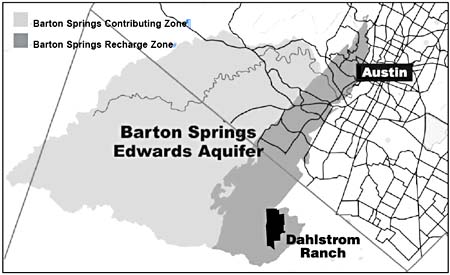
Earp explained that part of the Nance Ranch is over the recharge area for the Edwards Aquifer.

"Any development or construction in that area will be protected and developed according to the state laws and rules of the Edwards Aquifer Authority, which is precisely why they have rules in place to allow development," he said.

Koontz said, "Should the project move forward, the City of Kyle will comply with all state requirements and regulations regarding environmental protections, which may include studies to determine any adverse impact to the local environment, including any impact down river."

The intention is to design a tension span bridge that would not have footings in the river and would not affect the water flow, Earp said.

"It would be high enough in elevation to be traversable during any flood event, including the most recent 500-plus year events that the basin experienced," Earp said. "We desire to design a bridge over the Blanco that will serve the Western portion of the Nance Ranch, and possibly those neighbors beyond if interconnectivity can be managed. That bridge will serve as a life line to those that need a way to cross the Blanco and other low water crossings, to access grocery stores, work or medical facilities during times of severe flash flooding."

He added that it would also help emergency services that need to get into the future development.

Koontz reiterated, "The City of Kyle will ensure that any project in our city limits meets all applicable laws and is in line with environmental regulations. Our goal is to engage in responsible development that benefits the city overall as well as its residents and businesses."

Thursday, January 26, 2017

Which acronym do you prefer: HCPUA or ARWA?

OK, the headline poses a trick question because HCPUA is not really an acronym. But, still, I hate it. Not the agency, mind you, just the initials of the organization. I avoid talking about it at all costs out of the fear that, at best, I’ll transpose one or more of the letters or, at worst, I’ll leave one of them out completely. Yessirree, Bob, I’ll take ARWA any ol’ day of the week.

I bring this up for two reasons. First, the HCPUA, which stands for Hays Caldwell Public Utility Agency (which I originally confused as Hays County Public Utility Agency, so I have had this bias for a while now), is a rather important group of which the City of Kyle is a prominent sponsor, along with Buda, San Marcos and the Canyon Regional Water Authority. Kyle City Council member David Wilson currently serves as chair of the HCPUA and its 10-member board includes Mayor Todd Webster and assistant city manager James Earp The second, and the real reason, I bring this up is because I ran across this Notice of Intent today on behalf of the HCPUA to file a bill during the current legislative session to change its name to the Alliance Regional Water Authority or ARWA. Granted, the proposed name change strips the agency of its geographic identity, but, c’mon, you gotta admit ARWA comes off the tongue far more trippingly than HCPUA.

According to the notice of intent, ARWA "would be a conservation district formed to accomplish the purposes of Article 16, Section 59 of the Texas Constitution." For those who are really policy wonks, that article, which bears the title "Navigation Districts," contains a lot of gobbledygook about how these districts are formed, how elections must to be held to establish them, how board members shall be elected before you get down to the nitty-gritty, the section labeled "Powers and Duties," which says: ""A district may be created under this chapter to provide, in or adjacent to its boundaries for (1) the improvement, preservation, and conservation of inland and coastal water for navigation; (2) the control and distribution of storm water and floodwater of rivers and streams in aid of navigation; and (3) any other purposes necessary or incidental to the navigation of inland and coastal water or in aid of these purposes."

Which is somewhat fascinating because the HCPUA currently has absolutely nothing to do with navigating waterways, as far as I can tell, and everything to do with providing water to its sponsors. In fact, right there in its mission statement, it says the HCPUA "was formed in January 2007 for the purpose of resolving the long-term water needs for its Participants." Don’t see anything there relating to "navigation," unless you want to argue the agency has successfully navigated the various ways to get waters from places where it is to places where it isn’t, but is desperately needed.

I also bring this up because, although residents of Kyle are not talking all that much about HCPUA or ARWA now, they will. And probably sooner than they would want to. They will start talking about it on or possibly even a little before they start receiving water bills that are in the neighborhood of $25 higher per month and increase even more as the months wear on. Those higher water bills are needed to pay the HCPUA’s or ARWA’s capital improvement project involving a "pipeline and pump station interconnecting the Kyle and Buda water systems. The facilities are anticipated to be used in the short-term to provide for interim water sharing and will also eventually serve as the delivery infrastructure of the Carrizo water to Buda. The pipeline will be sized to handle the full anticipated flow to Buda. The pump station will allow for expansion to provide the full contract delivery amount to Buda." That may not sound like a big deal, but it is. The pipeline, alone, is budgeted to cost nearly $7.5 million and the pump station another $12 million. That’s $19.5 million and, like Trump’s border wall, we’re going to have to pay for it. And I don’t expect the name change to make it any cheaper.

Nevertheless, I still like it. ARWA. Say it to yourself. Then try to pronounce HCPUA. It’s really no contest.

Friday, September 16, 2016

Council to vote on becoming part of low income housing grant program

CDBG grants, one of the longest-running programs of the U.S. Department of Housing and Urban Development (HUD), can be used for a number of purposes, but they are most often associated with affordable housing and anti-poverty programs. CDBG funds may be used for community development activities (such as real estate acquisition, relocation, demolition, rehabilitation of housing and commercial buildings), construction of public facilities and improvements (such as water, sewer, and other utilities, street paving, and sidewalks), construction and maintenance of neighborhood centers, and the conversion of school buildings, public services, and economic development and job creation/retention activities. CDBG funds can also be used for preservation and restoration of historic properties in low-income neighborhoods. The stated goal of the Texas CDBG program "is to develop viable communities by providing decent housing and a suitable living environment as well as by expanding economic opportunities, principally for persons of low-to-moderate income."

Kyle is hoping to throw some of this grant money down the sewer.

OK, I’m being somewhat cute with that previous sentence, but the reality is that Kyle is planning on a major new commercial development coming to the city. To prepare for that, Tuesday’s city council agenda contains a number of items designed to win $975,631 in CDBG grant money that would be used for the construction of wastewater collection system improvements, specifically an interceptor sewer from Southlake Sewer Lift Station to Bunton Creek Sewer Lift Station.

"City of Kyle, Texas is working with a company that wishes to locate a plant facility in Kyle and will be a relatively large user of water and sewer service," according to material that’s part of Tuesday’s council agenda. "The anticipated sewer flows are estimated at 115,000 GPD to 140,000 GPD. There are some wastewater collection capacity issues caused by a bottleneck in the existing collection system that must be addressed through additional public infrastructure (sanitary sewer construction). To avoid overloading the existing Southlake Sewer Lift Station the construction of new interceptor sewer main is proposed. The proposed interceptor sewer will be installed so as to bypass the Southlake Lift Station and transport wastewater via gravity sewer to the Bunton Creek Sewer Lift Station."

The company " that wishes to locate a plant facility in Kyle and will be a relatively large user of water and sewer service" is the same one I wrote about on Aug. 31 when I said "City manager Scott Sellers told the city council tonight he would like to apply for a $1 million grant that would help lure an economic development project to Kyle that could mean at least 66 new jobs."

What’s on the council’s agenda Tuesday is the process for obtaining that grant. The other associated items include one to hire an outfit out of Tyler, Texas, Traylor and Associates, that has expertise in applying for CDBG grants of this sort; approving the necessary application with the Texas Department of Agriculture to be eligible for CDBG money; and a resolution outlining the requirements to participate in the CDBG program.

It should also be noted CDBG moneys normally require budget considerations separate and apart from the city’s regular budget process.

Other items on Tuesday’s agenda include:
  • Two public hearings, one to get input on the proposed impervious cover ordinance changes and the second regarding the revamped landscape ordinances that were forwarded to the council earlier this week from the Planning & Zoning Commission.
  • The possibility of spending $10,000 to be part of a Hays Caldwell Public Utility Agency’s study into the feasibility of locating a new wastewater treatment plant to serve the area in the vicinity of the Kyle-San Marcos border.
  • An agreement to provide water and wastewater services, at out-of-city rates, to the proposed Anthem Development, after Anthem constructs and installs all the required delivery mechanisms.
  • The first reading of an ordinance designed, in the city’s words, to even "the playing field and equally placing the roughly proportional cost of utility extensions on all new development, not just the market leaders as is the practice today." According to Assistant City Manager James Earp "Up until now, the city has allowed development to connect to lines built by other developers or the city, or a partnership of both, without having a way to collect the pro rata share of the infrastructure that the latter development requires to use. This results in earlier developers having a higher barrier to entry, than projects that follow and can benefit from the utility work that another developer was required to provide, sometimes at the additional expense of the city utility."
  • A consent agenda item that, if approved, will annex into the city 51.48 acres of land near the intersection of Jack Hays Trail and FM 1626 that is unoccupied except for a rather prominent radio tower. However, the property was recently purchased by Lennar Homes and is adjacent to a much larger area of land in the Plum Creek MUD that is also owned by Lennar, so one should expect it won’t be vacant for too much longer.
  • Another consent agenda item that seeks to make the Planing & Zoning Commission double as "the Impact Fee Advisory Committee for water and wastewater impact fee study and update." One can only hope P&Z can handle this assignment better than the last one they received from the council, i.e., to provide a mid-term Comprehensive Plan update. But after witnessing first-hand the reaction from P&Z commissioners when they were told this week they were getting this assignment, I’m not overly optimistic. In fact, P&Z Chair Michael Rubsam said "I hope they are also going to provide us with extensive training on how to do this."
  • Another consent agenda to accept a grant of $99,899.20 to cover the two-year salary for a victim services coordinator at the Kyle Police Department, As far as I know, this is the first time this subject has been discussed since February’s tragic murder of Samantha Dean, the last person to hold this position.

Here is the complete agenda.

Saturday, July 30, 2016

Council guarantees no property tax rate hike, but may consider higher-than-proposed stormwater fees; council also warns of major increases in water rates coming in next 10 years

The city council voted 5-0 (with two absences) today to guarantee the property tax will not increase any higher than the current $.5848 per $100 of taxable valuation while giving itself wiggle room to actually lower the rate by as much as a penny, a reduction proposed by the city manager, by the time they get around the passing the budget Sept. 6.

At the same time, no one on the council (during a discussion when all seven members were present) voiced any objection to the establishment of a stormwater utility and a few even suggested the city’s proposed fee $3-per-month fee to be paid by homeowners to fund the utility should be increased to as much as $5 a month.

And, the council warned, sometime during the next 10 years, the price of delivering water is going to drive up the water rates residents pay between $21 and $25 month.

Overall, however, council members seemed pleased with the city manager’s proposed budget suggesting, at least at today’s workshop, only minor alterations.

Mayor pro tem Damon Fogley and council member Daphne Tenorio had previously planned engagements and were forced to leave Saturday’s council workshop before the vote to set the maximum tax rate was taken.

City Manager Scott Sellers’s proposed budget for fiscal year 2016-17, which he made public a week ago yesterday and outlined to council members at today’s workshop, specifically called for a one cent decrease in the property tax rate. However, sometime within the last 24 hours, every council member received an e-mail from the Kyle Police Association asking the council to keep the tax rate at its current level and to use the $200,000 in revenue that rate would generate to align the department’s compensation package to a level that’s closer to what is offered to police officers in San Marcos. In effect, the council decided to delay an actual debate on that request until a later budget meeting but voted to set the maximum allowable tax rate at $.5848 simply to allow that later discussion to take place. Personally, my feeling is that when all is said and done, the actual tax rate for FY 2016-17 will be lower than the current rate by anywhere from one-half to one full cent.

In fact, council member Travis Mitchell initially wanted to set the maximum rate at a half-cent below the current rate today to send a signal to residents that tax rates would definitely be lowered and that the police association’s request could still be achieved by a combination of a half-cent increase over Sellers’s proposed rate combined with the elimination of certain positions. While some on the council, notably Shane Arabie, liked Mitchell’s idea, they also believed his aims could still be achieved by setting the maximum rate today at $.5848 with the option of then lowering it before the final budget is adopted.

Under Sellers’s proposed budget, residents would have $3 a month stormwater fee added to their utility bill (water, wastewater, trash pickup, etc) while commercial customers would pay an amount proportional to the amount of impervious surface their property contains. This would result in commercial customers being forced to pay almost two-thirds of the total stormwater fees, a proportion almost directly opposite to the commercial/residential ratio in property taxes.

For example, Stormwater Management Plan Administrator Kathy Roecker told the council today that while residents would pay $3 a month under Sellers’s proposal, Wal-Mart’s stormwater bill would be around $1,140 a month.

"The main reason why I think it’s important for us to do an adjustment factor for commercial is because something that is written into the stormwater plan is that we need to start trying to focus on incentivizing what they call lower-type development and green infrastructure," Roecker said. "If a developer is coming in and they actually can see if we implement some of these things it benefits the city because it reduces runoff. So if they put in a green roof, or a rain garden or use other emerging technologies, their rate is going to go down. So that is going to help us incentivize the developers to look at some of this. Right now, there is no incentive."

Roecker said the proposed fee structure would provide $1.08 million to the utility per year.

Tenorio questioned whether that was enough to really get the program up and running. "If you had your dream system," she asked Roecker. Then she paused and said "I want people to see what they are spending their money on and I want people to realize the money is being spent for their benefit. In order to make this a successful venture, I would like to see what you really need to get it done."

After noting San Marcos’s stormwater fee is $5.20, Sellers said "If we went to $5, we would generate $1.8 million. That is really a realistic number where we need to be."

Tenorio argued she would rather see the fee set at $5 now and "not have to come back next year and ask our citizens to pay $2 more. And I don’t want to reduce the tax rate one penny this year and then come back next year and say I need five more cents" to fund the stormwater utility.

Sellers admitted the number of employees on the stormwater staff will have to increase at some point "but we figured we would work ourselves into that over several years."

"I just think if we’re going to do something, I don’t want to do bare bones," Tenorio said. "You start with it ready to go. I don’t want to set you up to fail."

"I would say I would want to take a strong look at the $5 rate," Mitchell said. "But I don’t necessarily think the additional $2 should go to recurring labor costs. I would advocate for $5, keep the overhead where it is, allow those folks (new employees) to come in, so that over time we can make these big addressments and then hopefully reduce the amount of that fee down the road. Start with a high end, low overhead to make capital improvement expenditure and then see that rate come down over time."

Assistant City Manager James Earp told the council if the fee was increased to $5 "that would allow you to fully fund the mowing of the right-of-ways, the equipment purchases that are needed to get the work done the right way. If you only have two people mowing the entire city, it’s difficult to get a high level of service."

No one brought up the costs of NPDES permitting or whether the city as a whole or individual businesses (such as car washes) in Kyle are even required to obtain NPDES permits.

Sellers suggested some residents should be compensated for paying stormwater fees by having to pay lower Homeowner’s Association dues because the HOAs will no longer, under this plan, be financially obligated to maintain the stormwater facilities on their properties. He said he plans to have conversations with HOAs to address this subject.

City officials said that while water and wastewater rates will not be raised as part of this year’s budget, the city is going to be obligated to repay HCPUA for Kyle’s share of the debt HCPUA must assume to finance a 40-mile pipeline to transport groundwater from the Carrizo-Wilcox Aquifer in eastern Caldwell County to the more populous areas of eastern Hays County. Because of this expenditure, Kyle water customers should expect rates to rise, on the average, between $21 and $25 per month between now and 2026. The question the council admitted it must decide at some point in the near future is whether to phase that increase over the 10-year period or wait until 2026 and then dump the entire increase on homeowners at one time.

Friday, July 22, 2016

Size of roundabout needed for FM1626

As I have written many times, I have nothing against roundabouts, per se. In fact, I think they are kind of cool in the right place. My problem is, I am still not convinced a road with a 55-60 mile-an-hour posted speed limit is the right place.

I know roundabout champion and Kyle Assistant City Manager James Earp has produced all kinds of charts and graphs proving how safe roundabouts are, but none of his charts and graphs indicate if or when a study has been conducted on a roundabout placed on a four-lane divided highway such as FM 1626 where the speed limit is between 55 and 60 mph (and actual driving speeds are closer to 65). His charts show quite conclusively that roundabouts require motorists to reduce their speeds to negotiate the curvature, but he has produced nothing to show how many feet is required to slow the speed to the safe limit when the motorist is driving as fast as they do on FM 1626.

My limited research provided me with only one roundabout that has ever been constructed on a highway with a speed limit of 60 miles an hour and that highway is the 23-mile-long A612 which originates in England’s central Nottingham and ends in Averham. However, the speed limit on that part of the A612 where the roundabout is located is only 40 miles an hour and, at that point, the A612 is a two-lane road.

Then I ran across this interesting document prepared by the U.S. Department of Transportation, no less, which indicates that a roundabout on a road like FM 1626 would be required to have a radius (not a diameter, but a radius) of 250 feet. That seems to me to be a fairly large structure However, if the speed limit on 1626 between Kohlers and Marketplace was reduced to, say, 45 miles an hour, the required radius would be only around 150 feet, a significant size reduction.

This study also mentioned something else about roundabouts on four-lane roads such as 1626. As Mayor Pro Tem Damon Fogley correctly pointed out, they would reduce the number of collisions in which one vehicles smashes into another at a 90-degree angle. "However," the Department of Transportation study says, "at multilane roundabouts, increasing vehicle path curvature creates greater side friction between adjacent traffic streams and can result in more vehicles cutting across lanes and higher potential for sideswipe crashes."

So instead of the type of car crashes you’re likely to see while watching a Grade B cops-and-robbers movie, you’re more likely to see FM 1626 becoming a miniature NASCAR track with those types of accidents.

Pick your poison.

Tuesday, November 17, 2015

A conversation with the city about the house of cards known as the Dahlstrom deal

The Dahlstrom land reflects many aquifer recharge features, including this cave.

Item 33 of tonight’s City Council agenda states: "Consider and possible action in regards to an Agreement between the City of Kyle, Texas and the Dahlstrom Family regarding the Consensual Release of Extraterritorial Jurisdiction from Dripping Springs to the City of Kyle." This aroused my curiosity because I was wondering why the city was so anxious to have in its jurisdiction a huge swath of land that could not be developed because it was under a conservation easement. So I approached Assistant City Manager James Earp, who was gracious enough to take time out of his schedule this morning to talk about the deal and he says it all has to do with "connectivity." There is a subdivision, called Anthem, planned for property in Mountain City’s ETJ. The problem is getting water to the homes planned there. Originally the water was supposed to come from wells drilled by a company called Electro-Purification (EP) out of Houston, but that deal collapsed for reasons too complicated to go into here. Kyle said it would provide the water if Mountain City gave the ETJ to Kyle (this provision is contained in something called an Interlocal Agreement [ILA], which also contains a lot more provisions than merely the land for water swap). I call the Dahlstrom agreement a "house of cards," because everything is precipitated on Kyle absorbing land that is currently in Mountain City’s jurisdiction — land, if I read the tea leaves correctly, Mountain City has no plans on surrendering to Kyle.

Regardless, what follows is the transcript of my conversation with the assistant city manager.

Kyle Report: Why does the city want this property?

Earp: So this is the first step in multiple steps of the strategic process to get to the Anthem property, the Anthem property being Clark Wilson’s project that’s on the northwest side of Mountain City. That was one of the key players that was going to be in the EP water deal. We were approached and asked if we would provide utility services to that project so that they would not have to be a partner in EP. We said we would, but Anthem would have to be in our jurisdiction. So, in order to get to that property, we have to connect to it. Currently, we don’t connect either north or south. Although it looks (on a map of the region) like we connect with the Anthem property on the south, we really don’t because Mountain City needs to keep a strip in order to maintain connectivity (to other parts of its ETJ). So that gives us a barrier on the south that we couldn’t punch through. So the only option then was to come from the north. So we approached the property owners (on Anthem’s northern border), the Dahlstroms, and asked them if they would be willing to give us enough property to connect there and thus bring (Anthem) into our jurisdiction. The Dahlstroms’ property goes all the way north to 967 and essentially their response was they wanted to be a partner in helping EP not be a thing, but they weren’t interested in splitting their property into multiple jurisdictions. So they needed time to consider whether they wanted to release all of their property or not. So this is the first step in that process. The Dahlstroms have to agree to release the properties. In order for them to agree to request the release the properties from Dripping Springs, whose ETJ they are in, they wanted assurances from Kyle, which is what this agreement is. Once we get this agreement in place, then the next step would be to go to Dripping Springs with this agreement and a letter of request from the Dahlstroms to be released. Plus a letter from Kyle saying we’ll accept it. And ask Dripping Springs to release the ETJ. If that occurs, we will take that ETJ area and then we will be contiguous with the Anthem property. Then we move into the Mountain City phase where we do the agreement with Mountain City and Mountain City ultimately releases the Anthem project to us. We accept it and now it’s fully within our jurisdiction. That’s why we want the property.

KR: You’re assuming, however, Mountain City will approve the ILA. My interpretation of the recent Mountain City election results is that Mountain City is firmly against agreeing to the ILA. So isn’t all of this unnecessary?

Earp: No, it’s not, because we can’t get to that to that ILA without all these other steps.

KR: What happens if Mountain City doesn’t agree to the ILA? Where does that leave you?


The scenic Dahlstrom Ranch property
Earp: That doesn’t leave us anywhere. We still have done the process we needed to do. The (Anthem) property is going to develop one way or the other. It’s either going to be a MUD or it’s going to be on city utilities. There are a lot of reasons why it is more beneficial for it to be on city utilities. If that property develops as a MUD, there will be a wastewater treatment plant on that property. The Anthem project will have to have its own wastewater treatment plant. That’s a big thing, having a wastewater treatment plant built there. Right now, Onion Creek, which flows through there, would probably be the area that it drains into and that is not something many people on the Onion Creek want to see.

KR: So the City of Kyle has no plans to build a wastewater treatment plant on the west side of I-35?

Earp: We don’t have plans. I suppose that is something that will happen some time in the future, but for the Blanco basin. We plan to connect Anthem to our current wastewater treatment plant.

KR: Do you plan to run any utilities through the Dahlstrom property?

Earp: No. We can’t annex the (Anthem) property and we can’t serve it in our jurisdiction if we don’t connect to it. So we have to connect our ETJ, but not our utilities. Our utilities are either going to run by the (Hays) high school or down by the (Barton) middle school — these two areas are how we’re going to get back to the property. Or we can come up 150 if we have to.

KR: Do you have any additional plans for the Dahlstrom property?

Earp: Yes. So the Dahlstrom property is under a conservation easement so our intent is to market it and show it off and get the word out. It will be opening up, hopefully with their partnership with Hays County as soon as next year. The family wants to be careful about saying it is opening to the public because it’s controlled about how many people can be on the property at any given point in time. But it will be open as a park with some trails and some facilities.

KR: Are you referring to that 384-acre portion the county has already designated as a park in the northwest corner of the property or the entire ranch?

Earp: No, they are not going to open the entire ranch because the Onion Creek splits it in half. So they’re not going to have a way to get across the Onion Creek. Plus, part of the southern part of the property is under lease to Centex Materials. But to my knowledge — and I don’t want to mislead the public, because I don’t know all the details — I know there’s a plan for the northern part of the ranch off of 967. They already have plans with the county that they are working on. My understanding is they hope to be open by the first of the year or the middle of next year.

KR: Were you aware that even as we speak the Hays County Commissioners Court has on its agenda this morning an item to "execute an agreement with Plateau Land and Wildlife Management in the amount of $8,085 for a wildlife management plan for the Dahlstrom property"?

Earp: No, but that makes sense. The county doesn’t have a whole lot of park type resources as far as personnel and consultants and professionals go, so it makes sense to me that they would be hiring out for someone to do a wildlife plan.

KR: If Kyle assumes the property, will the city be assuming what is now a county park and, with it, O&M responsibility for the park?

Earp: Essentially, that would apply if we annexed the property, which we don’t intend to do, at least immediately. I do foresee there being some sort of a partnership arrangement in the future. We’re willing to partner with the county if that means we staff the visitors center. So it would be in our ETJ, just like any other county facility in our ETJ. The county’s the one responsible for operating it, manning it and running it, but, because I think this is going to be such a neat thing for our area to have — we don’t really have, to my knowledge, a conservation easement property that’s protected that you’re allowed to go into and go see. I think it’s going to be something that’s really going to be unique and neat for our community. I think we’re going to want to be a part of that. I just don’t know how that’s going to look yet. We haven’t had any conversations with the county or with the county and the Dahlstroms about that. But that’s something I see happening over the next year or two as we start to build a relationship with the Dahlstroms, in particular.

KR: Any thought been given to constructing, for lack of a better name or description, a conservation/wildlife educational center on the property?

Earp: The only way I can answer that is through the comments I’ve heard the Dahlstroms make, because I haven’t been a party to what they’ve negotiated with Hays County. But they did mention something to that effect, whether it be something like an information kiosk that would teach about the natural flora and fauna and interesting geological features. To what extend, I do not know, but I do know that’s something they’ve been very conscious of and thinking about. I’ve heard the Dahlstroms and/or their attorneys say they were considering having like cabins on site where people could stay and then have that as part of the experience. But there aren’t any immediate plans for that. The immediate plan is to have the information kiosk for visitors to check in and to open up trails and that’s about the extent of what the immediate plans are that I’m aware of.

KR: Is the city going to take over operations of the quarry?

Earp: No. The city will be responsible for the oversight and any type of licensing issues through the state. We would be responsible for those pieces. Right now, Dripping Springs has been doing that because it’s in Dripping Springs’ ETJ. But we’re not going to operate the quarry by any means.

KR: So right now you are telling me there are absolutely no plans to develop the Dahlstrom property if it becomes part of Kyle’s ETJ?

Earp: You can’t develop the property.

KR: You could if you bought the conservation easement.

Earp: Possibly, but that would cost money.

KR: About $350,000, as I understand it.

Earp: Yeah, today. But that’s not the family’s wishes. It’s definitely not our desire. In fact, our motivation was purely just to connect to the south. But, in meeting with the family, they’re the ones that made it clear that while they wanted to participate they didn’t know if they were comfortable breaking the ranch up into multiple jurisdictions anymore than it already is. They already have one little piece that I believe is in Buda or in Austin, one of the two. So they are the ones that told us that this is a bigger deal than you think it is because we really want to see our entire ranch go one way or the other. And we’ve been having those conversations for months, trying to figure out how that would work and how the family wants to see it. For the longest time the Dahlstroms have had more of a relationship with the Buda community than the Kyle community. So there’s concerns and considerations in that regard as well. I do know the property has in its conservation easement they excluded 20 acres on the vary far north on 967 that they could develop perhaps a visitors center or a conference center to go along with the property. Or they could do retail or something. But it’s my understanding from speaking with their attorney, because the impervious cover limits are so stringent that even though it’s 20 acres the development itself could only be four acres, maybe even three.

KR: Are you aware that the Greater San Marcos Partnership’s web site lists that the land on which the Anthem development is supposed to be built is for sale?

Earp: That was brought up at the Dripping Springs meeting. Clark Wilson owns the property. Where the San Marcos Partnership pulls those listings from is from a third party who then gets it from the original listing information. So what you’re seeing is the original listing from whenever Clark Wilson bought the property. I have e-mails from Clark Wilson where he was trying to track down how that information was still making it out to the web site because he doesn’t have it on the market.

KR: So it’s not really for sale.

Earp: It’s not really for sale.

KR: Aren’t you putting the cart before the horse? Shouldn’t you secure the ILA with Mountain City before pursuing this deal?

Earp: Let me tell you about the chicken and the egg conversation. Mountain City has represented they will not consider or take action until Dripping Springs takes action. Dripping Springs says it will not consider or take action until the Dahlstroms request in writing that they be released. The Dahlstroms said we won’t request in writing to be released until we have an agreement with Kyle. So the agreement with Kyle is on the agenda for tonight. That should lead to the letter which should lead to Dripping Springs releasing it which should lead to Mountain City considering it.

KR: Considering it, but not passing it.

Earp: I can’t guarantee, but they won’t even take it up until Dripping has done their part. Dripping won’t take it up until the Dahlstroms have requested that it be released. The Dahlstroms won’t request it until they have protections from Kyle.

So round and round it goes and where it stops …