The Kyle Report

The Kyle Report
Showing posts with label Special called City Council meeting. Show all posts

Saturday, July 28, 2018

City manager’s proposed budget reduced to three words: streets, water, wastewater

City Manager Scott Sellers formally unveiled today his $84.9 billion budget recommendation for the upcoming fiscal year — a proposal he described as "fantastic" — that contains (as far as I can see) nothing that could be called frivolous, maintains the current property tax rate but does seek a wastewater service rate increase and concentrates on providing the funds necessary to guarantee the city’s water supply, to expand its wastewater capabilities and accelerate street reconstruction and maintenance.

"Kudos to the staff," Mayor Pro Tem Shane Arabie said at the conclusion of Sellers’ presentation. "What was accomplished through this budget, the amount that we can accomplish because of this budget, brings us to another level of sophistication that we’ve reached as an entity and the high level of service that we are providing."

After thanking all the staff members who worked on the budget, and comparing the budget favorably to earlier budget projections for the upcoming year, Sellers said "We have brought forward a budget that is fantastic."

"There’s no better time to live in the city of Kyle than right now," the city manager said. "The quality of life is extremely high, the ability to fund quality-of-life initiatives is there and we are looking to the future in a way we’ve never been able to do in years past. To maintain the level of service that we are in this budget is truly exceptional."

According to my (albeit, unofficial) calculations, $44,137,063 — 51.99 percent of the total budget — will go towards street maintenance, the city’s water supply and wastewater upgrades in the form of new hires, equipment purchases and capital improvements. These unofficial calculations were, admittedly at a glance, seconded by the city manager just prior to his formal presentation to the council.

In that presentation, Sellers said the highlights of his budget recommendation were:
  • $84.9 million total proposed budget for all city funds;
  • $45.4 million in planned spending on capital (long-term) improvements in FY 2019;
  • $7 million dedicated to accelerate Stagecoach Road reconstruction project;
  • $19 million for the wastewater treatment plant expansion project construction;
  • $1.3 million for new equipment and vehicles;
  • $778,000 for 16 new full-time positions — eight in Public Works, three each in Police and Parks and one each in utility billing and information technology;
  • $441,511 for technology improvements;
  • A $324,201 increase for employee benefits to cover rising health insurance costs as well as merit and longevity pay increases;
  • No change in the property tax, water service or storm drainage rates although, according to Sellers presentation, the current property tax rate of $.5416 per $100 of assessed valuation exceeds the rollback rate by just under a penny, .96 of a cent;
  • A 10 percent overall increase in the wastewater service rate that will translate into a 3.5 percent increase — around $3.54 per month — in the average household utility bill; and
  • A 3.95 percent increase in the solid waste rates to pay for the annual increases included in the city’s contract with TDS

Of the almost $1.24 million earmarked for new equipment, the bulk of it — $994,500 of it or 80.2 percent — will be going to Public Works for such items as two dump trucks, an asphalt zipper, a street sweeper, a broom roller, a tub grinder, two concrete mixers, a trench shoring box and litter abatement equipment. The total also includes $110,000 for a new radio system.

Although the tax rate remains at 54.16 cents, property owners will face higher tax bills because of an 5.47 percent increase in property valuations this year. One piece of good news for residential homeowners is that it appears Kyle’s economic development efforts are producing dividends as the residential share of the total property tax bill fell from 74.36 percent last year to 70.95 percent this year. Although Finance Director Perwez Moheet said immediately following the budget presentation this reduction was not that big a deal, both Arabie and council member Damon Fogley welcomed the change and did say the 3.4 percent drop in the residential share of the total property tax bill was "of major significance."

The city will enter the new fiscal year with a debt of $80.5 million as compared to $85.6 million at the same time last year, according to the city manager’s presentation. However, the city manager cautioned, that figure does not include the $9.5 million in new debt planned for the wastewater treatment plant expansion or the "debt issued and/or planned by ARWA (Alliance Regional Water Authority) for the city’s share of capital expenditures," namely the pipeline required to bring water from the Carrizo Springs Aquifer to Kyle.

Tuesday, August 29, 2017

City manager says Kyle’s preparations avoided storm damage

City manager Scott Sellers stood in a room the floor of which was still being dried by a pair of industrial fans because water had seeped through under the walls and damaged or destroyed much of the carpeting and told the city council this evening that Kyle "prepared very well" for the weekend onslaught of rain and no major flooding occurred in the city as a result of the storm.

Much of the carpeting on the north end of the council chambers had been ripped out and water stains were evident on what was still in place. Fortunately, the floor of the council chamber is covered with carpet tiles so, if the city can find matching tiles, the entire carpet might not have to be replaced. The two giant fans drying the room were turned off just before the council meeting began at 7 p.m. to allow those inside to hear what was being said and were turned back on once the meeting adjourned.

Sellers spent time this weekend manning a power vacuum personally trying to suck up some of the water that blanketed the floor of the council chambers, the result of 50-plus straight hours of incessant rainfall that dumped eight-plus inches of rain on the city.

"The City of Kyle prepared very well for the hurricane," Sellers told the council, although, to be accurate, Hurricane Harvey which devastated and continues to devastate a large swath of Coastal Texas, did not hit Kyle, per se; only rains and some wind gusts produced by the storm affected us.

Sellers said the city began meeting with county emergency officials early last week and by midweek the city was making its "pre-disaster preparations which involved going through and unclogging any clogged culverts. We went to all of our known flooding areas and ensured that any debris was removed from those areas and that culverts were cleared. We encouraged our citizenry to pick up litter and check their storm drain lids. We staged barricades around the city. We strategically placed sandbags around the city and we also handed those out to homeowners on properties we knew were prone to flooding."

What Sellers did not tell the council was that sandbags were also placed strategically outside the north wall of the City Hall chambers but they did not prevent the water from seeping through.

"All in all, we had everything ready for this disaster which we learned from the last two major storm events here in Kyle," Sellers said. "And that pre-planning paid off. We were fortunate not to have any major flooding here in the city. We did not activate any emergency shelters here. We did have to close all our major low-water crossings, but not for long."

As far as what actions the council actually took during its 15-minute meeting (that was extended by an executive session that last three times as long as the regular meeting), it amended the city’s sign ordinance to permit businesses to erect more distinctive signage than the current ordinance permits and passed on first reading the ordinance adopting the budget for the upcoming fiscal year and a 3.32-cent reduction in the property tax rate. It is expected the budget and the tax rate will be formally adopted at next week’s council session.

Sunday, June 25, 2017

So much for a morning council meeting

At the end of last week’s regular City Council meeting, City Manager Scott Sellers announced a special meeting would have to be called for this week, presumably to be held on Wednesday since the regular Tuesday date was reserved for a Planning & Zoning Commission meeting and the Park Board had Monday reserved. The consensus at the time seemed to be the best time for the meeting would be Wednesday morning. The question that loomed was would the meeting begin at 8 a.m. or possibly even earlier.

Now the meeting has been posted officially and it’s for the normal 7 p.m. time, except on Wednesday instead of the regular Tuesday. I’m guessing that in polling all the council members, Wednesday evening was the only time a quorum would be available, which seems strange to me — back in Dallas where I worked for 47 years before moving here two and half years ago — no city meetings of any kind were ever held on Wednesday evenings because that was considered "church night," by a majority of Christian denominations. I guess that’s not the case here. (There was also the fact that Dallas City Council’s meetings began at 9 a.m. on most Wednesdays of every calendar year, but normally they adjourned well before 6 p.m. giving everyone plenty of time to attend to their individual religious obligations that evening.)

But even if Wednesday is a big church night in Kyle as well (truth in advertising: as a Jew, I really don’t keep up with the religious practices of my Christian colleagues), there’s no real reason for anyone other than at least four council members, the requisite city staff and the smattering of news junkies to break their normal Wednesday religious routines because Wednesday’s meeting is a strictly non-newsworthy housekeeping session that should last, oh, I don’t know, all of 10 minutes at the most. Here’s the agenda for the meeting; check it our for yourself and see if you can find anything on there that’s going to shake your soul.

The only question I have about all this surrounds Agenda Item 3, a change order for $141,826.03 for reconstructing 150 feet of Lehman Road, starting from its terminus at Goforth so that Lehman will have a designated left and right turn lane at that intersection. As I understood this project, from how it was described at last week’s council session, this is simply money being lifted from the Lehman Road account created as part of the 2013 bond package and added to the Goforth Road account, so that construction of these lanes can be completed before fall classes resume at Lehman High School, located right at that intersection. All the paperwork accompanying this agenda item details how it’s being added to the Goforth project, but there was no corresponding accounting to show it’s being removed from the Lehman project’s books. So is this really a $142,000 cost overrun? Hopefully we’ll learn that Wednesday.

Watch this space.

Wednesday, January 25, 2017

Major changes proposed for what can be located where in Kyle


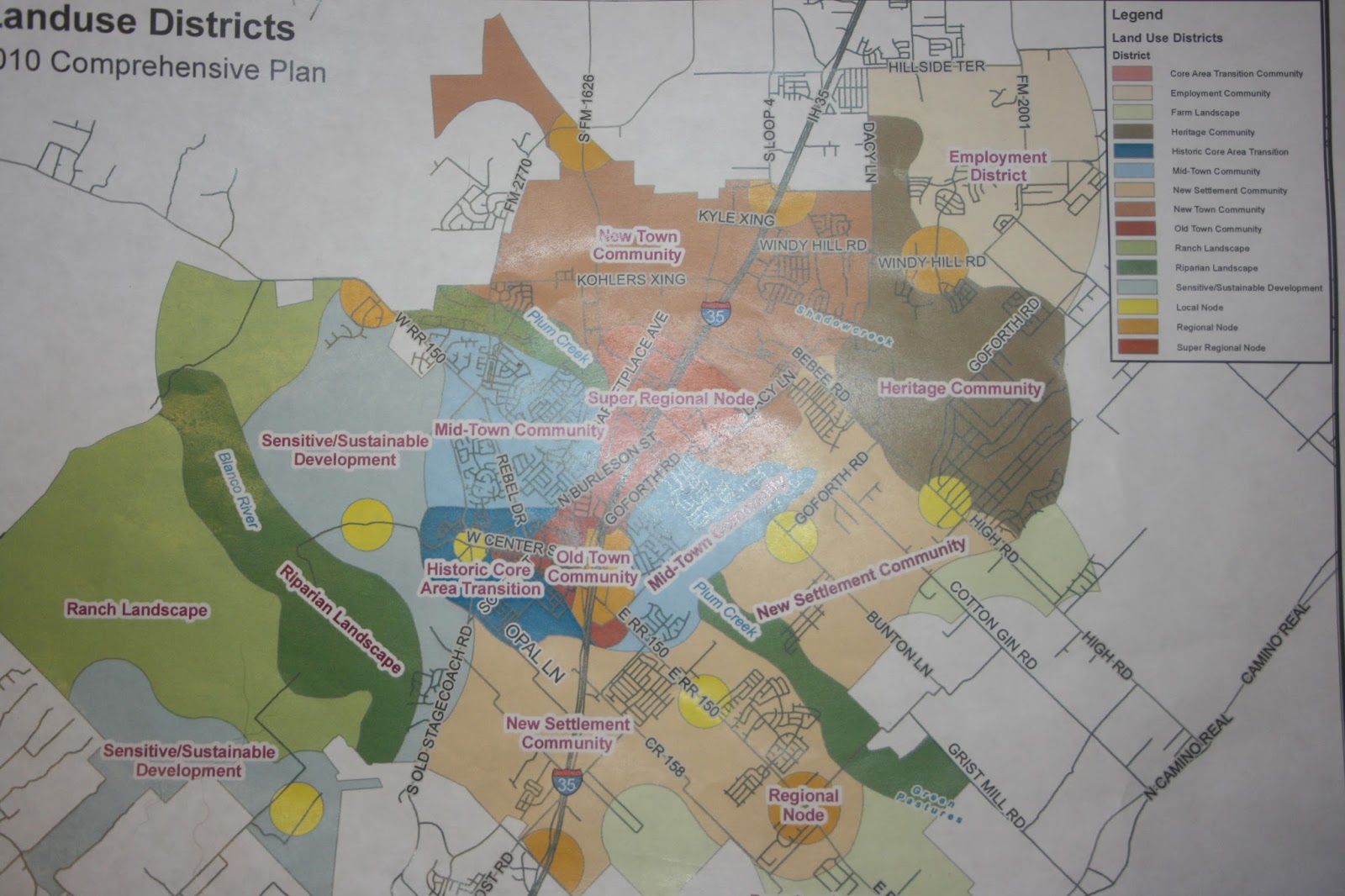
Members of the City Council and the Planning Commission tentatively agreed in a special joint meeting last night to bring logic to the City’s Comprehensive Plan, "tweaking" it by creating two new zoning designations and significantly altering where businesses can be located and what kind of residences can be constructed in locations across the city.


Focusing on the Comp Plan’s Landuse Districts, the two bodies also agreed to scrap the so-called "Employment District" located in far northeast Kyle, where no one plans — ever — to locate a place of employment, and to come up with an entirely new designation for the New Settlement districts located on the southern and eastern fringe of the city.

They also asked the Planning Department to prepare a three-year annexation plan to examine the possible expansion of the city’s boundaries by as much 10½ square miles, adding 5,675 to the city’s population. Most of the area planned for annexation is east of I-35.

Example of a mixed-use development
The changes were designed to make the Comprehensive Plan more logical than it is today by concentrating business locations along the city’s major arterials — I-35, FM 1626, the soon-to-be-rerouted FM 150 and even Center Street and Old Highway 81 — while, at the same time, realizing the opportunities that Kyle might have had to locate a major industrial park in the city have come and gone (residential development has consumed too much of the available land space). It was the consensus that Kyle’s business development should now concentrate on vertical instead of horizontal projects. With that in mind, they agreed to ask the Planning Department to draft proposed ordinances that would create mixed-use and office zoning designations. There was some confusion among the council and commission members as to what exactly constituted mixed -use. They all agreed that it should include developments consisting of retail uses on the ground floor with some form of residential (apartments, condominiums, etc.) on two or more levels above, but they were less sure whether it should include properties of multi-uses, i.e., both a retail outlet and a separate warehouse facility on the same parcel. (The logical solution would seem to create a separate mixed-use and multi-use zoning, but the decision-makers displayed no thoughts about going there.)

One of the more notable omissions was the absence of designating warehouse uses anywhere in the city except as conditional uses in the New Town and Heritage districts. Warehouses provide much of the blue-collar employment opportunities that are the pistons of Kyle’s economic engine and I could easily see that underdeveloped area of Lehman Road running north from RR 150 as a designated Warehouse District.

The biggest changes were made in four landuse districts, all of which are located in or in close proximity to the downtown area: the Core Area (that pink section on the above map that straddles I-35 from just north of Center Street to Kyle Parkway), the Super Regional Node (the orange blotch just south of the Core Area); Old Town Community (the area immediately west of I-35 that includes downtown); and the Historic Core (in royal blue immediately west of the Old Town Community).

Specifically, the council and the commissioners agreed to make the following zoning changes to the Landuse Districts:

  • Old Town District: Recommended zoning uses are central business district, entertainment, mixed use and office; conditional use is retail services.
  • Core Area Transition: Recommended zoning uses are commercial, retail services, entertainment, office; conditional uses are multi-family residential, townhomes, condominiums.
  • Historic Core Area: Recommended uses are single-family residential including the new R-1-3 zoning; conditional uses area multi-family residential, townhomes, entertainment, mixed use and retail services.
  • Mid-Town (the area in light blue east and west of the Core Area): Recommended use is single-family residential; conditional uses are multi-family, commercial and entertainment.
  • New Settlement: Come up with an entirely new designation for these two areas and make all zoning conditional uses.
  • Sensitive/Sustainable Development: Change the name so as eliminate the idea that developments proposed in this area would be faced with extreme environmental obstacles and to allow zoning that corresponds with the development agreements already in place in this farthest southwest area.
  • Local nodes (the yellow dots on the map): Add mixed use to the already-accepted residential and commercial uses as recommended; add retail services to the list of conditional uses.
  • Regional Nodes (the orange circles and semi-circles): Add retail services and mixed used zoning to the already listed commercial, condo and multi-family residential uses as recommended.
  • Super Regional Node: Eliminate condos and add entertainment, retail services and mixed use to the list of recommended uses; eliminate all the listed conditional uses and make office the single conditional use allowable here.

Council members and commissioners also reviewed a proposed Downtown Development Corridor that would designate all the land on either side of Old Highway 81, between the rail line and the interstate, for retail services, and recommend denser, more business-oriented development in a designated downtown business district bordered roughly by Front Street on the east, Blanco Street on the north, North Meyer Street on the west and West Moore Street on the south.

There was little to no debate during the meeting on any of the proposed landuse district allowable zoning changes, most of which were recommended by Mayor Todd Webster. Most of those in attendance seemed to merely quietly acquiesce. Council member Travis Mitchell expressed dissatisfaction to the idea of annexation over the concern of the cost of providing infrastructure to these areas. But in conversations I have had with City Manager Scott Sellers, we agree that most of that cost can be self-funded by the individual districts with our only disagreements revolving around exactly what self-funding tool to employ. Personally, I am a big proponent of TIFF Districts for this type of financing; I have seen them successfully finance development miracles in other areas of the state and country. Council member David Wilson and planning commissioner Irene Melendez were the only members of either body who did not attend the meeting and council member Daphne Tenorio left the meeting early, but I have no idea if that was in reaction to what was being proposed. She never vocalized any major objections concerning specific zoning changes recommended in individual districts.

I am guessing the next steps will be Planning Director Howard Koontz will codify all the changes recommended at last night’s meeting and present them to the Planning Commission which, after a brief debate, will recommend passage by the City Council and then that latter body will vote 6-1 to approve the recommended "tweaks."

Saturday, January 21, 2017

Interesting choice of words

When I first learned about Tuesday’s joint meeting of the City Council and the Planning Commission to hash over the City’s Comprehensive Plan, I was under the impression it was going to be a workshop, possibly with all 14 council members and commissioners sitting around a table hashing out how to have the Plan make more sense than it does now.

However, the official agenda for the affair has now been posted and it’s labeled as a "Special City Council Meeting." Does that mean the council members will be on the dais from which they will lecture planning commissioners on how the world goes ‘round? Does that mean planning commissioners will be confined to taking their turns at the lectern, if an when they are summoned for their opinion? I have no earthly idea.

I do know this. With the recent departures of Mike Rubsam and Mike Wilson from the Planning Commission, I’m not confident the holdovers and those that have replaced them have the knowledge to make meaningful contributions to this discussion. Mayor Todd Webster along with council members Shane Arabie and David Wilson should, for the good of the city’s smart growth future, dominate this discussion.

I also know that this meeting would not have even been necessary had the planning commissioners completed the assignment the council asked of them which was to make midterm amendments to the Comp Plan, which, of course, is what Tuesday’s meeting is designed to finally take care of. What I’m getting at here is, if the commissioners couldn’t do it then, why have any faith that they have seen the light and can do it now?

So even if they all are sitting around a table as equals, what I expect is for Webster, Wilson and Arabie to kind if go through the document, outlining the changes —like getting rid of some nodes and designating the part of town specified for business development where such development is a realistic possibility — they want the commissioners, at a subsequent meeting, to recommend the council formally adopt. I don’t expect much time wasted on debate.

So, perhaps, "meeting" is in reality a more apt description than "workshop" of what’s going to take place beginning 6:30 p.m. Tuesday at City Hall. We’ll just have to wait and see.

Tuesday, December 20, 2016

Number of executive sessions between now and the end of the year just got cut in half

I was part of a team of writers/reporters put together from all over the country to go to suburbs southeast of Houston to cover the Apollo space missions for United Press International. I especially think about one of them this time of year, Apollo 8, the first mission to orbit the moon, which rocketed into space exactly 48 years ago tomorrow, circled the moon 10 times on Christmas Eve and finally splashed down in the Pacific on Dec. 27. At that time, there was a weekly magazine called Life and reporters and photographers from that magazine had exclusive access inside the homes of the Apollo astronauts. But the fawning public wanted every bit of news about the astronauts and their families as could be fed, so when I wasn’t at my desk at the UPI Space Center bureau, I was parked outside an astronaut’s home, just in case one member of the family left the house for any reason. Because if one of them left the house for any reason, that was news. One of my favorite Christmas gifts of all time was delivered to me late Christmas Eve of 1968, when Barbara Lovell, the then 15-year-old daughter of Apollo 8 astronaut James Lovell, walked out of her home and up to my car to bring me a couple of homemade cookies and a cup of steaming hot coffee.

Beginning with Apollo 11, the first moon landing, the returning astronauts were placed in quarantine for three weeks to make sure they did not return bearing some kind of lunar disease. For reasons too complicated to go into here, I was the UPI reporter chosen to remain behind after the missions were completed to cover the "astronauts-in-quarantine" period. Nothing happened while the astronauts were in quarantine. Nothing. There were no news announcements from Mission Control about what the astronauts were doing while quarantined and, frankly, even if there had been, I sincerely doubt anyone would have given a green bean. To put it mildly, there was nothing in my journalistic career more boring and totally non-eventful than covering astronauts in quarantine.

Except executive sessions.

Now, to be fair, I have to admit that although some of them seem like it, I never seen an executive session last as long as an astronaut’s quarantine. But executive sessions are also far more frequent. Between July 1969 and December 1972, there were a total of six — count ‘em, just six — Apollo moon missions and only half of those resulted in quarantines (Apollo 13 didn’t count, because it’s moon landing was aborted and the quarantine requirement was abandoned following Apollo 14).

So naturally I reacted with some measure of glee this evening when I learned the City Council’s Thursday specially called meeting, which was created just so council members could go into a prolonged executive session to hash out revised terms for City Manager Scott Sellers’s contract extension, had been cancelled and will not be rescheduled until some time in 2017, even after the Council’s first regularly scheduled first meeting of the year on Jan. 3. No date has been set, but I’m betting it was also be a special called meeting.

So that mean’s there’s only one executive session on tap for Thursday evening; however, I’m anticipating that one will be a doozy because during that time, the Kyle Housing Authority Board will be interviewing prospective candidates to be the authority’s interim director and then debating among themselves which of those candidates should be named to the position, starting Jan. 1.

As for me, I will be wistfully thinking about a Christmas Eve visit from an astronaut’s daughter, bearing homemade cookies and hot coffee.

Monday, December 19, 2016

City Council to meet Thursday to mollify the mob

The City Council has scheduled a special meeting at 4 p.m. Thursday so that it can huddle in executive session in hopes of coming to some sort of agreement on City Manager Scott Sellers’s contract that will keep Sellers in Kyle until he retires and possibly satisfy the uninformed lynch mob that scuttled an earlier innovative, forward-looking deal that was in the city’s best possible interest.

Don’t expect any details of the contract to emerge from Thursday’s meeting because all the discussions will take place in a closed, executive session and, according to the meeting’s agenda, "No action will be taken on items discussed in executive session."

So there.

What will happen is that if an agreement with Sellers is reached Thursday — and it would be in the best possible interest of the city if that happens — then the details of the deal (1) will be placed in written contract form, (2) will be posted for public consumption and misinterpretation and (3) acted upon at a council meeting early next year, hopefully as early as the council’s first available meeting date on Jan. 3.

About the only thing public that will take place during the session will be gaveling the meeting to order, roll call, the pledge of allegiance, and a citizens comment period, and hopefully the local loonies won’t make another appearance for that period. After that the council will relocate to the second floor of City Hall to work on the contract particulars in private. Before too many people get all in an uproar, closed meetings to discuss contract negotiations such as this are mandated by state law.

The council meeting will kick off what could easily be eight hours of executive sessions divided between the council and the Housing Authority Board, the latter of which has scheduled a meeting for 5:45 p.m. Thursday during which it will seclude itself to interview prospective candidates to serve as the authority’s interim director.

The road goes on forever and the party never ends.

Friday, December 16, 2016

The fault, dear Brutus, is not in our stars, but in our charter and a few of our citizens

By now, anyone reading this already knows that city buckled under political pressure today and City Manager Scott Sellers graciously and somewhat magnanimously declined the offer to dwell in a residence that the city was intending to supply for him and future city managers, leaving unaddressed two fundamental questions: 1. How did city leaders find themselves in this quagmire? and 2. Was today’s decision a smart one?.

I’m going to tackle the second question first because it’s the easiest to answer. If the question was whether today’s decision was an expedient one, the answer would be "yes." I might even agree to an affirmative answer if the question became "Was this decision a wise one." Was it the politically correct one? Perhaps. Was it a smart one? Absolutely not.

Remove Scott Sellers as the subject of the discussion. Remove a city manager’s house as the subject of the discussion. Then the debate becomes should the city invest taxpayers money into buying land. Here is one truth about land: "They aren’t making any more of it." Investment advisor Seth Williams recently wrote about this very subject in Real Estate Tipster: "Most people don’t think of vacant land this way, but the reality is land is an extremely valuable resource with limited quantities available. Especially when you purchase land in the path of growth, you will find yourself with a finite asset that a lot of other people want to get their hands on. Stocks, bonds, mutual funds and 401Ks all make sense in certain scenarios, and so does land. If you go into this with the intent of holding the right property for the long-term, it can make a lot more sense (and be a lot more profitable) than any other investment vehicle out there."

In the collective rush to mollify a bunch of loud-mouths who went over the top in their personal attacks, not only on Sellers, but also on his family, the City Council rushed to judgment today and passed up the opportunity to make a fiscally sound investment that would pay long-term dividends to Kyle taxpayers.

And, as has been mentioned previously, it diminishes the appeal of Kyle to future city managers. Everybody focused on the availability of a home a potential city manager might have waiting for him in Kyle, but totally neglected that part of the conversation about the financial wreckage left behind by those forced to move. A city hires a new chief executive and the city usually expects that person to occupy and work in that position within two weeks, three at the max. But what happens to the home that city manager leaves behind in his previous city of employment? There are only two alternatives: 1. It can be dumped in a fire sale in which the owner takes a horrific financial beating or 2. the owner can suffer the financial burden of having to pay the expenses of two different residences until a decent price can be negotiated for the one left behind. Imagine how Kyle becomes "a destination city" for future city managers if they know that’s an immense problem they won’t have to deal with.

But that’s not going to happen because the city kowtowed to the shrieking of a very small, but an extremely loud and vengeful minority chorus, stoked by a small group of malcontents who will go to any lengths to stop progressive thought and growth in the city because such thought and such growth reduces their sphere of political influence. (They might even reveal themselves through negative reactions to this article on Facebook.) What motivated this mob was not rational thinking (I don’t think it’s a coincidence that when I searched for stock brokers with offices in Kyle I came up empty-handed) but old-fashioned green-eyed jealousy. ("It’s just not fair that the city manager and his family can live in that nice a house and I can’t.")

By the same token, I’m not convinced a majority of Kyle residents favored the arrangement either. What I do believe is that majority simply did not care one way or the other. What they are concerned about much more than the issue of a city manager’s residence is who will be the starting quarterback for the Dallas Cowboys following Sunday night’s game with the Bucs. After that comes "What’s for dinner tonight?"

But I guess that’s water under the bridge, If Kyle hoped to foster a reputation as a leader, an innovative thinker, those hopes were crushed this morning. Now all that’s left to determine is how the council will restructure Sellers’s contract extension. Personally, I hope the council, at the very minimum, offers him a salary increase equal to the cut he was willing to take as lease payments on the residence. The charade that was played out in council chambers this morning was Sellers falling on his own sword to save the city massive embarrassment. As a result, the city owes Sellers. Big time. And I, for one, hope council members realize this and act accordingly.

That still leaves question No. 1 and could provide a simple "exit strategy" for all concerned. At the risk of revealing closely held family secrets, I have learned through a series of conversations I have had with leaders in Kyle as well as those who worked for Sellers in Kilgore, the East Texas city where Sellers was city manager before coming here, that Sellers and his family lived in a home on a parcel of land that would be considered small by the owners of most ranches, must substantial by owners of any single family residences here in Kyle. I have also been told, but this I must admit I haven’t been able to confirm through more than one person, that Sellers found a comparable residence located in Kyle’s ETJ (another told me the plot was actually in or closer to Martindale). Regardless, Sellers was prohibited from securing a residence in either Kyle’s ETJ or somewhere close to Martindale) or anywhere else, for that matter, except inside the city limits of Kyle. Why? Because Kyle’s City Charter contains a requirement that the city manager must reside within the city limits. Human Resources Director Sandra Duran, I have been told, lives on a similar plot of land near Martindale and that’s OK, as well it should be. Only the city manager has this restriction placed upon him or her. Those types of homes don’t exist in Kyle. At least, not yet.

And that was a problem, a serious enough problem for Sellers’s family so that it ultimately put him in the position where he had to, however reluctantly, say goodbye to Kyle and accept one of the many opportunities that are flooding his way that don’t place restrictions on his freedom to chose where he wants to live. And where I come from, a person’s first responsibility is to his family. The council, in a desperate attempt to do whatever it could possibly do to keep Sellers in the job in Kyle, came up with the original, clever and innovative housing arrangement as a compromise offer.

But the reason I say this could provide an exit strategy is that provisions such as these imposed by other municipalities, when faced with legal challenges, have been struck down by the courts. Freedom of choice, as defined by the courts, "describes an individual’s opportunity and autonomy to perform action from at least two available options, unconstrained by external parties." The courts have ruled, quite obviously, such residency restrictions deny those constrained by them their freedom of choice.

A number of states have already recognized that fact and legislatures in four of them have enacted laws prohibiting municipalities from enforcing any kind of residency requirements.

Not only that, the charter’s provision is discriminatory. Most municipal laws of this type make residency requirements applicable to all municipal employees. In Kyle, however, those restrictions only apply to the city manager and that, by definition, is discriminatory.

I would hope city leaders huddle with their legal advisors and find a way for the city to simply ignore this provision on the grounds that, if challenged, the city would most likely prevail in any type of legal action. But even more than that, someone would have to be incredibly vindictive to even challenge such a move.

That’s not to say there’s not a despicable soul out there that could act vindictively just because he or she didn’t get their way. But I would also hope the city would look forward to squashing such souls. Vindictiveness has no place in our political discourse.
 

Tuesday, December 13, 2016

City Council to meet Friday to purchase city manager’s residence

The City Council is scheduled to gather in a special called meeting at 9 a.m. Friday to approve spending slightly more than $550,000 to purchase a home in Cypress Forest that essentially will become Kyle’s version of Gracie Mansion with the exception that, unlike the New York City’s mayor’s home, what will become the residence of this city’s current as well as future city managers is designated specifically and strictly as a residence.

Closing costs are expected to add approximately $6,500 to the purchase price.

Friday’s meeting agenda, which should last only slightly longer than the time it takes to casually eat one donut, consists of three items which should sail through without much, if any, debate: 1. A resolution accepting improvements to the Cypress Forest subdivision (and noting that it was accepted at a properly scheduled open meeting); 2. Approving an agreement with Scott Felder Homes to purchase a residence in that subdivision at a cost not to exceed $550,000 plus the closing costs; and 3. An amendment to the city’s budget to appropriate the $556,500 to cover the home’s cost and the closing costs.

Interestingly, the most expensive available home listed on Scott Felder's Cypress Forest website goes for $332,990, which is about $19,000 more than what he lists as his most expensive available plan for a new home in the subdivision. So I'm guessing right now the proposed city manager's residence is going to be a custom home not currently listed (something like this one Felder has for sale in Austin) or one of the higher-priced plans on a larger-than-normal-for-the-subdivision lot.

It turns out, however, according to Mayor Todd Webster "there are several homes being constructed in this ($550,000) range.  It is true that it is at the upper end but it is one of the floor plans they offer there. I expect it to be in the middle to upper range of the executive level homes in the neighborhood at build out. We considered price per square foot more than the overall purchase price but certainly considered both along with investment return."

The reason I don’t think there should be much debate over this item is because, quite frankly, is not only a smart move on the city’s part, but one I expect other city’s to follow in short order. Think about it: 1. The next time the city is in need of a new city manager, the pool of applicants will be much wider and deeper because those applicants will know that one major obstacle — the search for and acquisition of a place to live in a new location — has been removed. 2. The city can afford to adjust the salary demands of any potential city manager because housing costs — which probably amount to at least one third of a person’s personal family expenses — are eliminated from the equation (i.e., the purchase price of the home is more than repaid through lower city manager salaries). 3. The value of the property is only going to appreciate; in fact, it will probably be the most valuable piece of property on the city’s books before long.

Mayor Webster supported these assumptions.

"The city negotiated a price per square foot that is much lower than comparable properties and that made this a very good investment," the mayor told me early Wednesday morning. "Between the lease/reduced salary and very conservative prediction for valuation growth (2.5 percent/year), we expect a return of $240k-plus on the $550k by the end of the eight-year contract term.

"And, I think you are correct that should (City Manager Scott) Sellers leave or retire, the inclusion of housing in the compensation package should make Kyle very competitive for top tier city managers in any future recruiting effort," the mayor added. "The city manager profession is extremely transient, which makes the provision of housing something that should broaden the range and number of applicants in any future search.

"This was a very smart financial investment and a strategic decision that should earn an excellent financial return. Alternatively, we could have taken the traditional approach that would have resulted in a higher new starting base salary for the city manager. I think that approach may have been easier for the public to understand and accept, but it is hands down less advantageous for the city."

One other thing that wasn’t clear when I first learned of the emergency meeting was why this action couldn’t wait until the council’s Jan. 3 regularly scheduled meeting. I originally thought it might have something to do with the expiration date of Sellers’s contract, but Mayor Webster informed me that wasn’t the case. The pressing issue, according to the mayor, is the seemingly innocuous first item on the agenda. Apparently perhaps as many as a half-dozen potential homebuyers were going to be denied the opportunity to close on their purchases in Cypress Forest because a final plat on the first phase of the subdivision wasn’t in place

"The other items were tacked on," Mayor Webster said.. "The other items could have waited if we weren't already going to have a special meeting."